




Which of the following fluoro-compounds is most likely to behave as a Lewis base?
A. \[{\text{C}}{{\text{F}}_{\text{4}}}\]
B. \[{\text{Si}}{{\text{F}}_{\text{4}}}\]
C. \[{\text{B}}{{\text{F}}_3}\]
D. \[{\text{P}}{{\text{F}}_3}\]
Answer
 Verified
601.5k+ views
Hint:A Lewis base is electron-rich species. It tends to donate its electron pair. Draw the Lewis dot structures of all given molecules and determine which molecule has the lone pair of electrons to donate.
Complete answer:
A Lewis base is the species that can donate a pair of electrons.
Now, to determine which of fluoro -compounds is most likely to behave as a Lewis base we will draw the Lewis dot structures of all given fluoro –compounds.
A. \[{\text{C}}{{\text{F}}_{\text{4}}}\]
To draw the Lewis dot structure we have to determine the total number of valence electrons.
Carbon is a Group IVA element so it has 4 valence electrons. Fluorine is a group VIIA element so it has 7 valence electrons.
So, \[{\text{ total valence electrons = 4 + 7(4) = 32}}\]
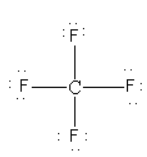
As there is no lone pair on the central carbon atom so \[{\text{C}}{{\text{F}}_{\text{4}}}\] cannot behave as a Lewis base.
Thus, option (A) \[{\text{C}}{{\text{F}}_{\text{4}}}\] is incorrect.
B. \[{\text{Si}}{{\text{F}}_{\text{4}}}\]
Silicon is a Group IVA element so it has 4 valence electrons. Fluorine is a group VIIA element so it has 7 valence electrons.
So, \[{\text{ total valence electrons = 4 + 7(4) = 32}}\]
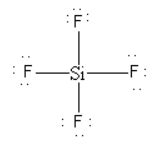
As there is no lone pair on the central silicon atom so \[{\text{Si}}{{\text{F}}_{\text{4}}}\]cannot behave as a Lewis base.
Thus, option (B) \[{\text{Si}}{{\text{F}}_{\text{4}}}\] is incorrect.
C. \[{\text{B}}{{\text{F}}_3}\]
Boron is a group IIIA element so it has 3 valence electrons. Fluorine is a group VIIA element so it has 7 valence electrons.
So, \[{\text{ total valence electrons = 3 + 7(3) = 24}}\]
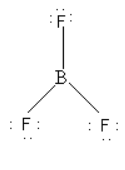
As there is no lone pair on the central boron atom so \[{\text{B}}{{\text{F}}_3}\]cannot behave as a Lewis base.
Thus, option (C) \[{\text{B}}{{\text{F}}_3}\] is incorrect.
D. \[{\text{P}}{{\text{F}}_3}\]
Phosphorus is a group VA element so it has 5 valence electrons. Fluorine is a group VIIA element so it has 7 valence electrons.
So, \[{\text{ total valence electrons = 5 + 7(3) = 26}}\]
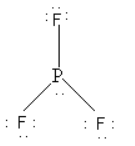
As there is a lone pair on the central phosphorus atom. So \[{\text{P}}{{\text{F}}_3}\] tends to donate its lone pair of electrons and behave as Lewis base.
Thus, option (D) \[{\text{P}}{{\text{F}}_3}\] is correct.
Note:
Lewis bases are also known as nucleophiles as they are electron-rich species. The number of valence electrons of an element is nothing but its group number. While drawing Lewis dot structures always first distribute the electrons as lone pairs on the surrounding atom to complete their octet. After completing the octet of the surrounding atom we can distribute the remaining electrons as a lone pair on the central atom to complete the octet of the central atom.
Complete answer:
A Lewis base is the species that can donate a pair of electrons.
Now, to determine which of fluoro -compounds is most likely to behave as a Lewis base we will draw the Lewis dot structures of all given fluoro –compounds.
A. \[{\text{C}}{{\text{F}}_{\text{4}}}\]
To draw the Lewis dot structure we have to determine the total number of valence electrons.
Carbon is a Group IVA element so it has 4 valence electrons. Fluorine is a group VIIA element so it has 7 valence electrons.
So, \[{\text{ total valence electrons = 4 + 7(4) = 32}}\]
As there is no lone pair on the central carbon atom so \[{\text{C}}{{\text{F}}_{\text{4}}}\] cannot behave as a Lewis base.
Thus, option (A) \[{\text{C}}{{\text{F}}_{\text{4}}}\] is incorrect.
B. \[{\text{Si}}{{\text{F}}_{\text{4}}}\]
Silicon is a Group IVA element so it has 4 valence electrons. Fluorine is a group VIIA element so it has 7 valence electrons.
So, \[{\text{ total valence electrons = 4 + 7(4) = 32}}\]
As there is no lone pair on the central silicon atom so \[{\text{Si}}{{\text{F}}_{\text{4}}}\]cannot behave as a Lewis base.
Thus, option (B) \[{\text{Si}}{{\text{F}}_{\text{4}}}\] is incorrect.
C. \[{\text{B}}{{\text{F}}_3}\]
Boron is a group IIIA element so it has 3 valence electrons. Fluorine is a group VIIA element so it has 7 valence electrons.
So, \[{\text{ total valence electrons = 3 + 7(3) = 24}}\]
As there is no lone pair on the central boron atom so \[{\text{B}}{{\text{F}}_3}\]cannot behave as a Lewis base.
Thus, option (C) \[{\text{B}}{{\text{F}}_3}\] is incorrect.
D. \[{\text{P}}{{\text{F}}_3}\]
Phosphorus is a group VA element so it has 5 valence electrons. Fluorine is a group VIIA element so it has 7 valence electrons.
So, \[{\text{ total valence electrons = 5 + 7(3) = 26}}\]
As there is a lone pair on the central phosphorus atom. So \[{\text{P}}{{\text{F}}_3}\] tends to donate its lone pair of electrons and behave as Lewis base.
Thus, option (D) \[{\text{P}}{{\text{F}}_3}\] is correct.
Note:
Lewis bases are also known as nucleophiles as they are electron-rich species. The number of valence electrons of an element is nothing but its group number. While drawing Lewis dot structures always first distribute the electrons as lone pairs on the surrounding atom to complete their octet. After completing the octet of the surrounding atom we can distribute the remaining electrons as a lone pair on the central atom to complete the octet of the central atom.
Recently Updated Pages
Master Class 11 Social Science: Engaging Questions & Answers for Success

Master Class 11 Chemistry: Engaging Questions & Answers for Success
Master Class 9 General Knowledge: Engaging Questions & Answers for Success
Master Class 9 Maths: Engaging Questions & Answers for Success
Master Class 9 Science: Engaging Questions & Answers for Success
Master Class 9 English: Engaging Questions & Answers for Success
Trending doubts
One Metric ton is equal to kg A 10000 B 1000 C 100 class 11 physics CBSE
Difference Between Prokaryotic Cells and Eukaryotic Cells
Two of the body parts which do not appear in MRI are class 11 biology CBSE
1 ton equals to A 100 kg B 1000 kg C 10 kg D 10000 class 11 physics CBSE
10 examples of friction in our daily life
Name the Largest and the Smallest Cell in the Human Body ?