




Which of the following expressions is known as Clausius inequality?
A. \[\oint {\dfrac{{dq}}{T}} \le 0\]
B. \[\oint {\dfrac{{dq}}{T} = 0} \]
C. \[\oint {\dfrac{T}{{dq}}} \le 0\]
D. \[\oint {\dfrac{{dq}}{T}} \ge \le 0\]
Answer
 Verified
633.6k+ views
Hint:Clausius equality and inequality are two terms which come into picture while finding the closed integral of the ratio of change of heat to the temperature of a thermodynamic system.
Complete step by step answer:
Assume:
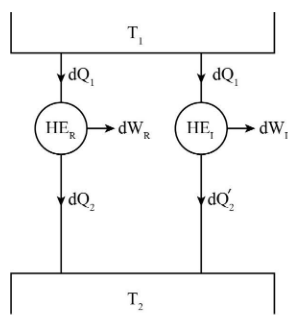
\[d{Q_1}\] is the amount of heat supplied to both the heat engines.
\[d{Q_2}\] and \[d{Q_2}^\prime \] be the amount of heat rejected to the sink by reversible and irreversible heat engines respectively.
\[{T_1}\] and \[{T_2}\] are the temperatures of the heat source and sink respectively.
\[d{W_R}\] and \[d{W_I}\] are the work produced by reversible and irreversible heat engines respectively.
\[{\rm{H}}{{\rm{E}}_R}\] and \[{\rm{H}}{{\rm{E}}_I}\] represents reversible and irreversible heat engine respectively.
Consider two heat engines, one is reversible heat engine and other is irreversible heat engine and both of them are operating between same temperature levels \[{T_1}\] and \[{T_2}\].
Carnot theorem states that if many heat engines are working under constant temperature source and constant temperature sink then the efficiency of reversible heat engines will always be high if compared to irreversible heat engines.
\[{\eta _R} > {\eta _I}\]……(1)
The efficiencies of reversible and irreversible heat engines as shown in figure are given as
\[{\eta _R} = \dfrac{{d{W_R}}}{{d{Q_1}}}\]
\[\Rightarrow{\eta _I} = \dfrac{{d{W_I}}}{{d{Q_1}}}\]
Substitute \[\dfrac{{d{W_R}}}{{d{Q_1}}}\] for \[{\eta _R}\] and \[\dfrac{{d{W_I}}}{{d{Q_1}}}\] for \[{\eta _I}\] in equation (1).
\[\dfrac{{d{W_R}}}{{d{Q_1}}} > \dfrac{{d{W_I}}}{{d{Q_1}}}\]……(2)
Using first law of thermodynamics for \[{\rm{H}}{{\rm{E}}_R}\] and \[{\rm{H}}{{\rm{E}}_I}\] respectively.
\[
d{W_R} = d{Q_1} - d{Q_2}\\
\Rightarrow d{W_I} = d{Q_1} - d{Q_2}^\prime
\]
Substitute \[d{Q_1} - d{Q_2}\] for \[d{W_R}\] and \[d{Q_1} - d{Q_2}^\prime \] for \[d{W_I}\] in equation (2).
\[
\dfrac{{d{Q_1} - d{Q_2}_{}}}{{d{Q_1}}} > \dfrac{{d{Q_1} - d{Q_2}^\prime }}{{d{Q_1}}}\\
\Rightarrow - \dfrac{{d{Q_2}}}{{d{Q_1}}} > - \dfrac{{d{Q_2}^\prime }}{{d{Q_1}}}\\
\Rightarrow\dfrac{{d{Q_2}}}{{d{Q_1}}} < \dfrac{{d{Q_2}^\prime }}{{d{Q_1}}}\\
\Rightarrow d{Q_2} < d{Q_2}^\prime
\]……(3)
Expanding the relation \[\oint {\dfrac{{dQ}}{T}} \] for irreversible heat engines.
\[\oint {\dfrac{{dQ}}{T}} = \dfrac{{d{Q_2}}}{{{T_1}}} - \dfrac{{d{Q_2}^\prime }}{{{T_2}}}\]
From equation (3), it is clear that the heat rejected by reversible heat engines is less than the heat rejected by the irreversible heat engine. Hence the term \[\left( {\dfrac{{d{Q_2}}}{{{T_1}}} - \dfrac{{d{Q_2}^\prime }}{{{T_2}}}} \right)\] becomes less than zero.
$\oint {\dfrac{{dQ}}{T}} = \dfrac{{d{Q_2}}}{{{T_1}}} - \dfrac{{d{Q_2}^\prime }}{{{T_2}}}\\
\Rightarrow\oint {\dfrac{{dQ}}{T}} < 0
$
Writing the above equation in per unit mass form.
$\oint {\dfrac{{dq}}{T}} < 0$
Therefore the expression for Clausius inequality is given by $\oint {\dfrac{{dq}}{T}} < 0$ and the option (A) is correct.
Note:: We have to note that the term $\oint {\dfrac{{dq}}{T}} $ is less than or equal to zero to make the system feasible in nature but if it became more than zero then it can be said that system is impossible in nature.
Complete step by step answer:
Assume:
\[d{Q_1}\] is the amount of heat supplied to both the heat engines.
\[d{Q_2}\] and \[d{Q_2}^\prime \] be the amount of heat rejected to the sink by reversible and irreversible heat engines respectively.
\[{T_1}\] and \[{T_2}\] are the temperatures of the heat source and sink respectively.
\[d{W_R}\] and \[d{W_I}\] are the work produced by reversible and irreversible heat engines respectively.
\[{\rm{H}}{{\rm{E}}_R}\] and \[{\rm{H}}{{\rm{E}}_I}\] represents reversible and irreversible heat engine respectively.
Consider two heat engines, one is reversible heat engine and other is irreversible heat engine and both of them are operating between same temperature levels \[{T_1}\] and \[{T_2}\].
Carnot theorem states that if many heat engines are working under constant temperature source and constant temperature sink then the efficiency of reversible heat engines will always be high if compared to irreversible heat engines.
\[{\eta _R} > {\eta _I}\]……(1)
The efficiencies of reversible and irreversible heat engines as shown in figure are given as
\[{\eta _R} = \dfrac{{d{W_R}}}{{d{Q_1}}}\]
\[\Rightarrow{\eta _I} = \dfrac{{d{W_I}}}{{d{Q_1}}}\]
Substitute \[\dfrac{{d{W_R}}}{{d{Q_1}}}\] for \[{\eta _R}\] and \[\dfrac{{d{W_I}}}{{d{Q_1}}}\] for \[{\eta _I}\] in equation (1).
\[\dfrac{{d{W_R}}}{{d{Q_1}}} > \dfrac{{d{W_I}}}{{d{Q_1}}}\]……(2)
Using first law of thermodynamics for \[{\rm{H}}{{\rm{E}}_R}\] and \[{\rm{H}}{{\rm{E}}_I}\] respectively.
\[
d{W_R} = d{Q_1} - d{Q_2}\\
\Rightarrow d{W_I} = d{Q_1} - d{Q_2}^\prime
\]
Substitute \[d{Q_1} - d{Q_2}\] for \[d{W_R}\] and \[d{Q_1} - d{Q_2}^\prime \] for \[d{W_I}\] in equation (2).
\[
\dfrac{{d{Q_1} - d{Q_2}_{}}}{{d{Q_1}}} > \dfrac{{d{Q_1} - d{Q_2}^\prime }}{{d{Q_1}}}\\
\Rightarrow - \dfrac{{d{Q_2}}}{{d{Q_1}}} > - \dfrac{{d{Q_2}^\prime }}{{d{Q_1}}}\\
\Rightarrow\dfrac{{d{Q_2}}}{{d{Q_1}}} < \dfrac{{d{Q_2}^\prime }}{{d{Q_1}}}\\
\Rightarrow d{Q_2} < d{Q_2}^\prime
\]……(3)
Expanding the relation \[\oint {\dfrac{{dQ}}{T}} \] for irreversible heat engines.
\[\oint {\dfrac{{dQ}}{T}} = \dfrac{{d{Q_2}}}{{{T_1}}} - \dfrac{{d{Q_2}^\prime }}{{{T_2}}}\]
From equation (3), it is clear that the heat rejected by reversible heat engines is less than the heat rejected by the irreversible heat engine. Hence the term \[\left( {\dfrac{{d{Q_2}}}{{{T_1}}} - \dfrac{{d{Q_2}^\prime }}{{{T_2}}}} \right)\] becomes less than zero.
$\oint {\dfrac{{dQ}}{T}} = \dfrac{{d{Q_2}}}{{{T_1}}} - \dfrac{{d{Q_2}^\prime }}{{{T_2}}}\\
\Rightarrow\oint {\dfrac{{dQ}}{T}} < 0
$
Writing the above equation in per unit mass form.
$\oint {\dfrac{{dq}}{T}} < 0$
Therefore the expression for Clausius inequality is given by $\oint {\dfrac{{dq}}{T}} < 0$ and the option (A) is correct.
Note:: We have to note that the term $\oint {\dfrac{{dq}}{T}} $ is less than or equal to zero to make the system feasible in nature but if it became more than zero then it can be said that system is impossible in nature.
Recently Updated Pages
Which will be the least stable resonating structure class 11 chemistry CBSE

How many 5 digit telephone numbers can be construc-class-11-maths-CBSE
How do you find the angle of the resultant vector class 11 physics CBSE
Draw labelled diagram of the following i Gram seed class 11 biology CBSE
1 Quintal is equal to a 110 kg b 10 kg c 100kg d 1000 class 11 physics CBSE
What is the need and importance of classification class 11 biology CBSE
Trending doubts
One Metric ton is equal to kg A 10000 B 1000 C 100 class 11 physics CBSE
Find the value of the expression given below sin 30circ class 11 maths CBSE
Draw a diagram of nephron and explain its structur class 11 biology CBSE
10 examples of friction in our daily life
Proton was discovered by A Thomson B Rutherford C Chadwick class 11 chemistry CBSE
The teeth used for biting and cutting food are called class 11 biology CBSE