




Which of the following corresponds to the principal value branch of ${{\tan }^{-1}} {x}$?
A. $\left( -\dfrac{\pi }{2},\dfrac{\pi }{2} \right)$
B. $\left[ -\dfrac{\pi }{2},\dfrac{\pi }{2} \right]$
C. $\left( -\dfrac{\pi }{2},\dfrac{\pi }{2} \right) - \left\{ 0 \right\}$
D. $\left( 0,\pi \right)$
Answer
 Verified
480.9k+ views
Hint: We explain the function ${{\tan }^{-1}}$. We express the inverse function of tan in the form of $arc\tan \left( x \right)={{\tan }^{-1}}x$. We draw the graph of ${{\tan }^{-1}}\left( x \right)$ and take an example of ${{\tan }^{-1}}1$ to understand the exact and general solution.
Complete step by step answer:
The given expression is the inverse function of trigonometric ratio tan. The arcus function represents the angle which on ratio tan gives the value.So, $arc\tan \left( x \right)={{\tan }^{-1}}x$. If $arc\tan \left( x \right)=\alpha $ then we can say $\tan \alpha =x$.Each of the trigonometric functions is periodic in the real part of its argument, running through all its values twice in each interval of $2\pi $. The general solution for that value where $\tan \alpha =x$ will be $n\pi +\alpha ,n\in \mathbb{Z}$.
But for $arc\tan \left( x \right)$, we won’t find the general solution. We use the principal value. For ratio tan we have $-\dfrac{\pi }{2} < arc\tan \left( x \right) < \dfrac{\pi }{2}$.The graph of the function is,
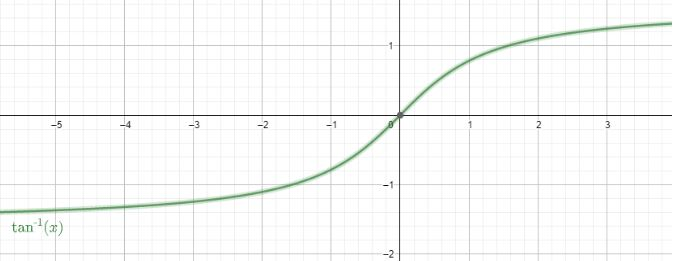
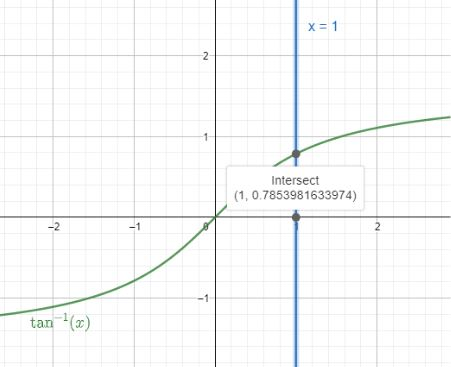
$arc\tan \left( x \right)=\alpha $ gives the angle $\alpha $ behind the ratio. We now take the example of $x=1$ in the function of $arc\tan \left( x \right)$. Let the angle be $\theta $ for which $arc\tan \left( 1 \right)=\theta $. This gives $\tan \theta =1$. Putting the value in the graph of $arc\tan \left( x \right)$, we get $\theta =45$.
For this we take the line of $x=1$ and see the intersection of the line with the graph $arc\tan \left( x \right)$.
The correct option is A.
Note: Although for elementary knowledge the principal domain is enough to solve the problem. But if mentioned to find the general solution then the domain changes to $-\dfrac{\pi }{2} < arc\tan \left( x \right) < \dfrac{\pi }{2}$. In that case we have to use the formula $x=n\pi +a$ for $\tan \left( x \right)=\tan a$ where $-\dfrac{\pi }{2} < a < \dfrac{\pi }{2}$.
Complete step by step answer:
The given expression is the inverse function of trigonometric ratio tan. The arcus function represents the angle which on ratio tan gives the value.So, $arc\tan \left( x \right)={{\tan }^{-1}}x$. If $arc\tan \left( x \right)=\alpha $ then we can say $\tan \alpha =x$.Each of the trigonometric functions is periodic in the real part of its argument, running through all its values twice in each interval of $2\pi $. The general solution for that value where $\tan \alpha =x$ will be $n\pi +\alpha ,n\in \mathbb{Z}$.
But for $arc\tan \left( x \right)$, we won’t find the general solution. We use the principal value. For ratio tan we have $-\dfrac{\pi }{2} < arc\tan \left( x \right) < \dfrac{\pi }{2}$.The graph of the function is,
$arc\tan \left( x \right)=\alpha $ gives the angle $\alpha $ behind the ratio. We now take the example of $x=1$ in the function of $arc\tan \left( x \right)$. Let the angle be $\theta $ for which $arc\tan \left( 1 \right)=\theta $. This gives $\tan \theta =1$. Putting the value in the graph of $arc\tan \left( x \right)$, we get $\theta =45$.
For this we take the line of $x=1$ and see the intersection of the line with the graph $arc\tan \left( x \right)$.
The correct option is A.
Note: Although for elementary knowledge the principal domain is enough to solve the problem. But if mentioned to find the general solution then the domain changes to $-\dfrac{\pi }{2} < arc\tan \left( x \right) < \dfrac{\pi }{2}$. In that case we have to use the formula $x=n\pi +a$ for $\tan \left( x \right)=\tan a$ where $-\dfrac{\pi }{2} < a < \dfrac{\pi }{2}$.
Recently Updated Pages
Master Class 11 Computer Science: Engaging Questions & Answers for Success

Master Class 11 Business Studies: Engaging Questions & Answers for Success
Master Class 11 Economics: Engaging Questions & Answers for Success
Master Class 11 English: Engaging Questions & Answers for Success
Master Class 11 Maths: Engaging Questions & Answers for Success
Master Class 11 Biology: Engaging Questions & Answers for Success
Trending doubts
One Metric ton is equal to kg A 10000 B 1000 C 100 class 11 physics CBSE
There are 720 permutations of the digits 1 2 3 4 5 class 11 maths CBSE
Discuss the various forms of bacteria class 11 biology CBSE
Draw a diagram of a plant cell and label at least eight class 11 biology CBSE
State the laws of reflection of light
Explain zero factorial class 11 maths CBSE