




Which of the following compounds will not be soluble in sodium bicarbonate?
A) $ {\text{2,4,6 - Trinitrophenol}} $
B) Benzoic acid
C) o-Nitrophenol
D) Benzene sulphonic acid
Answer
 Verified
530.4k+ views
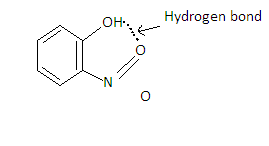
Hint: o-Nitro phenol has intramolecular hydrogen bonding which makes it difficult to release the $ {{\text{H}}^ + } $ ion. So it is a weak acid which will not show any reaction when reacted with sodium bicarbonate. Hence it is not soluble in sodium bicarbonate.
Complete answer:
The given compounds will be soluble in sodium bicarbonate only if they have higher acidity. This means that they can easily give $ {{\text{H}}^ + } $ ion and form sodium salts of acid. Here, $ {\text{2,4,6 - Trinitrophenol}} $ has higher acidity than o-Nitrophenol as it has 3 $ {\text{ - N}}{{\text{O}}_{\text{2}}} $ groups which is electron withdrawing group so it increases the acidic strength of phenol. So, it will be soluble in sodium bicarbonate. The reaction will be-
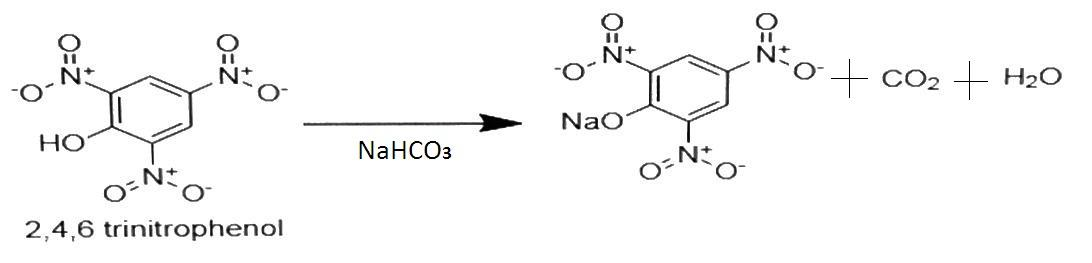
The product formed is the sodium salt of acid. Benzoic acid and Benzene sulphonic acid are strong acids as they give $ {{\text{H}}^ + } $ ion easily. So they are soluble in sodium bicarbonate. The reaction is as follows-
$ \Rightarrow {{\text{C}}_6}{{\text{H}}_5}{\text{COOH + NaHC}}{{\text{O}}_3} \to {\text{Na}}{{\text{C}}_6}{{\text{H}}_5}{\text{COO + }}{{\text{H}}_2}{\text{O + C}}{{\text{O}}_2} \\
{{\text{C}}_6}{{\text{H}}_5}{\text{S}}{{\text{O}}_2}{\text{OH + NaHC}}{{\text{O}}_3} \to {{\text{C}}_6}{{\text{H}}_5}{\text{S}}{{\text{O}}_2}{\text{ONa + }}{{\text{H}}_2}{\text{O + C}}{{\text{O}}_2} \\ $
Hence the answer is ‘C’.
Note:
Hydrogen Bonding is the bonding between the hydrogen atom of one molecule with the electronegative atom of an adjacent molecule. It is represented by (-). Hydrogen bonding is of two types-
(i)Intermolecular hydrogen bonding- Hydrogen bond formed between 2 molecules
(ii)Intermolecular hydrogen bonding-Hydrogen bond formed within the molecule.
In o-Nitrophenol, Intermolecular hydrogen bonding is present.
Complete answer:
The given compounds will be soluble in sodium bicarbonate only if they have higher acidity. This means that they can easily give $ {{\text{H}}^ + } $ ion and form sodium salts of acid. Here, $ {\text{2,4,6 - Trinitrophenol}} $ has higher acidity than o-Nitrophenol as it has 3 $ {\text{ - N}}{{\text{O}}_{\text{2}}} $ groups which is electron withdrawing group so it increases the acidic strength of phenol. So, it will be soluble in sodium bicarbonate. The reaction will be-
The product formed is the sodium salt of acid. Benzoic acid and Benzene sulphonic acid are strong acids as they give $ {{\text{H}}^ + } $ ion easily. So they are soluble in sodium bicarbonate. The reaction is as follows-
$ \Rightarrow {{\text{C}}_6}{{\text{H}}_5}{\text{COOH + NaHC}}{{\text{O}}_3} \to {\text{Na}}{{\text{C}}_6}{{\text{H}}_5}{\text{COO + }}{{\text{H}}_2}{\text{O + C}}{{\text{O}}_2} \\
{{\text{C}}_6}{{\text{H}}_5}{\text{S}}{{\text{O}}_2}{\text{OH + NaHC}}{{\text{O}}_3} \to {{\text{C}}_6}{{\text{H}}_5}{\text{S}}{{\text{O}}_2}{\text{ONa + }}{{\text{H}}_2}{\text{O + C}}{{\text{O}}_2} \\ $
Hence the answer is ‘C’.
Note:
Hydrogen Bonding is the bonding between the hydrogen atom of one molecule with the electronegative atom of an adjacent molecule. It is represented by (-). Hydrogen bonding is of two types-
(i)Intermolecular hydrogen bonding- Hydrogen bond formed between 2 molecules
(ii)Intermolecular hydrogen bonding-Hydrogen bond formed within the molecule.
In o-Nitrophenol, Intermolecular hydrogen bonding is present.
Recently Updated Pages
Master Class 11 English: Engaging Questions & Answers for Success

Master Class 11 Social Science: Engaging Questions & Answers for Success
Master Class 11 Maths: Engaging Questions & Answers for Success
Master Class 11 Biology: Engaging Questions & Answers for Success
Master Class 11 Physics: Engaging Questions & Answers for Success
Master Class 11 Chemistry: Engaging Questions & Answers for Success
Trending doubts
One Metric ton is equal to kg A 10000 B 1000 C 100 class 11 physics CBSE
Difference Between Prokaryotic Cells and Eukaryotic Cells
Find the value of the expression given below sin 30circ class 11 maths CBSE
Difference between physical and chemical change class 11 chemistry CBSE
Two of the body parts which do not appear in MRI are class 11 biology CBSE
Draw a diagram of a plant cell and label at least eight class 11 biology CBSE