




Which of the following compounds does not give a haloform reaction?
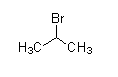
(A)
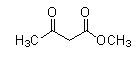
(B)
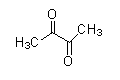
(C)
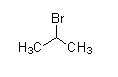
(D)
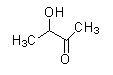
Answer
 Verified
651k+ views
Hint: To obtain Haloform as the product, the starting material needs to have methyl ketones in order to undergo reaction in Haloform reaction. Tertiary halogen atoms do not get oxidized in conditions as given in Haloform reaction.
Complete answer:
- The compound that does not have $$ - COC{H_3}$$ cannot undergo a Haloform reaction.
As we see the structures of all compounds, we find out that only compounds given in option (C) do not have $$ - COC{H_3}$$ group. So, it cannot give this reaction.
So, Correct answer is option (C)
Additional Information:
- Haloform reaction converts acetyl groups to carboxylic acid functionality by exhaustive halogenations and gives various haloform as side products.
- Following is the Haloform reaction of compound given in option (A) with mechanism.
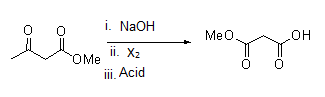
Mechanism:

Same way, all three protons get substituted by Bromine atoms and finally Hydrolysis converts acetyl group into carboxylic acid and Haloform is produced as a side product. Here, we have used $$B{r_2}$$ as a halogen, so respective haloforms will form.

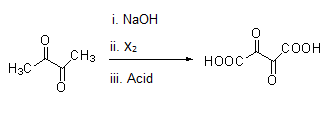
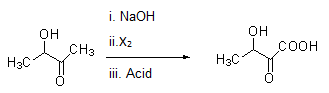
Same way compounds given in option (B) and (D) give Haloform reaction as shown under.
Note:
Secondary alcohol oxidizes itself in the conditions present in Haloform reaction and if it gets converted into methyl ketones, then it will give Haloform reaction even though it does not contain $$ - COC{H_3}$$ functionality. Acidic hydrolysis is necessary in order to obtain the final product.
Complete answer:
- The compound that does not have $$ - COC{H_3}$$ cannot undergo a Haloform reaction.
As we see the structures of all compounds, we find out that only compounds given in option (C) do not have $$ - COC{H_3}$$ group. So, it cannot give this reaction.
So, Correct answer is option (C)
Additional Information:
- Haloform reaction converts acetyl groups to carboxylic acid functionality by exhaustive halogenations and gives various haloform as side products.
- Following is the Haloform reaction of compound given in option (A) with mechanism.
Mechanism:
Same way, all three protons get substituted by Bromine atoms and finally Hydrolysis converts acetyl group into carboxylic acid and Haloform is produced as a side product. Here, we have used $$B{r_2}$$ as a halogen, so respective haloforms will form.
Same way compounds given in option (B) and (D) give Haloform reaction as shown under.
Note:
Secondary alcohol oxidizes itself in the conditions present in Haloform reaction and if it gets converted into methyl ketones, then it will give Haloform reaction even though it does not contain $$ - COC{H_3}$$ functionality. Acidic hydrolysis is necessary in order to obtain the final product.
Recently Updated Pages
Basicity of sulphurous acid and sulphuric acid are

Master Class 12 Economics: Engaging Questions & Answers for Success
Master Class 12 Biology: Engaging Questions & Answers for Success
Master Class 11 English: Engaging Questions & Answers for Success
Master Class 11 Physics: Engaging Questions & Answers for Success
Master Class 11 Computer Science: Engaging Questions & Answers for Success
Trending doubts
Draw a labelled sketch of the human eye class 12 physics CBSE
The chemical formula of tear gas is A CO Cl 2 B C 10 class 12 chemistry CBSE
Draw ray diagrams each showing i myopic eye and ii class 12 physics CBSE
Which are the Top 10 Largest Countries of the World?
Differentiate between homogeneous and heterogeneous class 12 chemistry CBSE
Which is the correct genotypic ratio of mendel dihybrid class 12 biology CBSE