




Which of the following complex ions has electrons that are symmetrically filled in both ${{t}_{2g}}$ and ${{e}_{g}}$ orbitals?
(A) ${{\left[ Co{{\left( N{{H}_{3}} \right)}_{6}} \right]}^{2+}}$
(B) ${{\left[ Mn{{\left( CN \right)}_{6}} \right]}^{4-}}$
(C) ${{\left[ Co{{F}_{6}} \right]}^{3-}}$
(D) ${{\left[ Fe{{F}_{6}} \right]}^{3-}}$
Answer
 Verified
599.1k+ views
Hint: According to crystal field theory, an octahedral complex is a complex which has six ligands systematically arranged around a central atom. Hence, we can assume that all of the given complexes are octahedral complexes. By looking at the electron distribution in the orbitals of given compounds we could identify which complex has symmetrically filled electrons.
Complete step by step solution:
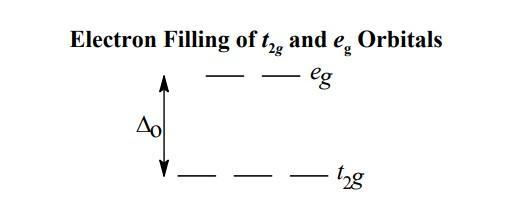
- In an octahedral complex, the d orbitals are split into ${{t}_{2g}}$ and ${{e}_{g}}$. Here the ${{t}_{2g}}$ orbitals will be lower in energy compared to ${{e}_{g}}$ orbitals. The splitting in an octahedral complex can be shown as follows,
- The symmetrical distribution of electrons in a complex depends on whether the complex is high spin or low spin and the spectrochemical series plays an important role in determining whether the complex is high spin or low spin. The series can be represented as follows
\[{{I}^{-}}<~B{{r}^{-}}<~C{{l}^{-}}<~{{F}^{-}}<~O{{H}^{-}}<~{{C}_{2}}O_{4}^{2-}<~{{H}_{2}}O<~N{{H}_{3}}<~en<~bipy<~phen<~C{{N}^{-}}\approx CO\]
- Ligands beyond water are strong field ligands and they form low spin complexes and ligands up to water are generally weak ligands and thus form high spin complexes. Let’s take each of the options and check whether it’s a high spin or low spin.
(i) ${{\left[ Co{{\left( N{{H}_{3}} \right)}_{6}} \right]}^{2+}}$
Here Co is in +2 oxidation state and will have a $3{{d}^{7}}$ configuration. Since ammonia is a strong field ligand it will have an unequal distribution of electrons. Among the five electrons in ${{t}_{2g}}$ there will be two electron pairs and an unpaired electron and in ${{e}_{g}}$ there will be two unpaired electrons. Hence this option is incorrect.
(ii) ${{\left[ Mn{{\left( CN \right)}_{6}} \right]}^{4-}}$
Strong field ligand and hence high spin complex. Unequal distribution of electrons. Five electrons in ${{t}_{2g}}$ and no electrons in ${{e}_{g}}$. Hence unequal distribution of electrons.
(iii) ${{\left[ Co{{F}_{6}} \right]}^{3-}}$
Four electrons in ${{t}_{2g}}$ orbital and two in ${{e}_{g}}$ orbital. Among that the electrons in ${{e}_{g}}$ will be unpaired and the two electrons are paired in ${{t}_{2g}}$. Hence unequal distribution of electrons.
(iv) ${{\left[ Fe{{F}_{6}} \right]}^{3-}}$
Fluorine is a weak field ligand and hence a high spin complex is formed. It will have three unpaired electrons in ${{t}_{2g}}$ orbital and two unpaired electrons in${{e}_{g}}$. Thus there is an equal distribution of electrons in ${{e}_{g}}$ and ${{t}_{2g}}$ orbitals.
Therefore the answer is option (D) ${{\left[ Fe{{F}_{6}} \right]}^{3-}}$.
Note: Keep in mind that the hexafluoroferrate (III) ion or ${{\left[ Fe{{F}_{6}} \right]}^{3-}}$ is paramagnetic in nature since it contains unpaired electrons. Also, the transitions in Fe (III) ion are spin forbidden and they are extremely weak and as a result the complex ${{\left[ Fe{{F}_{6}} \right]}^{3-}}$ is almost colorless.
Complete step by step solution:
- In an octahedral complex, the d orbitals are split into ${{t}_{2g}}$ and ${{e}_{g}}$. Here the ${{t}_{2g}}$ orbitals will be lower in energy compared to ${{e}_{g}}$ orbitals. The splitting in an octahedral complex can be shown as follows,
- The symmetrical distribution of electrons in a complex depends on whether the complex is high spin or low spin and the spectrochemical series plays an important role in determining whether the complex is high spin or low spin. The series can be represented as follows
\[{{I}^{-}}<~B{{r}^{-}}<~C{{l}^{-}}<~{{F}^{-}}<~O{{H}^{-}}<~{{C}_{2}}O_{4}^{2-}<~{{H}_{2}}O<~N{{H}_{3}}<~en<~bipy<~phen<~C{{N}^{-}}\approx CO\]
- Ligands beyond water are strong field ligands and they form low spin complexes and ligands up to water are generally weak ligands and thus form high spin complexes. Let’s take each of the options and check whether it’s a high spin or low spin.
(i) ${{\left[ Co{{\left( N{{H}_{3}} \right)}_{6}} \right]}^{2+}}$
Here Co is in +2 oxidation state and will have a $3{{d}^{7}}$ configuration. Since ammonia is a strong field ligand it will have an unequal distribution of electrons. Among the five electrons in ${{t}_{2g}}$ there will be two electron pairs and an unpaired electron and in ${{e}_{g}}$ there will be two unpaired electrons. Hence this option is incorrect.
(ii) ${{\left[ Mn{{\left( CN \right)}_{6}} \right]}^{4-}}$
Strong field ligand and hence high spin complex. Unequal distribution of electrons. Five electrons in ${{t}_{2g}}$ and no electrons in ${{e}_{g}}$. Hence unequal distribution of electrons.
(iii) ${{\left[ Co{{F}_{6}} \right]}^{3-}}$
Four electrons in ${{t}_{2g}}$ orbital and two in ${{e}_{g}}$ orbital. Among that the electrons in ${{e}_{g}}$ will be unpaired and the two electrons are paired in ${{t}_{2g}}$. Hence unequal distribution of electrons.
(iv) ${{\left[ Fe{{F}_{6}} \right]}^{3-}}$
Fluorine is a weak field ligand and hence a high spin complex is formed. It will have three unpaired electrons in ${{t}_{2g}}$ orbital and two unpaired electrons in${{e}_{g}}$. Thus there is an equal distribution of electrons in ${{e}_{g}}$ and ${{t}_{2g}}$ orbitals.
Therefore the answer is option (D) ${{\left[ Fe{{F}_{6}} \right]}^{3-}}$.
Note: Keep in mind that the hexafluoroferrate (III) ion or ${{\left[ Fe{{F}_{6}} \right]}^{3-}}$ is paramagnetic in nature since it contains unpaired electrons. Also, the transitions in Fe (III) ion are spin forbidden and they are extremely weak and as a result the complex ${{\left[ Fe{{F}_{6}} \right]}^{3-}}$ is almost colorless.
Recently Updated Pages
Three beakers labelled as A B and C each containing 25 mL of water were taken A small amount of NaOH anhydrous CuSO4 and NaCl were added to the beakers A B and C respectively It was observed that there was an increase in the temperature of the solutions contained in beakers A and B whereas in case of beaker C the temperature of the solution falls Which one of the following statements isarecorrect i In beakers A and B exothermic process has occurred ii In beakers A and B endothermic process has occurred iii In beaker C exothermic process has occurred iv In beaker C endothermic process has occurred

Master Class 11 Social Science: Engaging Questions & Answers for Success
Master Class 11 Physics: Engaging Questions & Answers for Success
Master Class 11 Maths: Engaging Questions & Answers for Success
Master Class 11 Economics: Engaging Questions & Answers for Success
Master Class 11 Computer Science: Engaging Questions & Answers for Success
Three beakers labelled as A B and C each containing 25 mL of water were taken A small amount of NaOH anhydrous CuSO4 and NaCl were added to the beakers A B and C respectively It was observed that there was an increase in the temperature of the solutions contained in beakers A and B whereas in case of beaker C the temperature of the solution falls Which one of the following statements isarecorrect i In beakers A and B exothermic process has occurred ii In beakers A and B endothermic process has occurred iii In beaker C exothermic process has occurred iv In beaker C endothermic process has occurred
Master Class 11 Social Science: Engaging Questions & Answers for Success
Master Class 11 Physics: Engaging Questions & Answers for Success
Trending doubts
One Metric ton is equal to kg A 10000 B 1000 C 100 class 11 physics CBSE
There are 720 permutations of the digits 1 2 3 4 5 class 11 maths CBSE
State and prove Bernoullis theorem class 11 physics CBSE
Draw a diagram of a plant cell and label at least eight class 11 biology CBSE
Difference Between Prokaryotic Cells and Eukaryotic Cells
1 Quintal is equal to a 110 kg b 10 kg c 100kg d 1000 class 11 physics CBSE