




Which of the following changes occur in the diaphragm and intercostal muscles when the expiration of air takes place?
(a)Internal intercostal muscles relax and diaphragm contracts
(b)External intercostal muscles and diaphragm relax
(c)Internal intercostal muscles contract and diaphragm relax
(d)External intercostal muscles and diaphragm contract
Answer
 Verified
618.6k+ views
Hint: The diaphragm along with the internal and external intercostal muscles is responsible for inspiration and expiration by contracting and relaxing. This is because relaxation and contraction of these muscles change the intrapulmonary pressure of the lungs.
Complete answer:
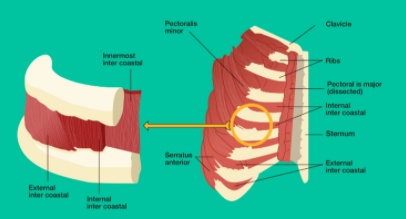
During expiration, the internal intercostal muscles contract, and the diaphragm relaxes. This is because the internal intercostal muscles contracting and the diaphragm relaxing decreases the volume of the thoracic cavity. This in turn decreases the volume of the lungs. Now, according to thermodynamics, at a constant temperature, the pressure is inversely proportional to volume. Thus, the intrapulmonary pressure will increase more than the atmospheric pressure. As a result, air will move out from the lungs to the atmosphere i.e. expiration.
Additional Information: Let us understand the mechanism of inspiration in detail.
In the case of inspiration the following events occur:
-Sternum and ribs are lifted upwards due to the contraction of external intercostal muscles.
-Diaphragm contracts and moves downwards
-There is an increase in the volume of the lungs causing a decrease in the intrapulmonary pressure.
-This results in air moving from the atmosphere to the lungs.
So, the correct option is ‘Internal intercostal muscles contract and diaphragm relax’.
Note: The respiratory system is divided into two parts i.e. the conducting part and the exchange part.
The conducting parts comprise all the structures from the external nostrils up to the terminal bronchioles. Their function is to humidify and warm the air as it passes through them.
Alveoli is the exchange part of the lungs where the actual diffusion of ${ O }_{ 2 }$ and ${ CO }_{ 2 }$ takes place. Also known as the respiratory part as actual respiration takes place here.
Complete answer:
During expiration, the internal intercostal muscles contract, and the diaphragm relaxes. This is because the internal intercostal muscles contracting and the diaphragm relaxing decreases the volume of the thoracic cavity. This in turn decreases the volume of the lungs. Now, according to thermodynamics, at a constant temperature, the pressure is inversely proportional to volume. Thus, the intrapulmonary pressure will increase more than the atmospheric pressure. As a result, air will move out from the lungs to the atmosphere i.e. expiration.
Additional Information: Let us understand the mechanism of inspiration in detail.
In the case of inspiration the following events occur:
-Sternum and ribs are lifted upwards due to the contraction of external intercostal muscles.
-Diaphragm contracts and moves downwards
-There is an increase in the volume of the lungs causing a decrease in the intrapulmonary pressure.
-This results in air moving from the atmosphere to the lungs.
So, the correct option is ‘Internal intercostal muscles contract and diaphragm relax’.
Note: The respiratory system is divided into two parts i.e. the conducting part and the exchange part.
The conducting parts comprise all the structures from the external nostrils up to the terminal bronchioles. Their function is to humidify and warm the air as it passes through them.
Alveoli is the exchange part of the lungs where the actual diffusion of ${ O }_{ 2 }$ and ${ CO }_{ 2 }$ takes place. Also known as the respiratory part as actual respiration takes place here.
Recently Updated Pages
Master Class 11 English: Engaging Questions & Answers for Success

Master Class 11 Social Science: Engaging Questions & Answers for Success
Master Class 11 Maths: Engaging Questions & Answers for Success
Master Class 11 Biology: Engaging Questions & Answers for Success
Master Class 11 Physics: Engaging Questions & Answers for Success
Master Class 11 Chemistry: Engaging Questions & Answers for Success
Trending doubts
One Metric ton is equal to kg A 10000 B 1000 C 100 class 11 physics CBSE
Difference Between Prokaryotic Cells and Eukaryotic Cells
Two of the body parts which do not appear in MRI are class 11 biology CBSE
Find the value of the expression given below sin 30circ class 11 maths CBSE
Draw a diagram of a plant cell and label at least eight class 11 biology CBSE
10 examples of friction in our daily life