




Which of the following bacteria is used as a vector for plant genetic engineering?
(a) Agrobacterium tumefaciens
(b) Bacteriophages
(c) Thermus aquaticus
(d) Pyrococcus furiosus
Answer
 Verified
600.3k+ views
Hint: A gram- negative bacteria having the shape of a rod and is found generally in the soil. It belongs to the bacterium family Rhizobiaceae that also includes nitrogen- fixing bacteria found in the roots of the legumes.
Complete step by step answer:
Agrobacterium tumefaciens are the soil bacterium that is mostly used as a vector for genetic engineering in plants. They are pathogenic in nature and produce tumors in plants and are thus non- beneficial for plants.
- Agrobacterium tumefaciens are also called Agrobacterium radiobacter, or Rhizobium radiobacter.
- They are the causative agent of tumors, also called crown galls in certain plants mainly of eudicots.
- The tumors can be induced in the plants by the insertion of the T- DNA, or transfer DNA into the pants with the help of the plasmids.
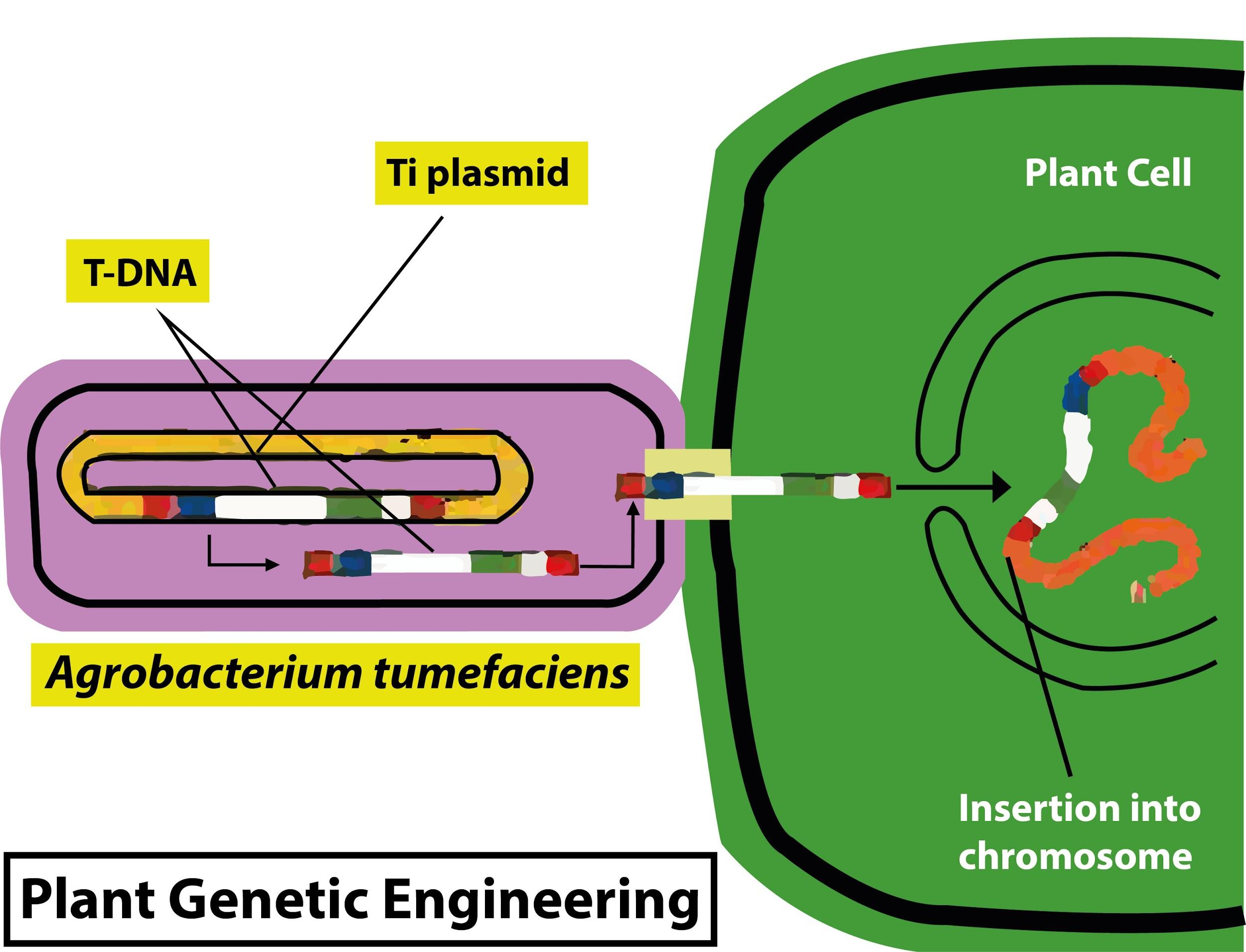
- This T- DNA can be inserted in a random location in the genome of the plant.
- These Agrobacterium are used in the introduction of DNA sequences into the plant genome that is present in the vectors of the T- DNA.
- The Agrobacterium tumefaciens bacteria is found to grow mostly at 28 degrees centigrade temperature.
- The plasmids present in this bacteria are mainly responsible for the transfer of the T-DNA into the plant cell and cause diseases.
- Agrobacterium tumefaciens generally affects the plants including grapes, walnuts, sugar beets, etc.
So, the correct answer is ‘Agrobacterium tumefaciens’.
Note: In 1679, Malpighi first described the galls on the plants. According to him, the galls are the extraordinary growth of the plants and are produced spontaneously. In 1897, Fridiano Cavara was the first to isolate Agrobacterium from the tumors of the plants in Napoli, Italy.
Complete step by step answer:
Agrobacterium tumefaciens are the soil bacterium that is mostly used as a vector for genetic engineering in plants. They are pathogenic in nature and produce tumors in plants and are thus non- beneficial for plants.
- Agrobacterium tumefaciens are also called Agrobacterium radiobacter, or Rhizobium radiobacter.
- They are the causative agent of tumors, also called crown galls in certain plants mainly of eudicots.
- The tumors can be induced in the plants by the insertion of the T- DNA, or transfer DNA into the pants with the help of the plasmids.
- This T- DNA can be inserted in a random location in the genome of the plant.
- These Agrobacterium are used in the introduction of DNA sequences into the plant genome that is present in the vectors of the T- DNA.
- The Agrobacterium tumefaciens bacteria is found to grow mostly at 28 degrees centigrade temperature.
- The plasmids present in this bacteria are mainly responsible for the transfer of the T-DNA into the plant cell and cause diseases.
- Agrobacterium tumefaciens generally affects the plants including grapes, walnuts, sugar beets, etc.
So, the correct answer is ‘Agrobacterium tumefaciens’.
Note: In 1679, Malpighi first described the galls on the plants. According to him, the galls are the extraordinary growth of the plants and are produced spontaneously. In 1897, Fridiano Cavara was the first to isolate Agrobacterium from the tumors of the plants in Napoli, Italy.
Recently Updated Pages
Master Class 12 Social Science: Engaging Questions & Answers for Success

Master Class 12 Physics: Engaging Questions & Answers for Success
Master Class 12 Maths: Engaging Questions & Answers for Success
Master Class 12 Economics: Engaging Questions & Answers for Success
Master Class 12 Chemistry: Engaging Questions & Answers for Success
Master Class 12 Business Studies: Engaging Questions & Answers for Success
Trending doubts
Which are the Top 10 Largest Countries of the World?
Draw a labelled sketch of the human eye class 12 physics CBSE
Explain the structure of megasporangium class 12 biology CBSE
What are the major means of transport Explain each class 12 social science CBSE
How many chromosomes are found in human ovum a 46 b class 12 biology CBSE
The diagram of the section of a maize grain is given class 12 biology CBSE