




Which of the following are the viral diseases?
(A) Malaria
(B) Cholera
(C) Hepatitis-B
(D) All of these
Answer
 Verified
589.2k+ views
Hint: Virus is the small microscopic particle that can replicate only inside the host organisms. It infects all the organisms like animals, plants and the other microorganisms. They are harmful to the other organisms causing many diseases. These are smaller than the bacteria which ranges from 20-300nm.
Complete answer:
The disease caused by the virus is called viral disease. These virus organisms remain inactive outside the host organisms. When they enter into the host organisms, they replicate their identical copies in the body of the host organisms and cause the disease. The virus does not possess cells. Hence when they enter into the body of the host, they force the host cell to produce its identical copies rapidly. It makes use of the host mechanism and the metabolism for the process of replication. These organisms have the nucleic acid content in the center called virion and it is surrounded by the protein cover called capsid.
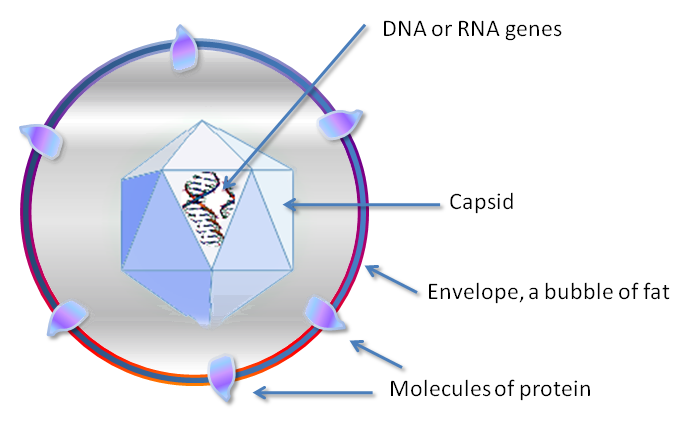
Malaria disease is caused by the protozoan Plasmodium and it is transmitted by the female anopheles’ mosquito. The cholera is the one of the bacterial diseases which is caused by the vibrio cholerae. The hepatitis-B is the only viral disease that is caused by hepatitis B. This virus affects the liver and the body fluid.
Hence the correct answer is OPTION(C)
Note: The common cold is the most common type of viral disease that is caused by infection of the virus in the upper respiratory tract. Chicken pox, influenza, AIDS, HIV, mumps, measles, rubella, hepatitis, shingles, meningitis, pneumonia etc. are some of the viral diseases.
Complete answer:
The disease caused by the virus is called viral disease. These virus organisms remain inactive outside the host organisms. When they enter into the host organisms, they replicate their identical copies in the body of the host organisms and cause the disease. The virus does not possess cells. Hence when they enter into the body of the host, they force the host cell to produce its identical copies rapidly. It makes use of the host mechanism and the metabolism for the process of replication. These organisms have the nucleic acid content in the center called virion and it is surrounded by the protein cover called capsid.
Malaria disease is caused by the protozoan Plasmodium and it is transmitted by the female anopheles’ mosquito. The cholera is the one of the bacterial diseases which is caused by the vibrio cholerae. The hepatitis-B is the only viral disease that is caused by hepatitis B. This virus affects the liver and the body fluid.
Hence the correct answer is OPTION(C)
Note: The common cold is the most common type of viral disease that is caused by infection of the virus in the upper respiratory tract. Chicken pox, influenza, AIDS, HIV, mumps, measles, rubella, hepatitis, shingles, meningitis, pneumonia etc. are some of the viral diseases.
Recently Updated Pages
Master Class 12 Social Science: Engaging Questions & Answers for Success

Master Class 12 Physics: Engaging Questions & Answers for Success
Master Class 12 Maths: Engaging Questions & Answers for Success
Master Class 12 Economics: Engaging Questions & Answers for Success
Master Class 12 Chemistry: Engaging Questions & Answers for Success
Master Class 12 Business Studies: Engaging Questions & Answers for Success
Trending doubts
Which are the Top 10 Largest Countries of the World?
Draw a labelled sketch of the human eye class 12 physics CBSE
Explain the structure of megasporangium class 12 biology CBSE
What are the major means of transport Explain each class 12 social science CBSE
How many chromosomes are found in human ovum a 46 b class 12 biology CBSE
The diagram of the section of a maize grain is given class 12 biology CBSE