




Which of the following are called food factories of the plants?
(a) Leaves
(b) Stem
(c) Roots
(d) Flowers
Answer
 Verified
635.7k+ views
Hint: The part of the plant that manufactures food for the plant by the process of photosynthesis. They have a large surface that enables them to be spread over a larger area thus increasing the area where the light falls.
Complete answer:
Leaves are the specialized structures for food production and hence, called food factories of the plants. Leaves are flat green structures which have a large surface area. The large surface area of leaves also provides a larger area for stomata to be spread all over the leaf. The amount of sunlight falling on the leaf is an important factor for many physiological processes of the plant, these include transpiration, photosynthesis, and respiration.
Additional information:
-Stomata is responsible for the exchange of gases in a plant and water loss due to transpiration.
-The leaves get their green color from a photosynthetic pigment called chlorophyll.
-Plant cells have chloroplasts, these contain chlorophyll and are responsible for photosynthesis.
-The interior part of the leaf between the upper and lower layers of epidermis is a parenchyma or chlorenchyma tissue called the mesophyll.
-The outer layer of the cells is covered with a waxy cuticle which is impermeable to liquid water.
-The cuticle performs several functions like protection against water loss by transpiration, regulation of gas exchange, and secretion of metabolic compounds.
So, the correct answer is ‘Leaves’.
Note:
-Most of the gymnosperms have thin needle-like or scale-like leaves that are advantageous in cold climates with frequent snow and frost.
-In C4 plants, Kranz leaf anatomy facilitates carbon fixation in plants.
-The presence of hairs on the leaf surface traps humidity in dry climates and creates a boundary layer reducing water loss.
Complete answer:
Leaves are the specialized structures for food production and hence, called food factories of the plants. Leaves are flat green structures which have a large surface area. The large surface area of leaves also provides a larger area for stomata to be spread all over the leaf. The amount of sunlight falling on the leaf is an important factor for many physiological processes of the plant, these include transpiration, photosynthesis, and respiration.
Additional information:
-Stomata is responsible for the exchange of gases in a plant and water loss due to transpiration.
-The leaves get their green color from a photosynthetic pigment called chlorophyll.
-Plant cells have chloroplasts, these contain chlorophyll and are responsible for photosynthesis.
-The interior part of the leaf between the upper and lower layers of epidermis is a parenchyma or chlorenchyma tissue called the mesophyll.
-The outer layer of the cells is covered with a waxy cuticle which is impermeable to liquid water.
-The cuticle performs several functions like protection against water loss by transpiration, regulation of gas exchange, and secretion of metabolic compounds.
So, the correct answer is ‘Leaves’.
Note:
-Most of the gymnosperms have thin needle-like or scale-like leaves that are advantageous in cold climates with frequent snow and frost.
-In C4 plants, Kranz leaf anatomy facilitates carbon fixation in plants.
-The presence of hairs on the leaf surface traps humidity in dry climates and creates a boundary layer reducing water loss.
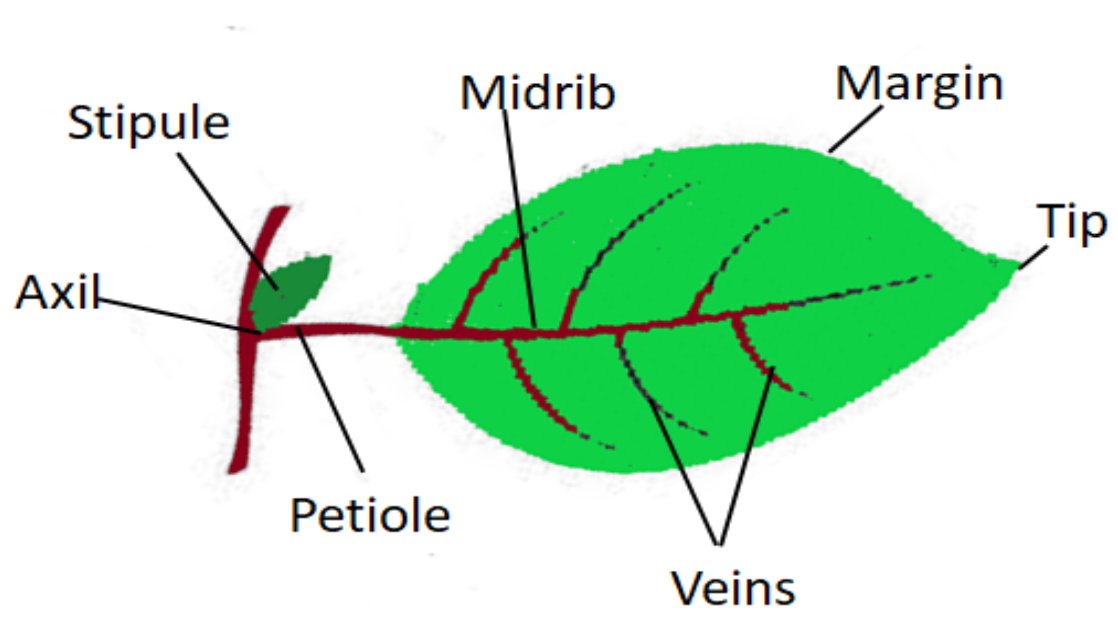
Figure: Structure of leave
Recently Updated Pages
Master Class 11 English: Engaging Questions & Answers for Success

Master Class 11 Social Science: Engaging Questions & Answers for Success
Master Class 11 Maths: Engaging Questions & Answers for Success
Master Class 11 Biology: Engaging Questions & Answers for Success
Master Class 11 Physics: Engaging Questions & Answers for Success
Master Class 11 Chemistry: Engaging Questions & Answers for Success
Trending doubts
Explain the Treaty of Vienna of 1815 class 10 social science CBSE
What is the full form of POSCO class 10 social science CBSE
Define Potential, Developed, Stock and Reserved resources
The diagonals of a rhombus are 10cm and 24cm Find the class 10 maths CBSE
Fill the blanks with proper collective nouns 1 A of class 10 english CBSE
One number is chosen from numbers 1 to 200 Find the class 10 maths CBSE