




Which of the following are called complex tissues?
A) Parenchyma and collenchyma
B) Collenchyma and sclerenchyma
C) Xylem and phloem
D) Xylem and parenchyma
Answer
 Verified
544.5k+ views
Hint: Meiosis is the type of cell division that takes place in the reproductive cells that is male and female gametes. It involves intermixing of the genes by the process of crossing over. The synaptonemal complex is formed during crossing over. It occurs during meiosis 1.
Complete answer:
The tissues can be divided into two types simple and complex.
I) The simple tissues are the ones that are made up of a single type of cell. For example-
Parenchyma- It is a simple permanent tissue that forms the soft parts of the leaves, fruit pulp and several other plant organs. It is the functional part of the organ tissue.
Sclerenchyma- It is a simple permanent tissue that comprises dead cells. They provide mechanical support to the plants.
Collenchyma- These are simple permanent tissue that is living and comprises elongated cells. Its function is to provide elasticity to the plants. Example -tracheid, fibres.
II) Complex tissues are tissues that are made up of more than one type of cell. For example, vascular bundle. The vascular bundle comprises of xylem and phloem.
Xylem- It is the complex tissue that consists of the tracheid, vessels, xylem parenchyma and fibres. The xylem parenchyma is the only living component. The function of the xylem is to conduct water and minerals from roots top various parts of the plant.
Phloem- It is a complex tissue that is made up of phloem parenchyma, companion cells, sieve tube cells and sieve plate. The function is to transport prepared food from the leaves to various parts of the plants.
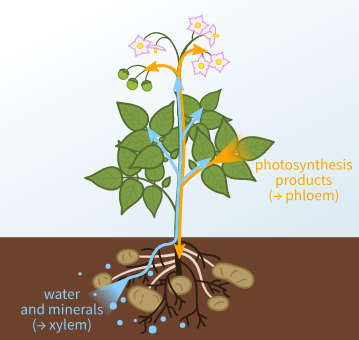
Therefore the correct answer is option ‘C’.
Note: The sucrose is the chief material that is transported in the phloem. The movement of water in the xylem takes place against gravity. It is possible due to the cohesive and adhesive force in the xylem vessel.
Complete answer:
The tissues can be divided into two types simple and complex.
I) The simple tissues are the ones that are made up of a single type of cell. For example-
Parenchyma- It is a simple permanent tissue that forms the soft parts of the leaves, fruit pulp and several other plant organs. It is the functional part of the organ tissue.
Sclerenchyma- It is a simple permanent tissue that comprises dead cells. They provide mechanical support to the plants.
Collenchyma- These are simple permanent tissue that is living and comprises elongated cells. Its function is to provide elasticity to the plants. Example -tracheid, fibres.
II) Complex tissues are tissues that are made up of more than one type of cell. For example, vascular bundle. The vascular bundle comprises of xylem and phloem.
Xylem- It is the complex tissue that consists of the tracheid, vessels, xylem parenchyma and fibres. The xylem parenchyma is the only living component. The function of the xylem is to conduct water and minerals from roots top various parts of the plant.
Phloem- It is a complex tissue that is made up of phloem parenchyma, companion cells, sieve tube cells and sieve plate. The function is to transport prepared food from the leaves to various parts of the plants.
Therefore the correct answer is option ‘C’.
Note: The sucrose is the chief material that is transported in the phloem. The movement of water in the xylem takes place against gravity. It is possible due to the cohesive and adhesive force in the xylem vessel.
Recently Updated Pages
Basicity of sulphurous acid and sulphuric acid are

Master Class 10 Computer Science: Engaging Questions & Answers for Success
Master Class 10 Social Science: Engaging Questions & Answers for Success
Master Class 10 Science: Engaging Questions & Answers for Success
Class 10 Question and Answer - Your Ultimate Solutions Guide
Master Class 10 Maths: Engaging Questions & Answers for Success
Trending doubts
What is the Total Duration of Football Match?
Explain the Treaty of Vienna of 1815 class 10 social science CBSE
In football, which nation is called "La Roja"?
Why is there a time difference of about 5 hours between class 10 social science CBSE
10 examples of evaporation in daily life with explanations
What is the full form of POSCO class 10 social science CBSE