




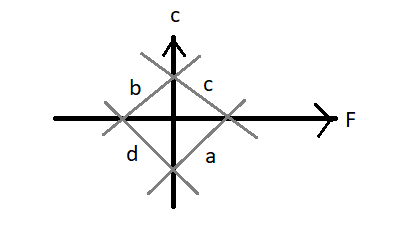
Which of the curves in the figure represents the relation between Celsius and Fahrenheit temperature?
$(A)$ Curve a
$(B)$Curve b
$(C)$Curve c
$(D)$Curve d
Answer
 Verified
540.6k+ views
Hint : Here, we’ll proceed by writing down the relation between Celsius and Fahrenheit temperature scales. After that, compare this equation with the general equation of a straight line. Then we will calculate the slope using those two equations and see which slopes in the diagram match it.
Formula used:
\[F = \dfrac{9}{5} \times C + 32\]
\[y = mx + c\]
\[m\] denotes the slope of the straight line and \[c\] denotes the intercept of the straight line on the y-axis
Complete step-by-step solution:
According to the relation between Celsius and Fahrenheit temperature scales, we get
\[F = \dfrac{9}{5} \times C + 32 - - - - - - \left( 1 \right)\]
We all know that the general equation of any straight line is given by
\[y = mx + c - - - - - - \left( 2 \right)\]
Where \[m\] denotes the slope of the straight line and \[c\] denotes the intercept of the straight line on the y-axis
Since in the given figure, it’s clear that the x-axis corresponds to the Fahrenheit temperature scale and therefore the y-axis corresponds to the Celsius temperature scale
By rearranging the equation (1), we get
\[ \Rightarrow F - 32 = \dfrac{9}{5} \times C\]
\[ \Rightarrow C = \dfrac{5}{9} \times \left( {F - 32} \right)\]
\[ \Rightarrow C = \left( {\dfrac{5}{9}} \right)F - \dfrac{5}{9} \times 32\]
\[C = \left( {\dfrac{5}{9}} \right)F - \dfrac{{160}}{9}. - - - - - - \left( 3 \right)\]
By comparing equation (2) with equation (3), we can say that the relation between the Celsius and Fahrenheit temperature is a straight line having a slope of \[\dfrac{5}{9}\] and y-intercept as\[\dfrac{{ - 160}}{9}\]. This suggests that the straight line representing the relation between the Celsius and Fahrenheit temperature has a positive slope and negative intercept. Therefore, the specified curve representing the relation between Celsius and Fahrenheit is curve \[a\] which is lying within the fourth quadrant.
So, the correct answer is “Option A”.
Note: In this particular problem, it’s important to know the various characteristics of the straight lines lying in the figure given. The curve \[a\] lying in the fourth quadrant have the positive slope and negative intercept, the curve \[b\] lying in the second quadrant have a positive slope and positive intercept, the curve \[c\] lying in the first quadrant has a negative slope and positive intercept, and the curve \[d\] lying in the third quadrant have a negative slope and negative intercept.
Formula used:
\[F = \dfrac{9}{5} \times C + 32\]
\[y = mx + c\]
\[m\] denotes the slope of the straight line and \[c\] denotes the intercept of the straight line on the y-axis
Complete step-by-step solution:
According to the relation between Celsius and Fahrenheit temperature scales, we get
\[F = \dfrac{9}{5} \times C + 32 - - - - - - \left( 1 \right)\]
We all know that the general equation of any straight line is given by
\[y = mx + c - - - - - - \left( 2 \right)\]
Where \[m\] denotes the slope of the straight line and \[c\] denotes the intercept of the straight line on the y-axis
Since in the given figure, it’s clear that the x-axis corresponds to the Fahrenheit temperature scale and therefore the y-axis corresponds to the Celsius temperature scale
By rearranging the equation (1), we get
\[ \Rightarrow F - 32 = \dfrac{9}{5} \times C\]
\[ \Rightarrow C = \dfrac{5}{9} \times \left( {F - 32} \right)\]
\[ \Rightarrow C = \left( {\dfrac{5}{9}} \right)F - \dfrac{5}{9} \times 32\]
\[C = \left( {\dfrac{5}{9}} \right)F - \dfrac{{160}}{9}. - - - - - - \left( 3 \right)\]
By comparing equation (2) with equation (3), we can say that the relation between the Celsius and Fahrenheit temperature is a straight line having a slope of \[\dfrac{5}{9}\] and y-intercept as\[\dfrac{{ - 160}}{9}\]. This suggests that the straight line representing the relation between the Celsius and Fahrenheit temperature has a positive slope and negative intercept. Therefore, the specified curve representing the relation between Celsius and Fahrenheit is curve \[a\] which is lying within the fourth quadrant.
So, the correct answer is “Option A”.
Note: In this particular problem, it’s important to know the various characteristics of the straight lines lying in the figure given. The curve \[a\] lying in the fourth quadrant have the positive slope and negative intercept, the curve \[b\] lying in the second quadrant have a positive slope and positive intercept, the curve \[c\] lying in the first quadrant has a negative slope and positive intercept, and the curve \[d\] lying in the third quadrant have a negative slope and negative intercept.
Recently Updated Pages
Master Class 11 Social Science: Engaging Questions & Answers for Success

Master Class 11 Chemistry: Engaging Questions & Answers for Success
Master Class 12 Business Studies: Engaging Questions & Answers for Success
Master Class 12 Chemistry: Engaging Questions & Answers for Success
Master Class 12 Biology: Engaging Questions & Answers for Success
Class 12 Question and Answer - Your Ultimate Solutions Guide
Trending doubts
One Metric ton is equal to kg A 10000 B 1000 C 100 class 11 physics CBSE
Difference Between Prokaryotic Cells and Eukaryotic Cells
How many of the following diseases can be studied with class 11 biology CBSE
Two of the body parts which do not appear in MRI are class 11 biology CBSE
Which of the following enzymes is used for carboxylation class 11 biology CBSE
Explain zero factorial class 11 maths CBSE