




Which model is shaded such that the fraction it represents is \[\dfrac{3}{6}\]
Answer
 Verified
628.5k+ views
Hint:
Now we want to find out the shaded region which represents a fraction $\dfrac{3}{6}$ . First we will bring this fraction in the lowest form. Then we will check each figure, To find what fraction the shaded portion represents we will use the formula $\dfrac{\text{number of shaded parts}}{\text{total number of parts}}$ . Hence we can calculate the fraction for each figure.
Complete step by step answer:
Now first let us check the given fraction. The given fraction is $\dfrac{3}{6}$ . Now we want to convert the fraction in its lowest form. A fraction $\dfrac{p}{q}$ is said to be in lowest form when p and q are co-primes or such that they cannot divide each other and q not equal to 0.
Hence if we divide the numerator and denominator of given fraction $\dfrac{3}{6}$ by 3 we get $\dfrac{1}{2}$
Hence the lowest form of the given fraction is $\dfrac{1}{2}$
Now consider the first figure given
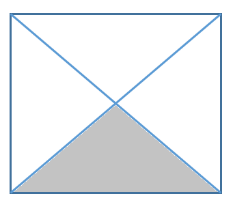
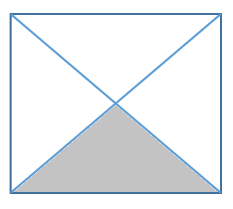
Now in this figure the square is divided in 4 equal parts and among them 1 is shaded.
Now the fraction it represents is given by $\dfrac{\text{number of shaded parts}}{\text{number of total parts}}$
Hence the shaded portion represents $\dfrac{1}{4}$
Now let us consider the second figure
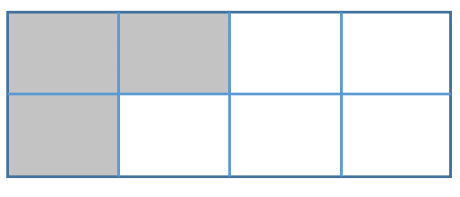
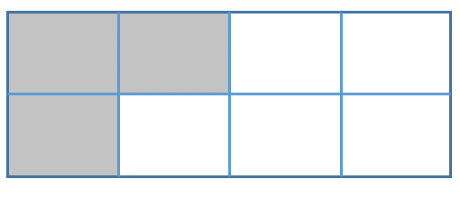
Now in this figure we have that the rectangle is divided in 8 equal parts and among them 3 parts are shaded.
Now the fraction it represents is given by $\dfrac{\text{number of shaded parts}}{\text{number of total parts}}$
Hence the shaded portion represents $\dfrac{3}{8}$
Now let us consider the third figure
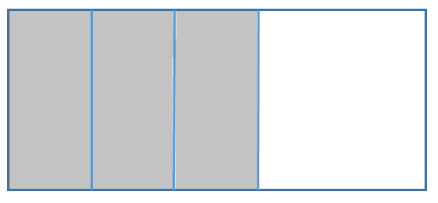
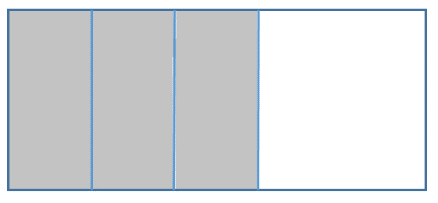
Now we can see that the rectangle is not divided into equal parts hence we cannot calculate the fraction it represents.
Now let us consider the next figure
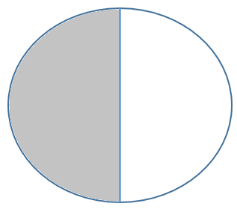
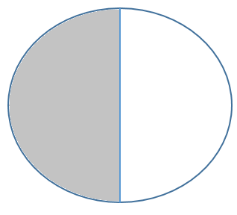
Now in this figure, we can see that the circle is divided in two equal parts and 1 part is shaded.
Now the fraction it represents is given by $\dfrac{\text{number of shaded parts}}{\text{number of total parts}}$
Hence the shaded portion represents $\dfrac{1}{2}$
Hence we have the fourth figure is the one which represents the fraction $\dfrac{1}{2}$ and hence $\dfrac{3}{6}$ .
Note:
Note that when checking the fraction the shaded portion represents we use the formula $\dfrac{\text{number of shaded parts}}{\text{number of total parts}}$ but before using this we must check if the figure is divided in equal parts if it is not divided in equal parts then we cannot use this formula.
Now we want to find out the shaded region which represents a fraction $\dfrac{3}{6}$ . First we will bring this fraction in the lowest form. Then we will check each figure, To find what fraction the shaded portion represents we will use the formula $\dfrac{\text{number of shaded parts}}{\text{total number of parts}}$ . Hence we can calculate the fraction for each figure.
Complete step by step answer:
Now first let us check the given fraction. The given fraction is $\dfrac{3}{6}$ . Now we want to convert the fraction in its lowest form. A fraction $\dfrac{p}{q}$ is said to be in lowest form when p and q are co-primes or such that they cannot divide each other and q not equal to 0.
Hence if we divide the numerator and denominator of given fraction $\dfrac{3}{6}$ by 3 we get $\dfrac{1}{2}$
Hence the lowest form of the given fraction is $\dfrac{1}{2}$
Now consider the first figure given
Now in this figure the square is divided in 4 equal parts and among them 1 is shaded.
Now the fraction it represents is given by $\dfrac{\text{number of shaded parts}}{\text{number of total parts}}$
Hence the shaded portion represents $\dfrac{1}{4}$
Now let us consider the second figure
Now in this figure we have that the rectangle is divided in 8 equal parts and among them 3 parts are shaded.
Now the fraction it represents is given by $\dfrac{\text{number of shaded parts}}{\text{number of total parts}}$
Hence the shaded portion represents $\dfrac{3}{8}$
Now let us consider the third figure
Now we can see that the rectangle is not divided into equal parts hence we cannot calculate the fraction it represents.
Now let us consider the next figure
Now in this figure, we can see that the circle is divided in two equal parts and 1 part is shaded.
Now the fraction it represents is given by $\dfrac{\text{number of shaded parts}}{\text{number of total parts}}$
Hence the shaded portion represents $\dfrac{1}{2}$
Hence we have the fourth figure is the one which represents the fraction $\dfrac{1}{2}$ and hence $\dfrac{3}{6}$ .
Note:
Note that when checking the fraction the shaded portion represents we use the formula $\dfrac{\text{number of shaded parts}}{\text{number of total parts}}$ but before using this we must check if the figure is divided in equal parts if it is not divided in equal parts then we cannot use this formula.
Recently Updated Pages
Master Class 11 English: Engaging Questions & Answers for Success

Master Class 11 Social Science: Engaging Questions & Answers for Success
Master Class 11 Maths: Engaging Questions & Answers for Success
Master Class 11 Biology: Engaging Questions & Answers for Success
Master Class 11 Physics: Engaging Questions & Answers for Success
Master Class 11 Chemistry: Engaging Questions & Answers for Success
Trending doubts
Explain the Treaty of Vienna of 1815 class 10 social science CBSE
What is the Total Duration of Football Match?
First Cotton Mill of India
In which year voting age was reduced from 21 to 18?
10 examples of evaporation in daily life with explanations
What planets have no moons Which one has only one moon class 10 physics CBSE