




Which match(es) is/ are not correct?
A. Spermatogonium - 46 chromosomes
B. Spermatid - 46 chromosomes
C. Sperm - 23 chromosomes
D. Secondary spermatocytes - 23 chromosomes
a. Only A
b. A,B,C
c. C and D
d. A,B,C,D
Answer
 Verified
529.8k+ views
Hint: Sperms are the male gametes that are produced by their primary sex organs named the testes. We know that sperms are produced by the process of gametogenesis. All the terms are related to the process of spermatogenesis that begins at puberty in males. It starts up in males usually from 10 to 16 years. Biologically males produce sperm in large quantities (around 200 million a day).
Complete answer:
Lets us firstly infer about the gametogenesis in the male:
In testis, the immature male germ cells produce sperms by spermatogenesis at puberty. The spermatogonia present on the sidewall of seminiferous tubules multiply by mitotic division and increase in number.
Each spermatogonium is diploid and contains 46 chromosomes. Some of the spermatogonia are called primary spermatocytes by the process of meiosis. A primary spermatocyte completes the first meiosis to form an equal number, haploid cells called secondary spermatocytes, to form 23 chromosomes.
The secondary spermatocytes undergo a second meiotic division to form 4 equal, haploid spermatids. The spermatids are transformed into spermatozoa by the process called spermiogenesis. The diagram below shows the process of formation of sperms.
After spermiogenesis, sperms head gets embedded into Sertoli cells and are finally released from the seminiferous tubules by the process of spermiation. We all know that spermatogonia are formed after spermatogenesis, at this time chromosomes number per cell is 46. After the first successive mitosis, it forms primary spermatocytes. In this, the first meiotic division takes place to form secondary spermatocytes which have 23 chromosomes. The second meiotic division form spermatids which are 23 chromosomes per cell. Successive division leads to the formation of spermatozoa or sperm which is 23 chromosomes.
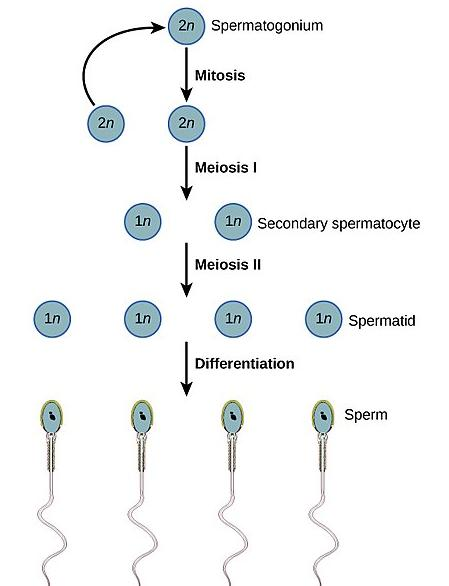
From the above information, we can infer option A, Only A is incorrect.
Note: Spermatogenesis starts at the age of puberty at which there is a significant increase in the secretion of gonadotropin-releasing hormone. The increased levels are GnRH then acts at the anterior pituitary glands and stimulates the secretion of two gonadotropin - luteinising hormones (LH) and follicle-stimulating hormones (FSH). LH acts at Leydig cells to synthesise androgens whereas FSH acts on Sertoli cells which secrete factors that help in the process of spermatogenesis.
Complete answer:
Lets us firstly infer about the gametogenesis in the male:
In testis, the immature male germ cells produce sperms by spermatogenesis at puberty. The spermatogonia present on the sidewall of seminiferous tubules multiply by mitotic division and increase in number.
Each spermatogonium is diploid and contains 46 chromosomes. Some of the spermatogonia are called primary spermatocytes by the process of meiosis. A primary spermatocyte completes the first meiosis to form an equal number, haploid cells called secondary spermatocytes, to form 23 chromosomes.
The secondary spermatocytes undergo a second meiotic division to form 4 equal, haploid spermatids. The spermatids are transformed into spermatozoa by the process called spermiogenesis. The diagram below shows the process of formation of sperms.
After spermiogenesis, sperms head gets embedded into Sertoli cells and are finally released from the seminiferous tubules by the process of spermiation. We all know that spermatogonia are formed after spermatogenesis, at this time chromosomes number per cell is 46. After the first successive mitosis, it forms primary spermatocytes. In this, the first meiotic division takes place to form secondary spermatocytes which have 23 chromosomes. The second meiotic division form spermatids which are 23 chromosomes per cell. Successive division leads to the formation of spermatozoa or sperm which is 23 chromosomes.
From the above information, we can infer option A, Only A is incorrect.
Note: Spermatogenesis starts at the age of puberty at which there is a significant increase in the secretion of gonadotropin-releasing hormone. The increased levels are GnRH then acts at the anterior pituitary glands and stimulates the secretion of two gonadotropin - luteinising hormones (LH) and follicle-stimulating hormones (FSH). LH acts at Leydig cells to synthesise androgens whereas FSH acts on Sertoli cells which secrete factors that help in the process of spermatogenesis.
Recently Updated Pages
Master Class 11 Social Science: Engaging Questions & Answers for Success

Master Class 11 Physics: Engaging Questions & Answers for Success
Master Class 11 Maths: Engaging Questions & Answers for Success
Master Class 11 Economics: Engaging Questions & Answers for Success
Master Class 11 Computer Science: Engaging Questions & Answers for Success
Master Class 11 Chemistry: Engaging Questions & Answers for Success
Trending doubts
One Metric ton is equal to kg A 10000 B 1000 C 100 class 11 physics CBSE
There are 720 permutations of the digits 1 2 3 4 5 class 11 maths CBSE
1 Quintal is equal to a 110 kg b 10 kg c 100kg d 1000 class 11 physics CBSE
State and prove Bernoullis theorem class 11 physics CBSE
Difference Between Prokaryotic Cells and Eukaryotic Cells
Which among the following are examples of coming together class 11 social science CBSE