




Which liquid can be dehydrated to produce ethene?
Answer
 Verified
526.2k+ views
Hint: Dehydration is the process of removal of water molecules. These are the reverse of the hydration reaction. This process generally occurs in the presence of strong acids or high temperatures. These fall under the category of Elimination Reaction where hydrogen is removed from one atom and hydroxyl from the other one.
Complete answer:
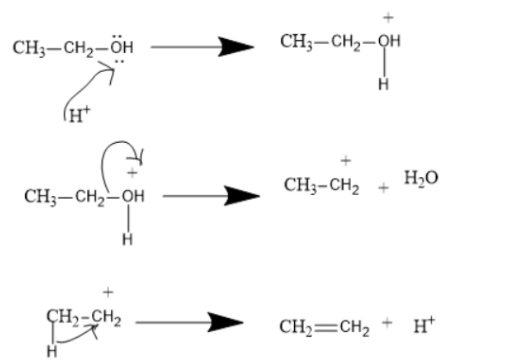
Ethyl Alcohol or Ethanol is dehydrated to produce Ethene or ethylene. There are some important characteristics regarding this particular reaction-
1. This reaction can take place in presence of strong acids like sulphuric acid or Phosphoric acid or in the presence of heat and a temperature not too high.(These catalysts reduce the Activation Energy required to convert reactant to product).
2. This Reaction is an Example of E2 Elimination. Ethyl alcohol is a primary alcohol so if it produces primary carbocation it will be very unstable (i.e. the E1 mechanism) and hence the loss of proton and that of water occurs at the same time in a single step reaction.
${C_2}{H_5}OH\xrightarrow{\Delta }{C_2}{H_4} + {H_2}O$

In this process the taking up of protons from the acid by oxygen of Alcohol and the removal of water molecules occurs in a single step, this is the most common way of elimination in ethanol.
However at some places the E1 reaction is also given however it is less favourable because the ethyl carbocation is very less stable.
Note:
In case of secondary and tertiary alcohol however we mostly prefer the E1 mechanism since the secondary and tertiary carbocation are very stable. Here the formation of carbocation is the rate determining step. These reactions are in more than one step. In some cases however dehydration produces Ether instead of producing alkene.
Complete answer:
Ethyl Alcohol or Ethanol is dehydrated to produce Ethene or ethylene. There are some important characteristics regarding this particular reaction-
1. This reaction can take place in presence of strong acids like sulphuric acid or Phosphoric acid or in the presence of heat and a temperature not too high.(These catalysts reduce the Activation Energy required to convert reactant to product).
2. This Reaction is an Example of E2 Elimination. Ethyl alcohol is a primary alcohol so if it produces primary carbocation it will be very unstable (i.e. the E1 mechanism) and hence the loss of proton and that of water occurs at the same time in a single step reaction.
${C_2}{H_5}OH\xrightarrow{\Delta }{C_2}{H_4} + {H_2}O$
In this process the taking up of protons from the acid by oxygen of Alcohol and the removal of water molecules occurs in a single step, this is the most common way of elimination in ethanol.
However at some places the E1 reaction is also given however it is less favourable because the ethyl carbocation is very less stable.
Note:
In case of secondary and tertiary alcohol however we mostly prefer the E1 mechanism since the secondary and tertiary carbocation are very stable. Here the formation of carbocation is the rate determining step. These reactions are in more than one step. In some cases however dehydration produces Ether instead of producing alkene.
Recently Updated Pages
Three beakers labelled as A B and C each containing 25 mL of water were taken A small amount of NaOH anhydrous CuSO4 and NaCl were added to the beakers A B and C respectively It was observed that there was an increase in the temperature of the solutions contained in beakers A and B whereas in case of beaker C the temperature of the solution falls Which one of the following statements isarecorrect i In beakers A and B exothermic process has occurred ii In beakers A and B endothermic process has occurred iii In beaker C exothermic process has occurred iv In beaker C endothermic process has occurred

Master Class 11 Social Science: Engaging Questions & Answers for Success
Master Class 11 Physics: Engaging Questions & Answers for Success
Master Class 11 Maths: Engaging Questions & Answers for Success
Master Class 11 Economics: Engaging Questions & Answers for Success
Master Class 11 Computer Science: Engaging Questions & Answers for Success
Three beakers labelled as A B and C each containing 25 mL of water were taken A small amount of NaOH anhydrous CuSO4 and NaCl were added to the beakers A B and C respectively It was observed that there was an increase in the temperature of the solutions contained in beakers A and B whereas in case of beaker C the temperature of the solution falls Which one of the following statements isarecorrect i In beakers A and B exothermic process has occurred ii In beakers A and B endothermic process has occurred iii In beaker C exothermic process has occurred iv In beaker C endothermic process has occurred
Master Class 11 Social Science: Engaging Questions & Answers for Success
Master Class 11 Physics: Engaging Questions & Answers for Success
Trending doubts
One Metric ton is equal to kg A 10000 B 1000 C 100 class 11 physics CBSE
There are 720 permutations of the digits 1 2 3 4 5 class 11 maths CBSE
State and prove Bernoullis theorem class 11 physics CBSE
Draw a diagram of a plant cell and label at least eight class 11 biology CBSE
Difference Between Prokaryotic Cells and Eukaryotic Cells
1 Quintal is equal to a 110 kg b 10 kg c 100kg d 1000 class 11 physics CBSE