



Which kind of plastid is more common in the leaves of the plant?
Answer
 Verified
570k+ views
Hint: They are the sites of photosynthesis and are present in photosynthetic plants, algae, and cyanobacteria. They also help in the functioning of various processes that include amino acid synthesis, fatty acid synthesis, and the immune response.
Complete answer:
The more common plastid in the leaves of the plant is the chlorophyll where the photosynthesis occurs. An organelle surrounded by a double membrane, free-moving, and a third thinner membrane that folds inwards, known as the thylakoid membrane. The green pigments, Chlorophylls are present in the thylakoid membrane that absorbs red and blue light from the sun and reflects green light present in photosynthetic organisms such as plants.
These chloroplasts are located in the mesophyll cells of plant leaves. They are plano-convex or bi-convex shaped in higher plants. Chloroplast is a double-membrane structure consisting of an inner and outer membrane with intercellular space between them. They allow the materials to pass through them. The chloroplast consists of two parts, Grana and stroma. Inside stroma, Grana is embedded in the form of a disc-like, while on the other hand a matrix is found in the chloroplast which is jelly-like, and colorless. Photosynthesis is the mechanism by which light energy is converted into chemical energy, resulting in the creation of organic compounds rich in oxygen and energy.
Chlorophyll a and b are the two of its important pigments. The chloroplasts varied in shape and structure depending upon the type of organisms in which they are found.
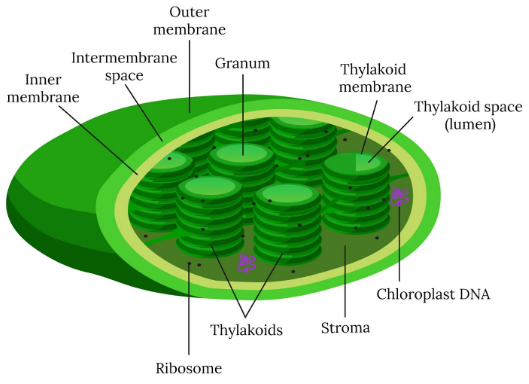
Chloroplast
Note:
Chloroplast has its DNA, also known as the plastome when referring to genomes of other plastids. They are found in algae as well as green plants and contain their own DNA and ribosomes that can produce their own proteins. In 1837 Hugo von Mohl first introduced the chloroplast while in 1884 Eduard Strasburger was introduced first.
Complete answer:
The more common plastid in the leaves of the plant is the chlorophyll where the photosynthesis occurs. An organelle surrounded by a double membrane, free-moving, and a third thinner membrane that folds inwards, known as the thylakoid membrane. The green pigments, Chlorophylls are present in the thylakoid membrane that absorbs red and blue light from the sun and reflects green light present in photosynthetic organisms such as plants.
These chloroplasts are located in the mesophyll cells of plant leaves. They are plano-convex or bi-convex shaped in higher plants. Chloroplast is a double-membrane structure consisting of an inner and outer membrane with intercellular space between them. They allow the materials to pass through them. The chloroplast consists of two parts, Grana and stroma. Inside stroma, Grana is embedded in the form of a disc-like, while on the other hand a matrix is found in the chloroplast which is jelly-like, and colorless. Photosynthesis is the mechanism by which light energy is converted into chemical energy, resulting in the creation of organic compounds rich in oxygen and energy.
Chlorophyll a and b are the two of its important pigments. The chloroplasts varied in shape and structure depending upon the type of organisms in which they are found.
Chloroplast
Note:
Chloroplast has its DNA, also known as the plastome when referring to genomes of other plastids. They are found in algae as well as green plants and contain their own DNA and ribosomes that can produce their own proteins. In 1837 Hugo von Mohl first introduced the chloroplast while in 1884 Eduard Strasburger was introduced first.
Recently Updated Pages
Master Class 11 English: Engaging Questions & Answers for Success

Master Class 11 Social Science: Engaging Questions & Answers for Success
Master Class 11 Maths: Engaging Questions & Answers for Success
Master Class 11 Biology: Engaging Questions & Answers for Success
Master Class 11 Physics: Engaging Questions & Answers for Success
Master Class 11 Chemistry: Engaging Questions & Answers for Success
Trending doubts