




Which is/are correct representations of boranes?
A. ${B_n}{H_{n + 4}}$
B. ${B_n}{H_{n + 6}}$
C. ${B_n}{H_{2n + 2}}$
D.None of these
Answer
 Verified
579.3k+ views
Hint: Boranes is basically the name given to the class of synthetic hydrides of boron. These were often labelled as electron deficient because of their multicenter bonding. Usually they have a generic formula ${B_X}{H_Y}$ .
Complete step by step answer:
Basically, the hydrides of boron are known as boranes. They are further classified as closo, nido, hypo and conjunto boranes. The key difference between closo, and nido boranes is that in closo structure, it has $n + 1$ skeletal bonding electron pairs whereas in case of nido structure there is $n + 2$ skeletal bonding electron pairs. They are non-classically bonded compounds i.e. there are not enough electrons to form two center, two electron bonds between all pairs of adjacent atoms in the molecule. The boron hydrides were first systematically synthesized and characterized during the period 1912 to 1973 by the German chemist Alfred Stock.
Now, the boranes that were prepared by stock had the general formula ${B_n}{H_{n + 4}}$ and ${B_n}{H_{n + 6}}$ . The hydrides of boron are more numerous than those of any other element except carbon. The simplest isolable borane is diborane i.e. ${B_2}{H_6}$ . It is one of the most extensively studied and most synthetically useful chemical intermediates. This substance is highly unstable at room temperature with a sweet odor. The structures of borane and diborane are as shown:
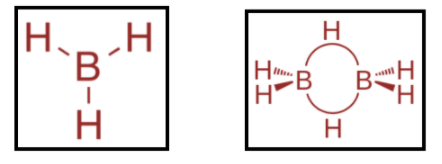
Hence, option A and option B, both are correct.
Note: Boranes have been widely studied as potential fuel for rockets and for automotive uses. They further act as ligands in the coordination compounds. They also find their applications in medicine, materials and thin films.
Complete step by step answer:
Basically, the hydrides of boron are known as boranes. They are further classified as closo, nido, hypo and conjunto boranes. The key difference between closo, and nido boranes is that in closo structure, it has $n + 1$ skeletal bonding electron pairs whereas in case of nido structure there is $n + 2$ skeletal bonding electron pairs. They are non-classically bonded compounds i.e. there are not enough electrons to form two center, two electron bonds between all pairs of adjacent atoms in the molecule. The boron hydrides were first systematically synthesized and characterized during the period 1912 to 1973 by the German chemist Alfred Stock.
Now, the boranes that were prepared by stock had the general formula ${B_n}{H_{n + 4}}$ and ${B_n}{H_{n + 6}}$ . The hydrides of boron are more numerous than those of any other element except carbon. The simplest isolable borane is diborane i.e. ${B_2}{H_6}$ . It is one of the most extensively studied and most synthetically useful chemical intermediates. This substance is highly unstable at room temperature with a sweet odor. The structures of borane and diborane are as shown:
Hence, option A and option B, both are correct.
Note: Boranes have been widely studied as potential fuel for rockets and for automotive uses. They further act as ligands in the coordination compounds. They also find their applications in medicine, materials and thin films.
Recently Updated Pages
Master Class 11 English: Engaging Questions & Answers for Success

Master Class 11 Maths: Engaging Questions & Answers for Success
Master Class 11 Biology: Engaging Questions & Answers for Success
Master Class 11 Physics: Engaging Questions & Answers for Success
Master Class 11 Accountancy: Engaging Questions & Answers for Success
Class 11 Question and Answer - Your Ultimate Solutions Guide
Trending doubts
One Metric ton is equal to kg A 10000 B 1000 C 100 class 11 physics CBSE
Discuss the various forms of bacteria class 11 biology CBSE
Draw a diagram of a plant cell and label at least eight class 11 biology CBSE
State the laws of reflection of light
Explain zero factorial class 11 maths CBSE
10 examples of friction in our daily life