




Which is true for the ideal voltage source?
A) Its voltage is regular
B) Its resistance is maximum
C) Its internal resistance is zero
D) All the above.
Answer
 Verified
598.2k+ views
Hint: A device that is connected in parallel to find the volt is known as a voltage source. Remember always that for an ideal voltage source the internal resistance must be infinite.
Complete step by step answer:
A voltage source should always be connected in parallel in the circuit because it measures the potential difference at the two terminals. The internal resistance of an ideal voltmeter is zero. Its voltage is not regular; it varies with the load resistance.
Thus correct option is (C).
The potential difference across the ends of the voltmeter is given by,
$V = {i_g}({R_g} + R)$
Where, $R$ is the resistance which is connected in series, ${R_g}$ is the resistance of the galvanometer, ${i_g}$is the current flowing through the galvanometer. A galvanometer is converted into a voltmeter by connecting high resistance in series to it.
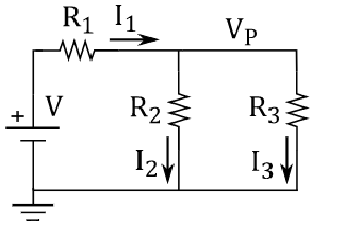
Consider the given diagram here the voltage source is connected in the parallel along with three resistors. The voltage source actually has two terminals. One terminal is positive, another terminal is negative.
Additional information:
The resistance of a conductor is defined as the ratio of the potential difference applied across its ends to the resulting current through the conductor. Resistance is the opposition offered by the substance to the flow of electric current. This opposition occurs because atoms or molecules of the substance obstruct the flow of charge carriers that are free electrons.
According to Ohm's law, the current flowing through a conductor is directly proportional to the potential difference across its ends provided the physical conditions like temperature, strain remain the same. Mathematically it can be represented as:
$V = IR$
Where $V$ is the voltage, $I$ is current, $R$is the resistance.
The resistance of a conductor depends on length, area of cross-section of the conductor, nature of the materials, and temperature.
Note:
Resistance of a voltmeter is very high and that of an ideal voltmeter is infinity.
The current drawn by an ideal voltmeter is zero.
Among low range and high range voltmeters, high range voltmeters will always have more resistance.
Complete step by step answer:
A voltage source should always be connected in parallel in the circuit because it measures the potential difference at the two terminals. The internal resistance of an ideal voltmeter is zero. Its voltage is not regular; it varies with the load resistance.
Thus correct option is (C).
The potential difference across the ends of the voltmeter is given by,
$V = {i_g}({R_g} + R)$
Where, $R$ is the resistance which is connected in series, ${R_g}$ is the resistance of the galvanometer, ${i_g}$is the current flowing through the galvanometer. A galvanometer is converted into a voltmeter by connecting high resistance in series to it.
Consider the given diagram here the voltage source is connected in the parallel along with three resistors. The voltage source actually has two terminals. One terminal is positive, another terminal is negative.
Additional information:
The resistance of a conductor is defined as the ratio of the potential difference applied across its ends to the resulting current through the conductor. Resistance is the opposition offered by the substance to the flow of electric current. This opposition occurs because atoms or molecules of the substance obstruct the flow of charge carriers that are free electrons.
According to Ohm's law, the current flowing through a conductor is directly proportional to the potential difference across its ends provided the physical conditions like temperature, strain remain the same. Mathematically it can be represented as:
$V = IR$
Where $V$ is the voltage, $I$ is current, $R$is the resistance.
The resistance of a conductor depends on length, area of cross-section of the conductor, nature of the materials, and temperature.
Note:
Resistance of a voltmeter is very high and that of an ideal voltmeter is infinity.
The current drawn by an ideal voltmeter is zero.
Among low range and high range voltmeters, high range voltmeters will always have more resistance.
Recently Updated Pages
Master Class 12 Social Science: Engaging Questions & Answers for Success

Master Class 12 Physics: Engaging Questions & Answers for Success
Master Class 12 Maths: Engaging Questions & Answers for Success
Master Class 12 Economics: Engaging Questions & Answers for Success
Master Class 12 Chemistry: Engaging Questions & Answers for Success
Master Class 12 Business Studies: Engaging Questions & Answers for Success
Trending doubts
Which are the Top 10 Largest Countries of the World?
Draw a labelled sketch of the human eye class 12 physics CBSE
Explain the structure of megasporangium class 12 biology CBSE
What are the major means of transport Explain each class 12 social science CBSE
How many chromosomes are found in human ovum a 46 b class 12 biology CBSE
The diagram of the section of a maize grain is given class 12 biology CBSE