




Which is the strongest base?
(A)- Pyrrole
(B)- Aniline
(C)- Pyridine
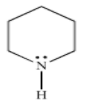
(D)-
Answer
 Verified
589.9k+ views
Hint: A compound is a base which can easily donate its electrons to the proton forming a conjugate acid. The value of the $p{{K}_{a}}$of this conjugate acid can determine the strength of basicity of its base.
Complete step by step answer:
In the given compounds, the nitrogen atom has a lone pair of electrons which makes these compounds basic in nature and the order of their basicity can be done on the basis of the ease to share these lone pair of electrons with ${{H}^{+}}$ ions and thus, stability of its conjugate acid formed.
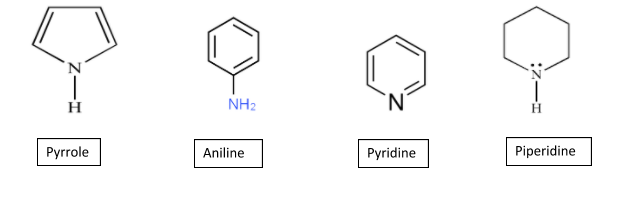
In case of a pyrrole molecule, the lone pair of electrons on the nitrogen atom is in delocalisation with the aromatic ring. So, when it shares these electrons with the proton, it distorts the aromaticity in the ring making it unstable and unfavourable. Thus, have the least tendency to donate its electron pair to the proton.
Whereas, in case of aniline and pyridine molecules, the lone pair on the nitrogen atom are present in the $s{{p}^{2}}$ hybrid orbital of the nitrogen atom due to the $C=N$ bond. So, it does not take part in the delocalisation within the aromatic ring and can easily share its lone pair. But due the presence of the lone pairs in the $s{{p}^{2}}$ orbitals which are strongly attracted to the nucleus make the sharing a little less easy. Thus, slightly basic in nature.
But in the piperidine molecule, these lone pairs are present in the $s{{p}^{3}}$ orbitals of the nitrogen, that is, secondary amine and there is no resonance in the ring. This makes it easy for the nitrogen to share its electrons and is highly basic.
Therefore, the strongest base is option (D)- piperidine.
Note: The stronger base has the highest value of $p{{K}_{a}}$ ,of its conjugate acid which is formed after the base donates its electron to proton.
The order of basicity in the given compounds is:
Piperidine > Aniline > Pyridine > Pyrrole
Complete step by step answer:
In the given compounds, the nitrogen atom has a lone pair of electrons which makes these compounds basic in nature and the order of their basicity can be done on the basis of the ease to share these lone pair of electrons with ${{H}^{+}}$ ions and thus, stability of its conjugate acid formed.
In case of a pyrrole molecule, the lone pair of electrons on the nitrogen atom is in delocalisation with the aromatic ring. So, when it shares these electrons with the proton, it distorts the aromaticity in the ring making it unstable and unfavourable. Thus, have the least tendency to donate its electron pair to the proton.
Whereas, in case of aniline and pyridine molecules, the lone pair on the nitrogen atom are present in the $s{{p}^{2}}$ hybrid orbital of the nitrogen atom due to the $C=N$ bond. So, it does not take part in the delocalisation within the aromatic ring and can easily share its lone pair. But due the presence of the lone pairs in the $s{{p}^{2}}$ orbitals which are strongly attracted to the nucleus make the sharing a little less easy. Thus, slightly basic in nature.
But in the piperidine molecule, these lone pairs are present in the $s{{p}^{3}}$ orbitals of the nitrogen, that is, secondary amine and there is no resonance in the ring. This makes it easy for the nitrogen to share its electrons and is highly basic.
Therefore, the strongest base is option (D)- piperidine.
Note: The stronger base has the highest value of $p{{K}_{a}}$ ,of its conjugate acid which is formed after the base donates its electron to proton.
The order of basicity in the given compounds is:
Piperidine > Aniline > Pyridine > Pyrrole
Recently Updated Pages
Draw ray diagrams each showing i myopic eye and ii class 12 physics CBSE

Which of the following graphs shows the variation of class 12 physics CBSE
Draw a labelled diagram of the human male reproductive class 12 biology CBSE
Describe the experiment to compare the emf of two cells class 12 physics CBSE
What is standard hydrogen electrode
What is conventional current and electric current class 12 physics CBSE
Trending doubts
A member of Simon commission later became Prime Minister class 12 social science CBSE
Give one example of a reptile that is viviparous class 12 biology CBSE
What is the Full Form of PVC, PET, HDPE, LDPE, PP and PS ?
Suicide bags of cells are aEndoplasmic reticulum bLysosome class 12 biology CBSE
The first microscope was invented by A Leeuwenhoek class 12 biology CBSE
What is a transformer Explain the principle construction class 12 physics CBSE