




Which is the primary ${\text{C}}{{\text{O}}_{\text{2}}}$ acceptor for ${\text{C3}}$plant and ${\text{C4}}$plant?
Answer
 Verified
637.8k+ views
Hint: The first organic compound produced in ${\text{C3}}$plants is a three-carbon compound while in the case of ${\text{C4}}$plants it is a four-carbon compound and due to this reason they differ from one another.
Complete answer:
${\text{C3}}$Plants: These plants are defined as the plants that show the ${\text{C3}}$ pathway. These plants utilize the Calvin cycle in the dark reaction of photosynthesis. ${\text{C3}}$plants don’t lose the water so they keep their stomata open for a longer time during the day. These plants intake carbon dioxide through minute pores present on the surface of leaves called stomata. Their leaves do not show kranz anatomy which is one of the features of ${\text{C4}}$plant.
Diagram showing the Calvin cycle:
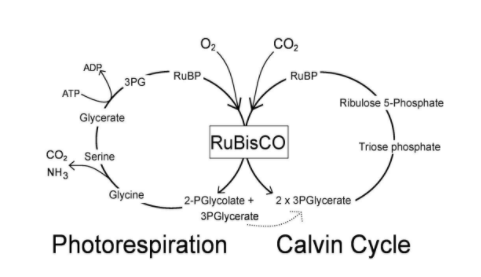
The primary ${\text{C}}{{\text{O}}_{\text{2}}}$ acceptor for ${\text{C3}}$ plants is RuBisCO (Ribulose-${\text{1}}$,${\text{5}}$-bisphosphate carboxylase/oxygenase) this enzyme catalyzes the entry of carbon dioxide into the photosynthetic metabolism and it is found in the chloroplast that plays a vital role during the Calvin cycle. Examples of ${\text{C3}}$plants are eucalyptus, sunflower, etc.
${\text{C4}}$Plants: These plants are defined as the plants that utilize the ${\text{C4}}$ pathway or Hatch-slack pathway at the time of dark reaction. They use ${\text{C4}}$ photosynthesis to avoid photorespiration. These types of plants are best suited for hot, dry climates and they produce more energy than the ${\text{C3}}$ plants. Leaves of these plants show kranz anatomy is a specialized structure present in${\text{C4}}$where the mesophyll cells are clustered around the bundle-sheath cells in a ring-like pattern.
Diagram showing ${\text{C4}}$pathway:
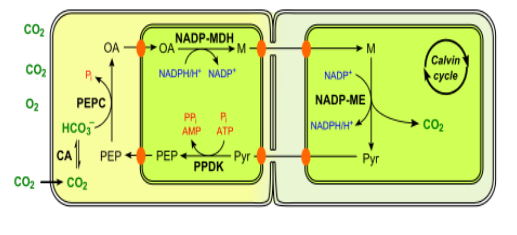
The primary ${\text{C}}{{\text{O}}_{\text{2}}}$ acceptor for${\text{C4}}$plants is PEP (Phosphoenolpyruvate) and it is located in the mesophyll cells and an essential enzyme in ${\text{C4}}$plants. Examples of ${\text{C4}}$plants are crops of maize, millets, etc.
Note: Carbon fixation in ${\text{C3}}$plants takes place only at a single place i.e. only one chloroplast is involved while in ${\text{C4}}$plants it takes place twice first in the mesophyll cells and second in the bundle-sheath cells i.e. two chloroplasts are involved.
Complete answer:
${\text{C3}}$Plants: These plants are defined as the plants that show the ${\text{C3}}$ pathway. These plants utilize the Calvin cycle in the dark reaction of photosynthesis. ${\text{C3}}$plants don’t lose the water so they keep their stomata open for a longer time during the day. These plants intake carbon dioxide through minute pores present on the surface of leaves called stomata. Their leaves do not show kranz anatomy which is one of the features of ${\text{C4}}$plant.
Diagram showing the Calvin cycle:
The primary ${\text{C}}{{\text{O}}_{\text{2}}}$ acceptor for ${\text{C3}}$ plants is RuBisCO (Ribulose-${\text{1}}$,${\text{5}}$-bisphosphate carboxylase/oxygenase) this enzyme catalyzes the entry of carbon dioxide into the photosynthetic metabolism and it is found in the chloroplast that plays a vital role during the Calvin cycle. Examples of ${\text{C3}}$plants are eucalyptus, sunflower, etc.
${\text{C4}}$Plants: These plants are defined as the plants that utilize the ${\text{C4}}$ pathway or Hatch-slack pathway at the time of dark reaction. They use ${\text{C4}}$ photosynthesis to avoid photorespiration. These types of plants are best suited for hot, dry climates and they produce more energy than the ${\text{C3}}$ plants. Leaves of these plants show kranz anatomy is a specialized structure present in${\text{C4}}$where the mesophyll cells are clustered around the bundle-sheath cells in a ring-like pattern.
Diagram showing ${\text{C4}}$pathway:
The primary ${\text{C}}{{\text{O}}_{\text{2}}}$ acceptor for${\text{C4}}$plants is PEP (Phosphoenolpyruvate) and it is located in the mesophyll cells and an essential enzyme in ${\text{C4}}$plants. Examples of ${\text{C4}}$plants are crops of maize, millets, etc.
Note: Carbon fixation in ${\text{C3}}$plants takes place only at a single place i.e. only one chloroplast is involved while in ${\text{C4}}$plants it takes place twice first in the mesophyll cells and second in the bundle-sheath cells i.e. two chloroplasts are involved.
Recently Updated Pages
If x a + bt + ct2 where x is in meters and t is in class 11 physics CBSE

A car covers the first half distance between two places class 11 physics CBSE
The resultant of two vectors overrightarrow P and overrightarrow class 11 physics CBSE
Find the value of cos 135 class 11 maths CBSE
A mass M is held in place by an applied force F and class 11 physics CBSE
A solution of glucose in water is labelled as 10 dfracwv class 11 chemistry CBSE
Trending doubts
One Metric ton is equal to kg A 10000 B 1000 C 100 class 11 physics CBSE
Find the value of the expression given below sin 30circ class 11 maths CBSE
What do you mean by retardation What is its SI uni class 11 physics CBSE
Draw a diagram of nephron and explain its structur class 11 biology CBSE
10 examples of friction in our daily life
Difference between physical and chemical change class 11 chemistry CBSE