




Which is the latest model proposed to explain the structure of plasma membrane?
A. Fluid Mosaic model
B. Molecular model
C. Unit membrane model
D. None of the above
Answer
 Verified
603.9k+ views
Hint: Each cell of our body is encased in a small bubble of membrane called the plasma membrane. Before the emergence of electron microscopy in the 1950s, scientists did not know about the structure of a cell membrane and its components. To identify membranes before they could actually be visualized, researchers and biologists used indirect evidence. Specifically, it was through the models of Langmuir, Gorter, Overton, Grendel, and Davson and Danielli, that it was deduced that these membranes have proteins, lipids and a bilayer. The advent of the electron microscope contributed to the development of the modern membrane model.
Complete answer:
The model which is currently accepted for the structure of the plasma membrane is the fluid mosaic model, and it was first proposed in 1972. It has evolved over time, but still provides a good basic description of the behavior and structure of membranes in many cells.
According to this model, plasma membrane is a mosaic of components: proteins, cholesterol, and phospholipids, that move fluidly and freely in the plane of the membrane.
The diagram of the membrane below is a snapshot of the dynamic process in which proteins and phospholipids are continually sliding past one another.
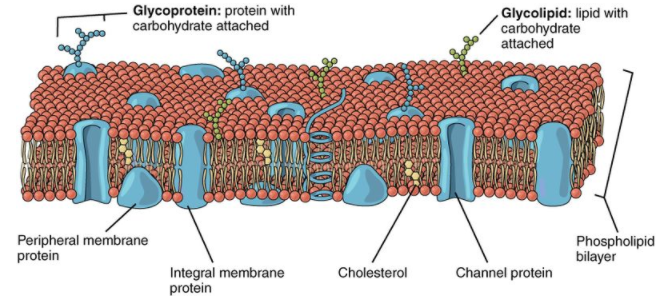
The fluidity means that, if we insert a fine needle into a cell, its membrane will simply part to flow around that needle. Once the needle is removed, the membrane will again flow back together seamlessly.
The principal components of the plasma membrane are proteins, lipids (cholesterol and phospholipids), and carbohydrate groups which are attached to some of the proteins and lipids.
-A phospholipid is a lipid made of two fatty acid tails, glycerol and a phosphate-linked head group. Usually, biological membranes involve two layers of phospholipids with their tails pointing inwards; the arrangement is called a phospholipid bilayer.
-Cholesterol, which is another lipid, composed of four fused carbon rings, and it is found alongside the phospholipids in the core of the membrane.
-Membrane proteins may extend partially into the plasma membrane, cross the membrane entirely, or be loosely attached to its outside or inside face.
-Carbohydrate groups are attached to the proteins forming lipids, glycoproteins, or glycolipids, and are present only on the outer surface of the membrane.
Hence, the correct answer is option (A).
Note: The proportions of lipids, carbohydrates and proteins in the plasma membrane vary between various types of cells. For a typical human cell, proteins account for about 50% of the composition by mass, lipids (of all types) account for about 40% and the remaining 10% comes from carbohydrates.
Complete answer:
The model which is currently accepted for the structure of the plasma membrane is the fluid mosaic model, and it was first proposed in 1972. It has evolved over time, but still provides a good basic description of the behavior and structure of membranes in many cells.
According to this model, plasma membrane is a mosaic of components: proteins, cholesterol, and phospholipids, that move fluidly and freely in the plane of the membrane.
The diagram of the membrane below is a snapshot of the dynamic process in which proteins and phospholipids are continually sliding past one another.
The fluidity means that, if we insert a fine needle into a cell, its membrane will simply part to flow around that needle. Once the needle is removed, the membrane will again flow back together seamlessly.
The principal components of the plasma membrane are proteins, lipids (cholesterol and phospholipids), and carbohydrate groups which are attached to some of the proteins and lipids.
-A phospholipid is a lipid made of two fatty acid tails, glycerol and a phosphate-linked head group. Usually, biological membranes involve two layers of phospholipids with their tails pointing inwards; the arrangement is called a phospholipid bilayer.
-Cholesterol, which is another lipid, composed of four fused carbon rings, and it is found alongside the phospholipids in the core of the membrane.
-Membrane proteins may extend partially into the plasma membrane, cross the membrane entirely, or be loosely attached to its outside or inside face.
-Carbohydrate groups are attached to the proteins forming lipids, glycoproteins, or glycolipids, and are present only on the outer surface of the membrane.
Hence, the correct answer is option (A).
Note: The proportions of lipids, carbohydrates and proteins in the plasma membrane vary between various types of cells. For a typical human cell, proteins account for about 50% of the composition by mass, lipids (of all types) account for about 40% and the remaining 10% comes from carbohydrates.
Recently Updated Pages
Master Class 11 English: Engaging Questions & Answers for Success

Master Class 11 Social Science: Engaging Questions & Answers for Success
Master Class 11 Maths: Engaging Questions & Answers for Success
Master Class 11 Biology: Engaging Questions & Answers for Success
Master Class 11 Physics: Engaging Questions & Answers for Success
Master Class 11 Chemistry: Engaging Questions & Answers for Success
Trending doubts
One Metric ton is equal to kg A 10000 B 1000 C 100 class 11 physics CBSE
Difference Between Prokaryotic Cells and Eukaryotic Cells
Two of the body parts which do not appear in MRI are class 11 biology CBSE
Find the value of the expression given below sin 30circ class 11 maths CBSE
Draw a diagram of a plant cell and label at least eight class 11 biology CBSE
10 examples of friction in our daily life