




Which is the last electron acceptor in cyclic photophosphorylation?
a. Plastoquinone
b. Plastocyanin
c. Reaction center of PS1
d. None of the above
Answer
 Verified
549k+ views
Hint: Cyclic photophosphorylation is a cyclical process leading to the moment of electrons. On the thylakoid membrane surface to the stromal side, PS1 is present. The first donor of electrons is water and oxygen as a waste product is produced in oxygen photosynthesis. Different electron donors are used in anoxygenic photosynthesis.
Complete answer:
The electrons are released if the PS1 molecule is excited. The electrons are collected from the substratum FRS by ferredoxin. Due to the lack of NADP + ferredoxin electrons, they are reversed to PS1 molecules through a carrier of electrons, cytochrome b6, cytochrome f, and plastocyanin. These electron carriers make downhill transfers from FRS to PS1 easier. The phosphorylation 1 between the ferredoxin and cytochrome b6 takes place during these electrons transfer 2 and the other 1 takes place between cytochrome b6 and cytochrome f. In this cycle, there are therefore 2 ATP molecules generated.
Light energy is consumed by proteins containing pigments, such as chlorophyll, in the two photosystems. Light-dependent reactions kick off Photosystem II. When a molecule's chlorophyll absorbs a photon in the reaction center, an electron in that molecule gains energy. Because of an electron's highly volatile state, it is transferred from one molecule to another, resulting in a redox reaction chain known as an electron transport chain (ETC). The electron flow is between PSII, Cytochrome b6f, and PSI. The electron in PSI receives energy from other photons. NADP is the ultimate electron acceptor. Water is the first electron donor in oxygenic photosynthetic reactions.
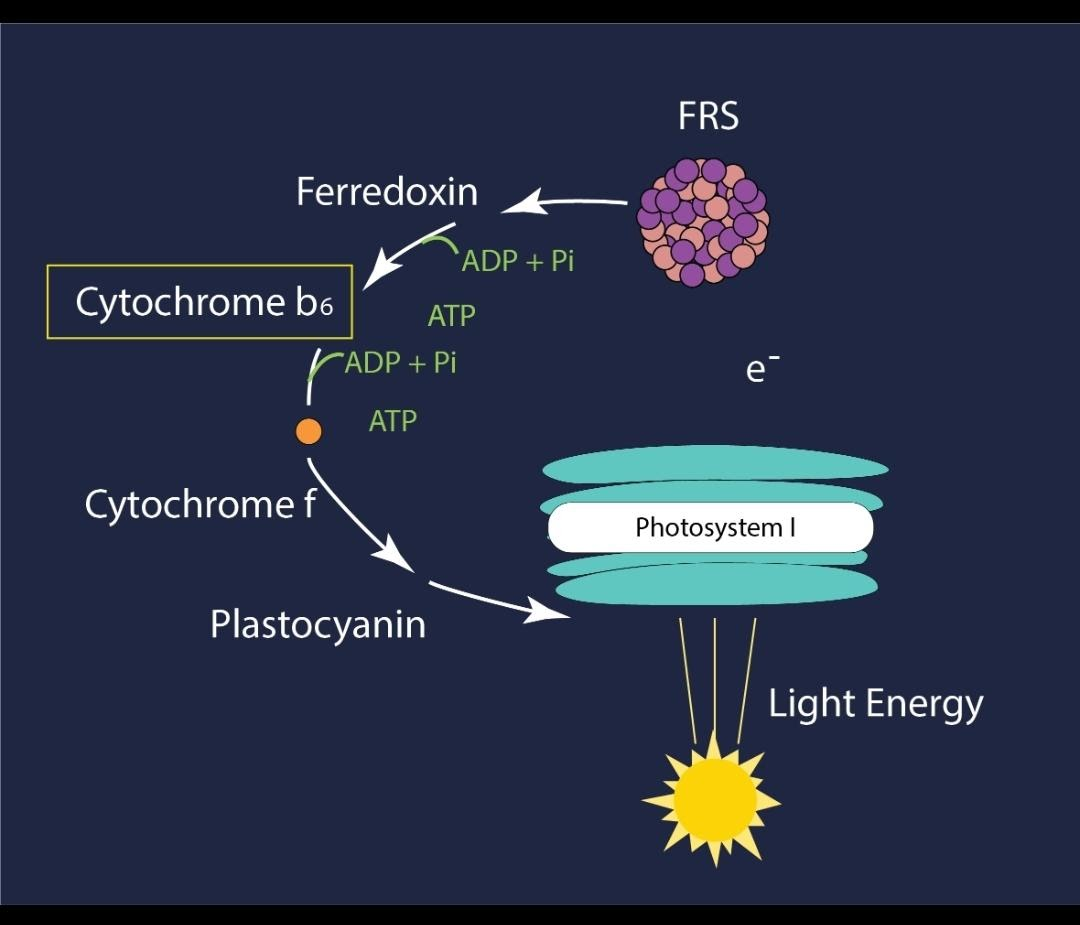
Hence, the correct answer is the option(C) reaction center of PS1.
Note:
PS1 is only functional when electrons from P700 (PS1) pass via ferredoxin but do not migrate to NADP, instead returning to chlorophyll a, the reaction center of PS1, through the cytochrome b6 f complex and plastocyanin.
It happens when PII isn't working properly.
Complete answer:
The electrons are released if the PS1 molecule is excited. The electrons are collected from the substratum FRS by ferredoxin. Due to the lack of NADP + ferredoxin electrons, they are reversed to PS1 molecules through a carrier of electrons, cytochrome b6, cytochrome f, and plastocyanin. These electron carriers make downhill transfers from FRS to PS1 easier. The phosphorylation 1 between the ferredoxin and cytochrome b6 takes place during these electrons transfer 2 and the other 1 takes place between cytochrome b6 and cytochrome f. In this cycle, there are therefore 2 ATP molecules generated.
Light energy is consumed by proteins containing pigments, such as chlorophyll, in the two photosystems. Light-dependent reactions kick off Photosystem II. When a molecule's chlorophyll absorbs a photon in the reaction center, an electron in that molecule gains energy. Because of an electron's highly volatile state, it is transferred from one molecule to another, resulting in a redox reaction chain known as an electron transport chain (ETC). The electron flow is between PSII, Cytochrome b6f, and PSI. The electron in PSI receives energy from other photons. NADP is the ultimate electron acceptor. Water is the first electron donor in oxygenic photosynthetic reactions.
Hence, the correct answer is the option(C) reaction center of PS1.
Note:
PS1 is only functional when electrons from P700 (PS1) pass via ferredoxin but do not migrate to NADP, instead returning to chlorophyll a, the reaction center of PS1, through the cytochrome b6 f complex and plastocyanin.
It happens when PII isn't working properly.
Recently Updated Pages
Master Class 11 English: Engaging Questions & Answers for Success

Master Class 11 Social Science: Engaging Questions & Answers for Success
Master Class 11 Maths: Engaging Questions & Answers for Success
Master Class 11 Biology: Engaging Questions & Answers for Success
Master Class 11 Physics: Engaging Questions & Answers for Success
Master Class 11 Chemistry: Engaging Questions & Answers for Success
Trending doubts
One Metric ton is equal to kg A 10000 B 1000 C 100 class 11 physics CBSE
Difference Between Prokaryotic Cells and Eukaryotic Cells
Find the value of the expression given below sin 30circ class 11 maths CBSE
Two of the body parts which do not appear in MRI are class 11 biology CBSE
Draw a diagram of a plant cell and label at least eight class 11 biology CBSE
10 examples of friction in our daily life