




Which is the largest endocrine organ?
A. Thyroid
B. Pancreas
C. Liver
D. Pituitary
Answer
 Verified
653.4k+ views
Hint: The largest endocrine gland is placed just under Adam’s apple. Intake of iodized salt is essential for its proper growth and development.
Complete answer
Endocrine glands are the set of secretory organs that release their secretions directly into the blood. They are devoid of any ductal system. The Thyroid gland is the largest endocrine gland weighing approximately 25grams. The dimension of the gland can be written as 5 x 3 x 2 cm and is larger in females than males.
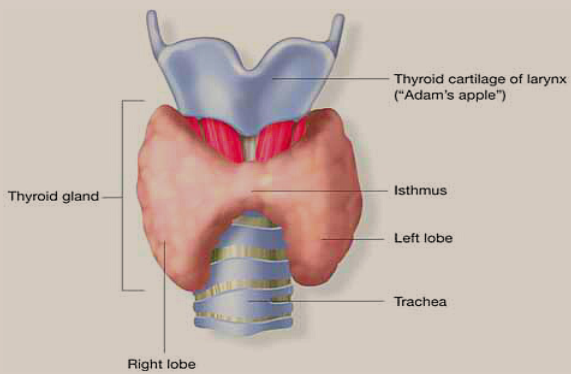
The thyroid gland is a butterfly-shaped bilobed organ situated at the front of the neck just below the thyroid cartilage. The lower two-third part of both the lobes is connected with the help of a thin connective tissue band which is known as Isthmus. The functional unit of the thyroid gland is known as the Thyroid follicle which is lined by ‘Follicular cells' and ‘Parafollicular' cells. The thyroid follicles store the secretion in the form of colloids. The thyroid gland secretes three kinds of hormones, namely, T 3, T 4, and Calcitonin. T 3 and T 4 are collectively known as thyroid hormones and are interchangeable. They maintain the metabolic rate, temperature, growth, and development of the human body.
- Triiodothyronine (T 3)- It is the metabolically active form of thyroid hormone. It is produced from tetraiodothyronine by the removal of an iodine group by the enzyme deiodinase.
- Tetraiodothyronine (T 4) or Thyroxine- It is the storage form of the hormone. It consists of 80% of the total hormone.
- Calcitonin- It is mainly responsible for the transport of calcium to the bone tissue for bone formation and also decreases the increased blood calcium level.
Note:
> The liver is the largest gland in our body and consists of both endocrine and endocrine parts.
> Some amount of triiodothyronine is also produced by the thyroid glands themselves with the hell of tyrosine amino acid.
> The enlargement of the thyroid glands due to the deficiency of iodine is known as Goitre.
Complete answer
Endocrine glands are the set of secretory organs that release their secretions directly into the blood. They are devoid of any ductal system. The Thyroid gland is the largest endocrine gland weighing approximately 25grams. The dimension of the gland can be written as 5 x 3 x 2 cm and is larger in females than males.
The thyroid gland is a butterfly-shaped bilobed organ situated at the front of the neck just below the thyroid cartilage. The lower two-third part of both the lobes is connected with the help of a thin connective tissue band which is known as Isthmus. The functional unit of the thyroid gland is known as the Thyroid follicle which is lined by ‘Follicular cells' and ‘Parafollicular' cells. The thyroid follicles store the secretion in the form of colloids. The thyroid gland secretes three kinds of hormones, namely, T 3, T 4, and Calcitonin. T 3 and T 4 are collectively known as thyroid hormones and are interchangeable. They maintain the metabolic rate, temperature, growth, and development of the human body.
- Triiodothyronine (T 3)- It is the metabolically active form of thyroid hormone. It is produced from tetraiodothyronine by the removal of an iodine group by the enzyme deiodinase.
- Tetraiodothyronine (T 4) or Thyroxine- It is the storage form of the hormone. It consists of 80% of the total hormone.
- Calcitonin- It is mainly responsible for the transport of calcium to the bone tissue for bone formation and also decreases the increased blood calcium level.
Note:
> The liver is the largest gland in our body and consists of both endocrine and endocrine parts.
> Some amount of triiodothyronine is also produced by the thyroid glands themselves with the hell of tyrosine amino acid.
> The enlargement of the thyroid glands due to the deficiency of iodine is known as Goitre.
Recently Updated Pages
Basicity of sulphurous acid and sulphuric acid are

Master Class 11 English: Engaging Questions & Answers for Success
Master Class 11 Physics: Engaging Questions & Answers for Success
Master Class 11 Computer Science: Engaging Questions & Answers for Success
Master Class 11 Chemistry: Engaging Questions & Answers for Success
Master Class 11 Social Science: Engaging Questions & Answers for Success
Trending doubts
Difference Between Prokaryotic Cells and Eukaryotic Cells
One Metric ton is equal to kg A 10000 B 1000 C 100 class 11 physics CBSE
Draw a diagram of nephron and explain its structur class 11 biology CBSE
What will happen if the mucus is not secreted by the class 11 biology CBSE
Draw a diagram of a plant cell and label at least eight class 11 biology CBSE
Proton was discovered by A Thomson B Rutherford C Chadwick class 11 chemistry CBSE