




Which is the dominant phase in Pteridophytes?
Answer
 Verified
541.5k+ views
Hint: Pteridophytes are vascular plants. They reproduce by spores rather than seeds. After the angiosperms, they are the most diverse land plants with about 11 thousands different species. Most of the diverse species are found in tropics, only 600 species are adapted for life in temperate climates. They differ greatly in size ranging from tiny floating ferns to tree ferns that can be upto 30 meters tall.
Complete answer:
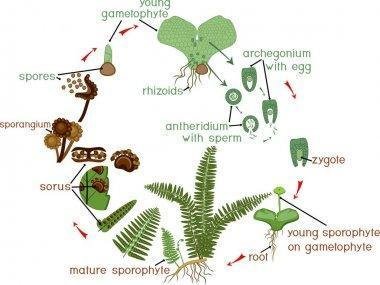
Pteridophytes exhibit true alternation of generations. Sporophyte generation produces spores by the process of meiosis. Gametophyte generation produces gametes by mitosis. We can take fern as an example to illustrate the life cycle of all Pteridophytes.
The undersides of fern leaves produce sporangia. Meiosis within sporangia forms the haploid spores. Wind-borne spores when come in contact with shady, moist habitats they germinate and yield multicellular, microscopic gametophyte which is the sexual stage of the life cycle. Gametophytes mature and produce archegonia (egg forming structure) and antheridia (sperm forming structure).
In the presence of water, multi flagellated sperms swim from antheridia, they are chemically attracted to archegonia and fertilize the eggs.
The diploid zygote produced by the fusion of haploid eggs and sperms, divide mitotically and differentiate to form mature sporophytes, thus completing the life cycle.
Dominant phase in Pteridophytes is sporophyte.
Note:
Pteridophytes show transition from simple to complex leaves. Club Mosses and Horsetails have simple microphyllous leaves. These leaves have a single, unbranched vein, and vascular supplies that don't cause gaps in the stem vasculature. Class Filicopsida (the true Ferns) have larger, complex macrophyllous leaves. Veins of these leaves are extensively branched, forming distinct gaps in xylem and phloem of stem.
Complete answer:
Pteridophytes exhibit true alternation of generations. Sporophyte generation produces spores by the process of meiosis. Gametophyte generation produces gametes by mitosis. We can take fern as an example to illustrate the life cycle of all Pteridophytes.
The undersides of fern leaves produce sporangia. Meiosis within sporangia forms the haploid spores. Wind-borne spores when come in contact with shady, moist habitats they germinate and yield multicellular, microscopic gametophyte which is the sexual stage of the life cycle. Gametophytes mature and produce archegonia (egg forming structure) and antheridia (sperm forming structure).
In the presence of water, multi flagellated sperms swim from antheridia, they are chemically attracted to archegonia and fertilize the eggs.
The diploid zygote produced by the fusion of haploid eggs and sperms, divide mitotically and differentiate to form mature sporophytes, thus completing the life cycle.
Dominant phase in Pteridophytes is sporophyte.
Note:
Pteridophytes show transition from simple to complex leaves. Club Mosses and Horsetails have simple microphyllous leaves. These leaves have a single, unbranched vein, and vascular supplies that don't cause gaps in the stem vasculature. Class Filicopsida (the true Ferns) have larger, complex macrophyllous leaves. Veins of these leaves are extensively branched, forming distinct gaps in xylem and phloem of stem.
Recently Updated Pages
Master Class 11 English: Engaging Questions & Answers for Success

Master Class 11 Social Science: Engaging Questions & Answers for Success
Master Class 11 Maths: Engaging Questions & Answers for Success
Master Class 11 Biology: Engaging Questions & Answers for Success
Master Class 11 Physics: Engaging Questions & Answers for Success
Master Class 11 Chemistry: Engaging Questions & Answers for Success
Trending doubts
One Metric ton is equal to kg A 10000 B 1000 C 100 class 11 physics CBSE
Difference Between Prokaryotic Cells and Eukaryotic Cells
1 ton equals to A 100 kg B 1000 kg C 10 kg D 10000 class 11 physics CBSE
Find the value of the expression given below sin 30circ class 11 maths CBSE
Two of the body parts which do not appear in MRI are class 11 biology CBSE
Draw a diagram of a plant cell and label at least eight class 11 biology CBSE