




Which is the common passage for food and air?
Answer
 Verified
641.4k+ views
Hint: It is the critical region that joins the oral cavity and nasopharynx with the larynx and hypopharynx and serves for both the digestive and respiratory system.
Complete answer:
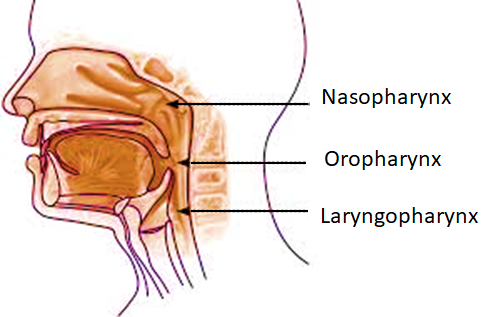
The common passage for food and air is the oropharynx. All food, liquid, and air pass through this. Even though the passage of food and water and the passage of air are separated at the beginning, that is air enters through the nasal cavity, and water and food enter through the oral cavity. These two passages later unite to form oropharynx.
The word pharynx is derived from the Greek word pharynx, meaning “throat “. It is the common pathway for food and air. There are three regions of passage in the pharynx, they are:
> Nasopharynx – It is the upper portion of the pharynx which extends from the base of the skull to the upper surface of the soft palate. It is an air passage and Ulva prevents food from entering it during swallowing.
> Oropharynx – the middle portion of the pharynx. It extends from Ulva to the level of the hyoid bone. A flap of connective tissue called the epiglottis closes over the glottis when food is swallowed to prevent aspiration because both food and air pass through the pharynx . The oropharynx is lined by nonkeratinized squamous epithelium. Its main job is to swallow. It is the critical region that joins the oral cavity and nasopharynx with the larynx and hypopharynx.
> Laryngopharynx – it is also known as hypopharynx, it is a lower part of the pharynx. It connects to the esophagus and lies inferior to the epiglottis and extends to the location of the respiratory (laryngeal) and digestive (oesophageal) pathways.
Note:
- Two sets of pharyngeal muscles form the pharynx and determine the shape of its lumen in the humans.
- In the pharynx, there are a pair of soft tissue masses known as tonsils or palatine tonsils.
Complete answer:
The common passage for food and air is the oropharynx. All food, liquid, and air pass through this. Even though the passage of food and water and the passage of air are separated at the beginning, that is air enters through the nasal cavity, and water and food enter through the oral cavity. These two passages later unite to form oropharynx.
The word pharynx is derived from the Greek word pharynx, meaning “throat “. It is the common pathway for food and air. There are three regions of passage in the pharynx, they are:
> Nasopharynx – It is the upper portion of the pharynx which extends from the base of the skull to the upper surface of the soft palate. It is an air passage and Ulva prevents food from entering it during swallowing.
> Oropharynx – the middle portion of the pharynx. It extends from Ulva to the level of the hyoid bone. A flap of connective tissue called the epiglottis closes over the glottis when food is swallowed to prevent aspiration because both food and air pass through the pharynx . The oropharynx is lined by nonkeratinized squamous epithelium. Its main job is to swallow. It is the critical region that joins the oral cavity and nasopharynx with the larynx and hypopharynx.
> Laryngopharynx – it is also known as hypopharynx, it is a lower part of the pharynx. It connects to the esophagus and lies inferior to the epiglottis and extends to the location of the respiratory (laryngeal) and digestive (oesophageal) pathways.
Note:
- Two sets of pharyngeal muscles form the pharynx and determine the shape of its lumen in the humans.
- In the pharynx, there are a pair of soft tissue masses known as tonsils or palatine tonsils.
Recently Updated Pages
Master Class 11 English: Engaging Questions & Answers for Success

Master Class 11 Social Science: Engaging Questions & Answers for Success
Master Class 11 Maths: Engaging Questions & Answers for Success
Master Class 11 Biology: Engaging Questions & Answers for Success
Master Class 11 Physics: Engaging Questions & Answers for Success
Master Class 11 Chemistry: Engaging Questions & Answers for Success
Trending doubts
Explain the Treaty of Vienna of 1815 class 10 social science CBSE
What is the full form of POSCO class 10 social science CBSE
Define Potential, Developed, Stock and Reserved resources
The diagonals of a rhombus are 10cm and 24cm Find the class 10 maths CBSE
Fill the blanks with proper collective nouns 1 A of class 10 english CBSE
What planets have no moons Which one has only one moon class 10 physics CBSE