




Which is the accepted structure of ${{H}_{2}}{{O}_{2}}$ in gas phase?
(A)
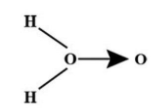
(B)
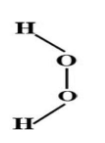
(C) both
(D) none
Answer
 Verified
612.9k+ views
Hint: \[{{H}_{2}}{{O}_{2}}\] is not a planar molecule, there is an oxygen-oxygen bond which has 2 pairs of nonbonding electrons each. This creates a strong repulsion between the atoms of Hydrogen and the unbonded electrons of Oxygen.
Complete answer:
Let us start from the simplest thing we know is ${{H}_{2}}{{O}_{2}}$ a molecule that has 2 atoms of Hydrogen and 2 atoms of Oxygen. Also, Oxygen has six electrons in its outermost shell, which are called valence electrons. These electrons are used in the bond formation between atoms which give rise to a molecule or a compound.
In \[{{H}_{2}}{{O}_{2}}\], each Hydrogen is connected to any one of the Oxygen atoms. This Oxygen is further connected with the other Oxygen atom.
So, we get the skeletal or simple structure as H-O-O-H.
A single bond always consists of 2 electrons, where 1 electron is contributed by every atom. In the case of \[{{H}_{2}}{{O}_{2}}\], in the O-H bond, one electron is donated by Oxygen and the other by Hydrogen. Same is the case of the O-O bond.
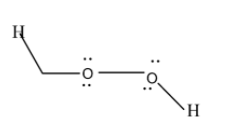
As you can see from the structure, both of the oxygen have some electrons left, which are not used in making bonds. These are called non-bonding electrons and this causes repulsion to occur (electrons are negatively charged and like charges repel). Due to this repulsion, there is a bent shape in this molecule.
Note:
Always remember that Hydrogen will make bonds with Oxygen due to a special property called “Hydrogen bonding”. Also, Hydrogen makes only one bond, by sharing only 1 electron as it has only 2 electrons in its outermost shell. Whereas, Oxygen makes 2 bonds, one with Hydrogen and with the other Oxygen. ${{H}_{2}}{{O}_{2}}$ is not planar, but known to have an “open-book structure”.
Complete answer:
Let us start from the simplest thing we know is ${{H}_{2}}{{O}_{2}}$ a molecule that has 2 atoms of Hydrogen and 2 atoms of Oxygen. Also, Oxygen has six electrons in its outermost shell, which are called valence electrons. These electrons are used in the bond formation between atoms which give rise to a molecule or a compound.
In \[{{H}_{2}}{{O}_{2}}\], each Hydrogen is connected to any one of the Oxygen atoms. This Oxygen is further connected with the other Oxygen atom.
So, we get the skeletal or simple structure as H-O-O-H.
A single bond always consists of 2 electrons, where 1 electron is contributed by every atom. In the case of \[{{H}_{2}}{{O}_{2}}\], in the O-H bond, one electron is donated by Oxygen and the other by Hydrogen. Same is the case of the O-O bond.
As you can see from the structure, both of the oxygen have some electrons left, which are not used in making bonds. These are called non-bonding electrons and this causes repulsion to occur (electrons are negatively charged and like charges repel). Due to this repulsion, there is a bent shape in this molecule.
Note:
Always remember that Hydrogen will make bonds with Oxygen due to a special property called “Hydrogen bonding”. Also, Hydrogen makes only one bond, by sharing only 1 electron as it has only 2 electrons in its outermost shell. Whereas, Oxygen makes 2 bonds, one with Hydrogen and with the other Oxygen. ${{H}_{2}}{{O}_{2}}$ is not planar, but known to have an “open-book structure”.
Recently Updated Pages
Master Class 12 Economics: Engaging Questions & Answers for Success

Master Class 12 English: Engaging Questions & Answers for Success
Master Class 12 Social Science: Engaging Questions & Answers for Success
Master Class 12 Maths: Engaging Questions & Answers for Success
Master Class 12 Physics: Engaging Questions & Answers for Success
Master Class 9 General Knowledge: Engaging Questions & Answers for Success
Trending doubts
One Metric ton is equal to kg A 10000 B 1000 C 100 class 11 physics CBSE
Difference Between Prokaryotic Cells and Eukaryotic Cells
Two of the body parts which do not appear in MRI are class 11 biology CBSE
1 ton equals to A 100 kg B 1000 kg C 10 kg D 10000 class 11 physics CBSE
10 examples of friction in our daily life
DNA is not present in A Nucleus B Mitochondria C Chloroplast class 11 biology CBSE