




which is not true for Euglena.
(a) Presence of chlorophyll ‘a’ and ‘b’
(b) Presence of protoplasmic capsule
(c) Presence of cellulosic cell wall
(d) Presence of proteinaceous pellicle
Answer
 Verified
609.6k+ views
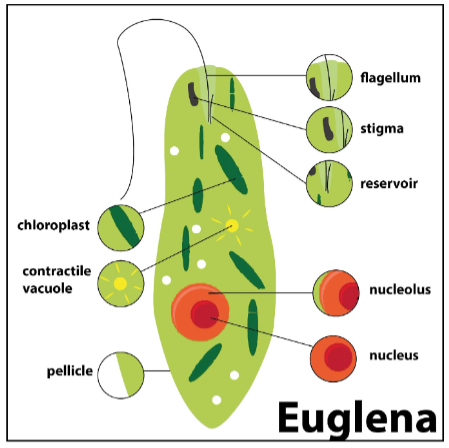
Hint: Euglena is enveloped in a protein-rich layer called ‘pellicle.’ This provides flexibility to their body. However, euglena doesn't have a structural layer as seen in many cells outside their cell membrane. In this way, it resembles the kingdom Animalia.
Complete answer:
Euglena doesn’t have a cellulosic cell wall. Kingdom Protista includes groups like chrysophytes, dinoflagellates, euglenoids, slime moulds, and protozoans. Members of the Kingdom Protista are primarily aquatic. The majority of the euglenoids are freshwater organisms found in stagnant water. Euglenoids have two flagella, one short and the other one is longer. They are photosynthetic in the presence of sunlight. However, when devoid of sunlight they live as heterotrophs by feeding on other smaller organisms. It is interesting to note that the pigments of euglenoids are identical to those found in higher plants.
Additional Information: -Flagella are outgrowths of the cell membrane. Flagellar movement helps in locomotion in protozoans like euglena.
-Proteinaceous pellicle in euglena has a substructure of microtubules. These microtubules are arranged in strips spiralling around the cell.
So, the correct answer is ‘Presence of the cellulosic cell wall.’
Note: -When there is enough sunlight euglena utilizes chlorophyll a and b and produces sugar by photosynthesis. Chlorophyll, in these organisms, is present within chloroplasts similar to plants.
-Euglena is believed to be surrounded by a protoplasmic capsule.
-Euglena exhibits a unique feature of metaboly. It is the action of pellicle strips sliding over one another. This property gives it exceptional flexibility and contractility.
Complete answer:
Euglena doesn’t have a cellulosic cell wall. Kingdom Protista includes groups like chrysophytes, dinoflagellates, euglenoids, slime moulds, and protozoans. Members of the Kingdom Protista are primarily aquatic. The majority of the euglenoids are freshwater organisms found in stagnant water. Euglenoids have two flagella, one short and the other one is longer. They are photosynthetic in the presence of sunlight. However, when devoid of sunlight they live as heterotrophs by feeding on other smaller organisms. It is interesting to note that the pigments of euglenoids are identical to those found in higher plants.
Additional Information: -Flagella are outgrowths of the cell membrane. Flagellar movement helps in locomotion in protozoans like euglena.
-Proteinaceous pellicle in euglena has a substructure of microtubules. These microtubules are arranged in strips spiralling around the cell.
So, the correct answer is ‘Presence of the cellulosic cell wall.’
Note: -When there is enough sunlight euglena utilizes chlorophyll a and b and produces sugar by photosynthesis. Chlorophyll, in these organisms, is present within chloroplasts similar to plants.
-Euglena is believed to be surrounded by a protoplasmic capsule.
-Euglena exhibits a unique feature of metaboly. It is the action of pellicle strips sliding over one another. This property gives it exceptional flexibility and contractility.
Recently Updated Pages
Master Class 11 Social Science: Engaging Questions & Answers for Success

Master Class 11 English: Engaging Questions & Answers for Success
Master Class 11 Maths: Engaging Questions & Answers for Success
Master Class 11 Chemistry: Engaging Questions & Answers for Success
Master Class 11 Biology: Engaging Questions & Answers for Success
Master Class 11 Physics: Engaging Questions & Answers for Success
Trending doubts
One Metric ton is equal to kg A 10000 B 1000 C 100 class 11 physics CBSE
Difference Between Prokaryotic Cells and Eukaryotic Cells
Draw a diagram of a plant cell and label at least eight class 11 biology CBSE
Two of the body parts which do not appear in MRI are class 11 biology CBSE
Which gas is abundant in air class 11 chemistry CBSE
10 examples of friction in our daily life