




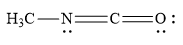
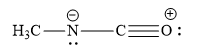
Which is not the resonance structure of methyl isocyanate?
A)
B)
C)
D)
Answer
 Verified
618k+ views
Hint: Resonance structures are the Lewis structures that describe the delocalisation of electrons in a molecule.
To check for resonance structure consider the formal charges on each atom. Also check if each atom has completed its octet.
Complete answer:
The atomic number of carbon is 6. It has 4 valence electrons. It shares its 4 valence electrons with 4 electrons of 4 other atoms to form 4 bonds. When C atom forms 4 bonds, it has no charge and is neutral in nature. When a carbon atom forms only 3 bonds and it has no unshared electron(s), then such carbon atom has unit positive charge. When a carbon atom forms only 3 bonds and it has one unshared electron pair, then such carbon atom has unit negative charge.
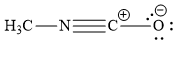
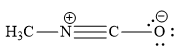
In the resonance structure given in the option (C), the carbon atom is surrounded by 8 valence electrons. Yet carbon atoms are shown to have positive charge. This is not possible. Instead of carbon atom, the positive charge should have been on nitrogen atom as shown below:
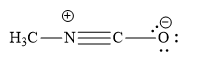
This is because, nitrogen atom forms 3 covalent bonds and one coordinate bond. Nitrogen atoms donate its lone pair of electrons to carbon atoms to form a coordinate bond. In turn, the pi electrons of carbon-oxygen double bonds are given to oxygen atoms. So oxygen atom gains unit negative charge.

The option (C) represents incorrect resonance structure of methyl isocyanate.
Note: Resonance structures are obtained by movement of pi electrons or unshared electrons. Electrons of sigma bonds do not move. Similarly, the atoms do not move and their position remains fixed.
To check for resonance structure consider the formal charges on each atom. Also check if each atom has completed its octet.
Complete answer:
The atomic number of carbon is 6. It has 4 valence electrons. It shares its 4 valence electrons with 4 electrons of 4 other atoms to form 4 bonds. When C atom forms 4 bonds, it has no charge and is neutral in nature. When a carbon atom forms only 3 bonds and it has no unshared electron(s), then such carbon atom has unit positive charge. When a carbon atom forms only 3 bonds and it has one unshared electron pair, then such carbon atom has unit negative charge.
In the resonance structure given in the option (C), the carbon atom is surrounded by 8 valence electrons. Yet carbon atoms are shown to have positive charge. This is not possible. Instead of carbon atom, the positive charge should have been on nitrogen atom as shown below:
This is because, nitrogen atom forms 3 covalent bonds and one coordinate bond. Nitrogen atoms donate its lone pair of electrons to carbon atoms to form a coordinate bond. In turn, the pi electrons of carbon-oxygen double bonds are given to oxygen atoms. So oxygen atom gains unit negative charge.
The option (C) represents incorrect resonance structure of methyl isocyanate.
Note: Resonance structures are obtained by movement of pi electrons or unshared electrons. Electrons of sigma bonds do not move. Similarly, the atoms do not move and their position remains fixed.
Recently Updated Pages
Master Class 11 English: Engaging Questions & Answers for Success

Master Class 11 Social Science: Engaging Questions & Answers for Success
Master Class 11 Maths: Engaging Questions & Answers for Success
Master Class 11 Biology: Engaging Questions & Answers for Success
Master Class 11 Physics: Engaging Questions & Answers for Success
Master Class 11 Chemistry: Engaging Questions & Answers for Success
Trending doubts
One Metric ton is equal to kg A 10000 B 1000 C 100 class 11 physics CBSE
Difference Between Prokaryotic Cells and Eukaryotic Cells
Find the value of the expression given below sin 30circ class 11 maths CBSE
Difference between physical and chemical change class 11 chemistry CBSE
Two of the body parts which do not appear in MRI are class 11 biology CBSE
Draw a diagram of a plant cell and label at least eight class 11 biology CBSE