




Which is not a greenhouse gas
A. Chlorofluorocarbon
B. Methane
C. Carbon dioxide
D. Hydrogen
Answer
 Verified
628.8k+ views
Hint: Greenhouse gases are responsible for causing the greenhouse effect which is a naturally occurring that is responsible for heating the earth’s surface and atmosphere. Vehicular emissions, fossil fuels burning, as well as some basic processes like respiration, are some of the sources of greenhouse gases.
Complete answer:
Main gases responsible for the greenhouse effect are carbon dioxide(81%), methane(10%), Chlorofluorocarbon or CFCs(3%) and Nitrous oxide(7%). These gases are collectively known as greenhouse gases. They selectively allow the short-wavelength energy to pass through but absorb and reflect back the longer wavelength energy to the earth, thus, heating up the atmosphere. Without the greenhouse effect, the average temperature of the earth’s surface would have been an extremely cold planet rather than the present average of approximately 14°C.
The greenhouse effect is also associated with global warming where an increase in the level of greenhouse gases has led to considerable heating of the earth. Scientists believe that global warming is the reason behind many adverse and odd climatic conditions being witnessed in various parts of the earth. It has also induced the melting of polar ice caps as well as glaciers in Himalayan snowcaps. CFCs have depleted the ozone layer which is present in the stratosphere and protects us from harmful ultraviolet radiation.
To reduce global warming, reducing the usage of fossil fuels is encouraged along with many other steps such as reducing deforestation, improving the efficiency of energy usage, and slowing down the growth of the human population.
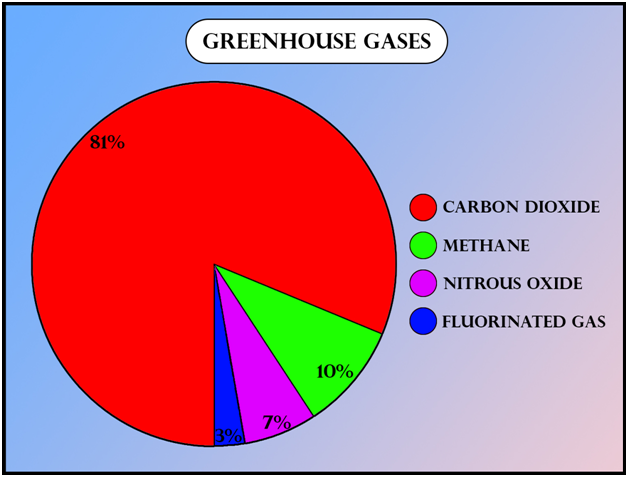
So, the correct answer is ‘Hydrogen’.
Note: Ultraviolet rays are highly injurious as they may have deleterious effects on ones’ DNA. It is high energy and can break bonds within these molecules and might induce mutation along with the ageing of skin and cancer. A high dose of UV-B radiation can lead to inflammation of the cornea and ultimately snow-blindness cataract, leading to permanent blindness.
Complete answer:
Main gases responsible for the greenhouse effect are carbon dioxide(81%), methane(10%), Chlorofluorocarbon or CFCs(3%) and Nitrous oxide(7%). These gases are collectively known as greenhouse gases. They selectively allow the short-wavelength energy to pass through but absorb and reflect back the longer wavelength energy to the earth, thus, heating up the atmosphere. Without the greenhouse effect, the average temperature of the earth’s surface would have been an extremely cold planet rather than the present average of approximately 14°C.
The greenhouse effect is also associated with global warming where an increase in the level of greenhouse gases has led to considerable heating of the earth. Scientists believe that global warming is the reason behind many adverse and odd climatic conditions being witnessed in various parts of the earth. It has also induced the melting of polar ice caps as well as glaciers in Himalayan snowcaps. CFCs have depleted the ozone layer which is present in the stratosphere and protects us from harmful ultraviolet radiation.
To reduce global warming, reducing the usage of fossil fuels is encouraged along with many other steps such as reducing deforestation, improving the efficiency of energy usage, and slowing down the growth of the human population.
So, the correct answer is ‘Hydrogen’.
Note: Ultraviolet rays are highly injurious as they may have deleterious effects on ones’ DNA. It is high energy and can break bonds within these molecules and might induce mutation along with the ageing of skin and cancer. A high dose of UV-B radiation can lead to inflammation of the cornea and ultimately snow-blindness cataract, leading to permanent blindness.
Recently Updated Pages
Master Class 11 English: Engaging Questions & Answers for Success

Master Class 11 Social Science: Engaging Questions & Answers for Success
Master Class 11 Maths: Engaging Questions & Answers for Success
Master Class 11 Biology: Engaging Questions & Answers for Success
Master Class 11 Physics: Engaging Questions & Answers for Success
Master Class 11 Chemistry: Engaging Questions & Answers for Success
Trending doubts
Explain the Treaty of Vienna of 1815 class 10 social science CBSE
What is the full form of POSCO class 10 social science CBSE
Define Potential, Developed, Stock and Reserved resources
The diagonals of a rhombus are 10cm and 24cm Find the class 10 maths CBSE
Fill the blanks with proper collective nouns 1 A of class 10 english CBSE
One number is chosen from numbers 1 to 200 Find the class 10 maths CBSE