




Which is an artificial method of vegetative propagation? Describe:
(i)A cutting
(ii)Budding
Answer
 Verified
626.1k+ views
Hint: It is a process in which the growth and development of a plant by asexual means. This development occurs through the fragmentation and regeneration of specialized plant parts. Many plants that reproduce asexually also are capable of sexual propagation.
Complete answer:
Vegetative Propagation may be a sort of agamogenesis during which new plants form just by using some fragment of the parent plant.
Artificial method of vegetative proliferation - the strategy for developing plants by utilizing counterfeit techniques is named fake spread.
It is for most of three sorts - Cutting, Budding, and Layering.
(i) Cutting - during this method, a healthy young branch with a couple of nodes and internodes is stopped and most of its leaves are removed. Presently the cut end is stuck into some great sodden soil. The cutting will then develop roots, and grow into a replacement plant. This method is employed to propagate plants like rose, sugarcane, and pineapple.
(ii) Budding - In budding, a bud with a little portion of the bark is taken from the specified plant. This is inserted into a little slot that's made within the bark of the opposite plant. Both the plants are integrated and the buds are not permitted to dry.
Additional Information: Vegetative reproduction includes vegetative or non-sexual plant structures, though sexual proliferation is cultivated through gamete creation and ensuing fertilization.
In nonvascular plants like mosses and liverworts, vegetative reproductive structures include gemmae and spores. In vascular plants, vegetative regenerative structures incorporate roots, stems, and leaves.
Vegetative propagation is shaped conceivable by meristem tissue, ordinarily found inside stems and leaves additionally because of the tips of roots, that contain undifferentiated cells. These cells effectively partition by mitosis to allow inescapable and fast essential plant development. Specialized, permanent plant part systems also originate from meristem tissue. It is the intensity of meristem tissue to consistently isolate that permits for plant recovery needed by vegetative proliferation.
Note: One advantage of vegetative propagation is that plants with favorable traits are repeatedly reproduced. Commercial crop growers can employ artificial vegetative propagation techniques to make sure advantageous qualities in their crops.
A major disadvantage, however, of vegetative propagation is that it doesn't leave any degree of genetic variation.
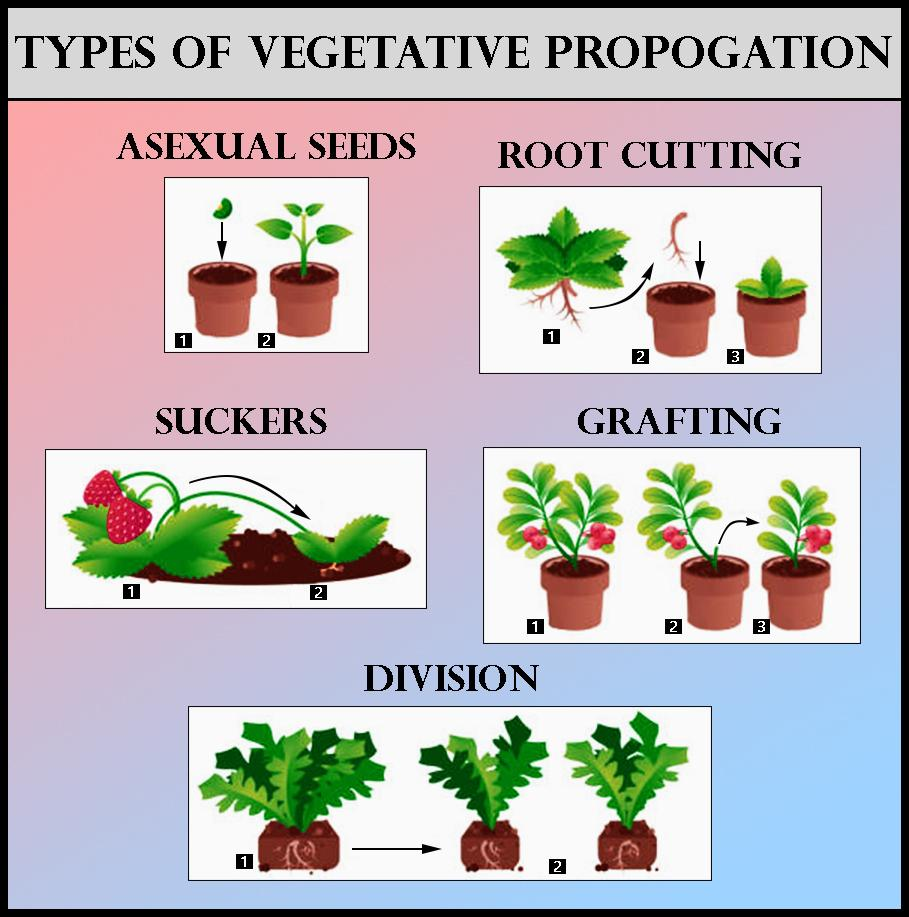
Complete answer:
Vegetative Propagation may be a sort of agamogenesis during which new plants form just by using some fragment of the parent plant.
Artificial method of vegetative proliferation - the strategy for developing plants by utilizing counterfeit techniques is named fake spread.
It is for most of three sorts - Cutting, Budding, and Layering.
(i) Cutting - during this method, a healthy young branch with a couple of nodes and internodes is stopped and most of its leaves are removed. Presently the cut end is stuck into some great sodden soil. The cutting will then develop roots, and grow into a replacement plant. This method is employed to propagate plants like rose, sugarcane, and pineapple.
(ii) Budding - In budding, a bud with a little portion of the bark is taken from the specified plant. This is inserted into a little slot that's made within the bark of the opposite plant. Both the plants are integrated and the buds are not permitted to dry.
Additional Information: Vegetative reproduction includes vegetative or non-sexual plant structures, though sexual proliferation is cultivated through gamete creation and ensuing fertilization.
In nonvascular plants like mosses and liverworts, vegetative reproductive structures include gemmae and spores. In vascular plants, vegetative regenerative structures incorporate roots, stems, and leaves.
Vegetative propagation is shaped conceivable by meristem tissue, ordinarily found inside stems and leaves additionally because of the tips of roots, that contain undifferentiated cells. These cells effectively partition by mitosis to allow inescapable and fast essential plant development. Specialized, permanent plant part systems also originate from meristem tissue. It is the intensity of meristem tissue to consistently isolate that permits for plant recovery needed by vegetative proliferation.
Note: One advantage of vegetative propagation is that plants with favorable traits are repeatedly reproduced. Commercial crop growers can employ artificial vegetative propagation techniques to make sure advantageous qualities in their crops.
A major disadvantage, however, of vegetative propagation is that it doesn't leave any degree of genetic variation.
Recently Updated Pages
Master Class 12 Economics: Engaging Questions & Answers for Success

Master Class 12 Social Science: Engaging Questions & Answers for Success
Master Class 12 English: Engaging Questions & Answers for Success
Master Class 12 Maths: Engaging Questions & Answers for Success
Master Class 12 Physics: Engaging Questions & Answers for Success
Master Class 12 Biology: Engaging Questions & Answers for Success
Trending doubts
Draw a labelled sketch of the human eye class 12 physics CBSE
Which are the Top 10 Largest Countries of the World?
Draw ray diagrams each showing i myopic eye and ii class 12 physics CBSE
Which is the correct genotypic ratio of mendel dihybrid class 12 biology CBSE
Differentiate between homogeneous and heterogeneous class 12 chemistry CBSE
Which animal never drinks water in its entire life class 12 biology CBSE