




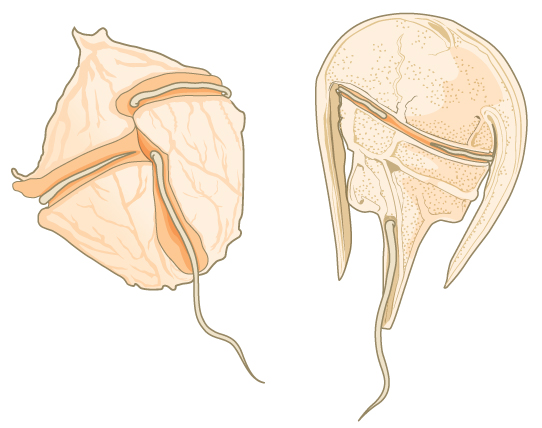
Which group of organisms is represented by the given figure?
A. Diatoms
B. Dinoflagellates
C. Bacteria
D. Euglenoids
Answer
 Verified
576k+ views
Hint: In the provided figure, two flagella can be observed. One is lying longitudinally whereas the other is present transversely inside a furrow in between the wall plates.
Complete answer:
Dinoflagellates are marine eukaryotes. These are the unicellular organisms. They are characterized by dinokont flagellation means the two flagella arising from the ventral side of the cell. Moreover, the flagella arising are dissimilar. One flagella is ribbon like and is located transversely while the other is located longitudinally beating posteriorly. Dinoflagellates are known to accumulate over the water surface causing shellfish poisoning. Also, the dinoflagellates possess the property of emitting blue green light which is known as bioluminescence.
On the other hand, diatoms are mostly non-motile while bacteria can have one flagella (monotrichous) or it may have one flagellum at each end (amphitrichous) or numerous flagella can be present as a tuft (lophotrichous) or flagella can be found distributed all over its body except the pole (peritrichous). Furthermore, Euglenoids possess two flagella which are rooted in the cell at the front as basal bodies.
Hence, the correct answer is option (B).
Note: The dinoflagellates belong to the phylum Dinoflagellata. These are single celled eukaryotic organisms. They are generally considered as algae. Most of the dinoflagellates are marine planktons but some can also thrive in freshwater habitats. Environmental factors like salinity, temperature or depth of the sea determines the distribution of population over the sea surface.
Complete answer:
Dinoflagellates are marine eukaryotes. These are the unicellular organisms. They are characterized by dinokont flagellation means the two flagella arising from the ventral side of the cell. Moreover, the flagella arising are dissimilar. One flagella is ribbon like and is located transversely while the other is located longitudinally beating posteriorly. Dinoflagellates are known to accumulate over the water surface causing shellfish poisoning. Also, the dinoflagellates possess the property of emitting blue green light which is known as bioluminescence.
On the other hand, diatoms are mostly non-motile while bacteria can have one flagella (monotrichous) or it may have one flagellum at each end (amphitrichous) or numerous flagella can be present as a tuft (lophotrichous) or flagella can be found distributed all over its body except the pole (peritrichous). Furthermore, Euglenoids possess two flagella which are rooted in the cell at the front as basal bodies.
Hence, the correct answer is option (B).
Note: The dinoflagellates belong to the phylum Dinoflagellata. These are single celled eukaryotic organisms. They are generally considered as algae. Most of the dinoflagellates are marine planktons but some can also thrive in freshwater habitats. Environmental factors like salinity, temperature or depth of the sea determines the distribution of population over the sea surface.
Recently Updated Pages
Master Class 11 Computer Science: Engaging Questions & Answers for Success

Master Class 11 Business Studies: Engaging Questions & Answers for Success
Master Class 11 Economics: Engaging Questions & Answers for Success
Master Class 11 English: Engaging Questions & Answers for Success
Master Class 11 Maths: Engaging Questions & Answers for Success
Master Class 11 Biology: Engaging Questions & Answers for Success
Trending doubts
One Metric ton is equal to kg A 10000 B 1000 C 100 class 11 physics CBSE
There are 720 permutations of the digits 1 2 3 4 5 class 11 maths CBSE
Discuss the various forms of bacteria class 11 biology CBSE
Draw a diagram of a plant cell and label at least eight class 11 biology CBSE
State the laws of reflection of light
Explain zero factorial class 11 maths CBSE