




Which class shows 8 dorsal plates of the shell?
A)Amphineura
B)Monoplacophora
C)Scaphopoda
D)Cephalopoda
Answer
 Verified
612.6k+ views
Hint: It belongs to the phylum Mollusca. The body is elongated and has bilateral symmetry. It is a Marine Mollusca and has 7 or 8 overlapping plates on the dorsal surface of the shell.
Complete answer:
-Amphineura commonly known as sea cradles or chitons and its literal meaning is many plate bearers. They are marine. They are found from shallow water to deep ocean.
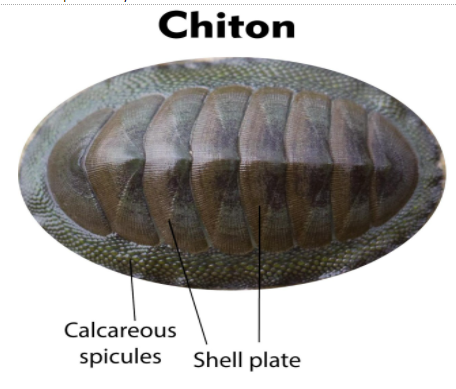
-At the front and back edges, the cells of Amphineura consist of eight overlapping dorsal plates. These plates are joined together on the outer margin and move internally to the girdle. The girdle is the thick part of the mantle.
-Girdles may have scales, spines or bristles; their plates are flexible, which helps them for locomotion. Shells also provide protection to the animals.
-The shells of animals are arranged in such a way that it has Chitons to roll into a protective ball when they are dislodged to an uneven surface.
Additional Information: Monoplacophora- they are primitive Mollusca. They are found in the deep sea. They bear only one dorsal plate.
Scaphopoda- they are shelled marine Mollusca. They have a tubular shell that is open at both ends.
Cephalopoda- it includes animals such as octopus nautilus, Cuttlefish. Their shell is internal or reduced. In nautilus the shell is external and in octopus, the cell is totally absent.
So, the correct answer is, "Amphineura".
Note: -Amphineura has tentacles or cephalic eyes. Their mouth is anterior with a radula. They feed on algae.
-Radula helps in scrapping the algae from the hard surfaces.
-Some species may also feed on small crustaceans.
Complete answer:
-Amphineura commonly known as sea cradles or chitons and its literal meaning is many plate bearers. They are marine. They are found from shallow water to deep ocean.
-At the front and back edges, the cells of Amphineura consist of eight overlapping dorsal plates. These plates are joined together on the outer margin and move internally to the girdle. The girdle is the thick part of the mantle.
-Girdles may have scales, spines or bristles; their plates are flexible, which helps them for locomotion. Shells also provide protection to the animals.
-The shells of animals are arranged in such a way that it has Chitons to roll into a protective ball when they are dislodged to an uneven surface.
Additional Information: Monoplacophora- they are primitive Mollusca. They are found in the deep sea. They bear only one dorsal plate.
Scaphopoda- they are shelled marine Mollusca. They have a tubular shell that is open at both ends.
Cephalopoda- it includes animals such as octopus nautilus, Cuttlefish. Their shell is internal or reduced. In nautilus the shell is external and in octopus, the cell is totally absent.
So, the correct answer is, "Amphineura".
Note: -Amphineura has tentacles or cephalic eyes. Their mouth is anterior with a radula. They feed on algae.
-Radula helps in scrapping the algae from the hard surfaces.
-Some species may also feed on small crustaceans.
Recently Updated Pages
Master Class 12 Economics: Engaging Questions & Answers for Success

Master Class 12 English: Engaging Questions & Answers for Success
Master Class 12 Social Science: Engaging Questions & Answers for Success
Master Class 12 Maths: Engaging Questions & Answers for Success
Master Class 12 Physics: Engaging Questions & Answers for Success
Master Class 11 Social Science: Engaging Questions & Answers for Success
Trending doubts
One Metric ton is equal to kg A 10000 B 1000 C 100 class 11 physics CBSE
Difference Between Prokaryotic Cells and Eukaryotic Cells
Two of the body parts which do not appear in MRI are class 11 biology CBSE
1 ton equals to A 100 kg B 1000 kg C 10 kg D 10000 class 11 physics CBSE
Draw a diagram of nephron and explain its structur class 11 biology CBSE
10 examples of friction in our daily life