




Which chemical reaction takes place in the mitochondria? Which molecules are produced in this reaction?
Answer
 Verified
607.8k+ views
Hint: Mitochondria is a cell organelle found in most eukaryotic organisms. It is a double membrane-bound, semi-autonomous organelle. Mitochondria is considered as the powerhouse of the cell as the energy molecules ATP are produced in the mitochondria.
Complete answer: A cell organelle which is semi-autonomous in function and is bound by a double membrane is called mitochondria. It is found in all cells of eukaryotic organisms. However, it is absent in some cells of multicellular organisms.
-An example is the erythrocytes which are referred to as RBC of the human blood. The main function of the mitochondria is to produce ATP molecules which are a source of energy for most of the metabolic activities to be carried in the body. Hence it is called a powerhouse of the cell as it provides power in the form of ATP.
-Depending upon the cell type the number of mitochondria in the cell varies. Mitochondria perform the function of the conversion of ADP into ATP by oxidizing pyruvate, glucose, and NADH. These oxidizing substrates are formed in the cytosol of the cell.
-Oxidative phosphorylation is the chemical reaction that occurs in the mitochondria of the cell. Oxygen is converted to water molecules in oxidative phosphorylation reactions. Tricarboxylic acid cycles take place in the matrix of mitochondria in eukaryotes.
-Tricarboxylic acid cycle (TCA) is also called a citric acid cycle (CAC) or Krebs cycle. Each molecule of glucose requires two turns of the Krebs cycle. Products obtained after completion of two rounds of Krebs cycle are two GTP, two ubiquinol, six NADH, and four molecules of carbon dioxide.
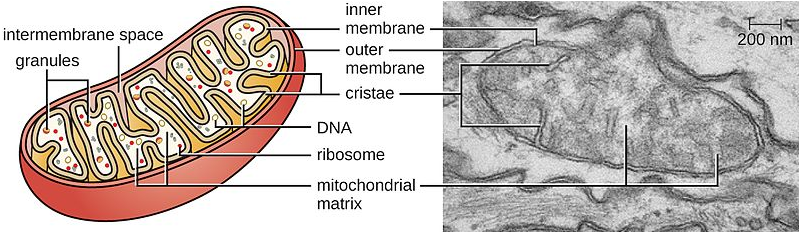
Note: The inner membrane of mitochondria contains proteins that are useful for the function of electron transport chain redox reactions, generation of ATP in the matrix of mitochondria, and for transporting the proteins in and out of the mitochondria. The enzyme ATP synthase is used for the production of ATP. Mitochondria also perform the function of regulating cellular metabolism.
Complete answer: A cell organelle which is semi-autonomous in function and is bound by a double membrane is called mitochondria. It is found in all cells of eukaryotic organisms. However, it is absent in some cells of multicellular organisms.
-An example is the erythrocytes which are referred to as RBC of the human blood. The main function of the mitochondria is to produce ATP molecules which are a source of energy for most of the metabolic activities to be carried in the body. Hence it is called a powerhouse of the cell as it provides power in the form of ATP.
-Depending upon the cell type the number of mitochondria in the cell varies. Mitochondria perform the function of the conversion of ADP into ATP by oxidizing pyruvate, glucose, and NADH. These oxidizing substrates are formed in the cytosol of the cell.
-Oxidative phosphorylation is the chemical reaction that occurs in the mitochondria of the cell. Oxygen is converted to water molecules in oxidative phosphorylation reactions. Tricarboxylic acid cycles take place in the matrix of mitochondria in eukaryotes.
-Tricarboxylic acid cycle (TCA) is also called a citric acid cycle (CAC) or Krebs cycle. Each molecule of glucose requires two turns of the Krebs cycle. Products obtained after completion of two rounds of Krebs cycle are two GTP, two ubiquinol, six NADH, and four molecules of carbon dioxide.
Note: The inner membrane of mitochondria contains proteins that are useful for the function of electron transport chain redox reactions, generation of ATP in the matrix of mitochondria, and for transporting the proteins in and out of the mitochondria. The enzyme ATP synthase is used for the production of ATP. Mitochondria also perform the function of regulating cellular metabolism.
Recently Updated Pages
Master Class 12 Economics: Engaging Questions & Answers for Success

Master Class 12 English: Engaging Questions & Answers for Success
Master Class 12 Social Science: Engaging Questions & Answers for Success
Master Class 12 Maths: Engaging Questions & Answers for Success
Master Class 12 Physics: Engaging Questions & Answers for Success
Master Class 9 General Knowledge: Engaging Questions & Answers for Success
Trending doubts
One Metric ton is equal to kg A 10000 B 1000 C 100 class 11 physics CBSE
Difference Between Prokaryotic Cells and Eukaryotic Cells
Two of the body parts which do not appear in MRI are class 11 biology CBSE
Find the value of the expression given below sin 30circ class 11 maths CBSE
1 ton equals to A 100 kg B 1000 kg C 10 kg D 10000 class 11 physics CBSE
Draw a diagram of nephron and explain its structur class 11 biology CBSE