




Which cells are absent in the gastrodermis of Hydra?
(a)Gland cells
(b)Nutritive cells
(c)Stinging cells
(d)Nerve cells
Answer
 Verified
579k+ views
Hint: Gastrodermis, as the name suggests, is the layer of cells that is responsible for the digestion of the food material in hydra. The gastrodermal layer is made up of various cells that take an active part in the digestive process.
Complete answer:
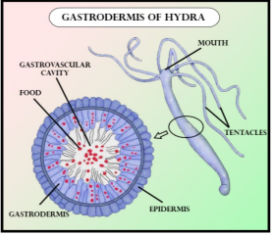
The cellular layer which lines the alimentary canal in Hydra is known as the gastrodermis. In the inner gastrodermis layer of Hydra, nutritive muscular cells, gland cells, nerve cells, sensory cells, and interstitial cells are present. Stinging cells or nematocysts are absent.
Additional Information: Hydra is a solitary polyp found in the freshwater. Hydra is known as one of the smallest polyps found in the marine environment and is a carnivore in its feeding habits. Hydra is diploblastic and has a tissue grade of organization with the division of labor. Hydra has a cylindrical body with 6 to 10 tentacles present. These are hollow tentacles that help in locomotion and food capture. The body wall of Hydra gas ectoderm and encoder, in between a very thin delicate mesogloea is present. Ectoderm contains epithelio-muscular cells, sensory cells, nerve cells, interstitial cells, and stinging cells or nematocysts.
So, the correct answer is ‘stinging cells’.
Note: Linnaeus gave the name Hydra, a Greek word that means water serpent on the basis of its ability to regenerate its lost parts. Hydra has great regeneration capacities. It is found that a piece of hydra will regenerate into a full hydra given it contains a part of epidermis and gastrodermis and size isn’t less than $\dfrac{1}{6}$ mm in diameter.
Complete answer:
The cellular layer which lines the alimentary canal in Hydra is known as the gastrodermis. In the inner gastrodermis layer of Hydra, nutritive muscular cells, gland cells, nerve cells, sensory cells, and interstitial cells are present. Stinging cells or nematocysts are absent.
Additional Information: Hydra is a solitary polyp found in the freshwater. Hydra is known as one of the smallest polyps found in the marine environment and is a carnivore in its feeding habits. Hydra is diploblastic and has a tissue grade of organization with the division of labor. Hydra has a cylindrical body with 6 to 10 tentacles present. These are hollow tentacles that help in locomotion and food capture. The body wall of Hydra gas ectoderm and encoder, in between a very thin delicate mesogloea is present. Ectoderm contains epithelio-muscular cells, sensory cells, nerve cells, interstitial cells, and stinging cells or nematocysts.
So, the correct answer is ‘stinging cells’.
Note: Linnaeus gave the name Hydra, a Greek word that means water serpent on the basis of its ability to regenerate its lost parts. Hydra has great regeneration capacities. It is found that a piece of hydra will regenerate into a full hydra given it contains a part of epidermis and gastrodermis and size isn’t less than $\dfrac{1}{6}$ mm in diameter.
Recently Updated Pages
Master Class 11 Computer Science: Engaging Questions & Answers for Success

Master Class 11 Business Studies: Engaging Questions & Answers for Success
Master Class 11 Economics: Engaging Questions & Answers for Success
Master Class 11 English: Engaging Questions & Answers for Success
Master Class 11 Maths: Engaging Questions & Answers for Success
Master Class 11 Biology: Engaging Questions & Answers for Success
Trending doubts
One Metric ton is equal to kg A 10000 B 1000 C 100 class 11 physics CBSE
There are 720 permutations of the digits 1 2 3 4 5 class 11 maths CBSE
Discuss the various forms of bacteria class 11 biology CBSE
Draw a diagram of a plant cell and label at least eight class 11 biology CBSE
State the laws of reflection of light
10 examples of friction in our daily life