




Which blood transfusion is correct?
Answer
 Verified
573.9k+ views
Hint: The process by which a specified quantity of blood or blood products is transferred to an individual through veins is known as a transfusion. The ABO grouping is done in blood, to understand the specific groups based on different antigens present, the compatibility of blood groups should be ensured before the process of transfusion, to avoid adverse effects such as the haemolysis of blood cells.
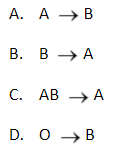
Complete answer: The individuals possessing O Blood group have no antigen present on the surface of their RBCs. Due to the absence of these antigens, there are no chances for the recipient’s immune system to produce antibodies to fight against these foreign blood cells coming. Thus no immune reaction occurs during the transfusion and effects such as haemolysis do not occur. Thus O group is considered as the universal recipient. Therefore O to B transfusion is the safest and correct.
Considering the other options given:
-Blood groups A and B consist of A and B antigens respectively on the surface of its RBCs. When A blood group is transferred to an individual with B group, the recipient’s immune system produces anti-A antibodies, which reject the transfused blood and cause agglutination reaction, these reactions can be so severe that it could even lead to death sometimes.
-Similarly, when B blood group is transfused to an individual possessing A blood group since the donor’s blood consists of B antigens, the recipient’s immune system starts producing anti-B antibodies, to fight against the foreign antigens. Producing immune reactions.
-AB blood group consists of both A and B antigens present equally on the RBC surface. When transfused into an individual having A blood group, the recipient’s body produces an anti-B antibody, which has effects against the A antigen on the donor group and causes an immune response in the recipient’s body.
Thus from the above-given options, D, is correct that is, the correct transfusion is from O to B.
Note: Blood group AB is known as the universal recipient group. Since there are no antibodies present in these individuals, there involves no immune response, with any blood group transferred. O blood group is the universal donor.
Complete answer: The individuals possessing O Blood group have no antigen present on the surface of their RBCs. Due to the absence of these antigens, there are no chances for the recipient’s immune system to produce antibodies to fight against these foreign blood cells coming. Thus no immune reaction occurs during the transfusion and effects such as haemolysis do not occur. Thus O group is considered as the universal recipient. Therefore O to B transfusion is the safest and correct.
Considering the other options given:
-Blood groups A and B consist of A and B antigens respectively on the surface of its RBCs. When A blood group is transferred to an individual with B group, the recipient’s immune system produces anti-A antibodies, which reject the transfused blood and cause agglutination reaction, these reactions can be so severe that it could even lead to death sometimes.
-Similarly, when B blood group is transfused to an individual possessing A blood group since the donor’s blood consists of B antigens, the recipient’s immune system starts producing anti-B antibodies, to fight against the foreign antigens. Producing immune reactions.
-AB blood group consists of both A and B antigens present equally on the RBC surface. When transfused into an individual having A blood group, the recipient’s body produces an anti-B antibody, which has effects against the A antigen on the donor group and causes an immune response in the recipient’s body.
Thus from the above-given options, D, is correct that is, the correct transfusion is from O to B.
Note: Blood group AB is known as the universal recipient group. Since there are no antibodies present in these individuals, there involves no immune response, with any blood group transferred. O blood group is the universal donor.
Recently Updated Pages
Master Class 11 Computer Science: Engaging Questions & Answers for Success

Master Class 11 Business Studies: Engaging Questions & Answers for Success
Master Class 11 Economics: Engaging Questions & Answers for Success
Master Class 11 English: Engaging Questions & Answers for Success
Master Class 11 Maths: Engaging Questions & Answers for Success
Master Class 11 Biology: Engaging Questions & Answers for Success
Trending doubts
One Metric ton is equal to kg A 10000 B 1000 C 100 class 11 physics CBSE
There are 720 permutations of the digits 1 2 3 4 5 class 11 maths CBSE
Discuss the various forms of bacteria class 11 biology CBSE
Draw a diagram of a plant cell and label at least eight class 11 biology CBSE
State the laws of reflection of light
Explain zero factorial class 11 maths CBSE