



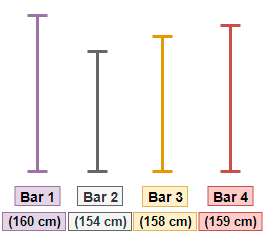
Which bar is the shortest?
Can you arrange these bars in the increasing order of their lengths?
Answer
 Verified
601.2k+ views
Hint: First of all check the unit of length of all the bars given. If they are the same then leave them but if they are not the same then first convert them into a single unit of length so the comparison can be easy. Once they are converted into the same unit, see the numerical values of the length of all the bars. The bar having the smallest numerical value will be at the first position and the bar having the highest numerical value will be at the last.
Complete step by step solution:
Here we have been provided with four bars of different lengths and we are asked to arrange them in the increasing order of their length. That means the bar with the shortest length will be at the first place and the bar with the greatest length will be at the last.
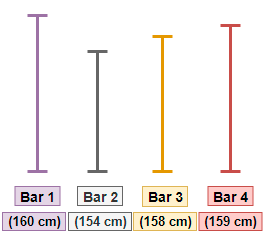
Now, first we need to check if the unit of length is the same for all the bars or not. Here we can see that all the four bars have their lengths in centimeters, so we need not change them. Therefore, we need to compare the numerical values of the four lengths. So we get,
$\Rightarrow $ 154 < 158 < 159 < 160
$\Rightarrow $ 154 cm < 158 cm < 159 cm < 160 cm
$\therefore $ Bar 2 < Bar 3 < Bar 4 < Bar 1
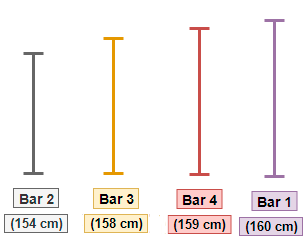
Hence the above arrangement is our answer.
Note: Note that there are many units used for the measurement of lengths or distances. Some of the basic units used to measure short heights of lengths are millimeter, centimeter, meter. In case we have to compare the lengths having different units then we need to make the unit same for all. This is done by using the relations between several units like: 1 meter = 100 centimeters = 1000 millimeters. You have to remember the relations between units that are used frequently not only for length but for mass, volume etc.
Complete step by step solution:
Here we have been provided with four bars of different lengths and we are asked to arrange them in the increasing order of their length. That means the bar with the shortest length will be at the first place and the bar with the greatest length will be at the last.
Now, first we need to check if the unit of length is the same for all the bars or not. Here we can see that all the four bars have their lengths in centimeters, so we need not change them. Therefore, we need to compare the numerical values of the four lengths. So we get,
$\Rightarrow $ 154 < 158 < 159 < 160
$\Rightarrow $ 154 cm < 158 cm < 159 cm < 160 cm
$\therefore $ Bar 2 < Bar 3 < Bar 4 < Bar 1
Hence the above arrangement is our answer.
Note: Note that there are many units used for the measurement of lengths or distances. Some of the basic units used to measure short heights of lengths are millimeter, centimeter, meter. In case we have to compare the lengths having different units then we need to make the unit same for all. This is done by using the relations between several units like: 1 meter = 100 centimeters = 1000 millimeters. You have to remember the relations between units that are used frequently not only for length but for mass, volume etc.
Recently Updated Pages
Find the greatest six digit number that is exactly class 8 maths CBSE

What is the time difference between India and Cana class 8 social science CBSE
Compare LPG and wood as fuels class 8 chemistry CBSE
In Indian rupees 1 trillion is equal to how many c class 8 maths CBSE
30 opposite words in English from a to z class 8 english CBSE
How many cubic feet equals to 1 unit sand class 8 maths CBSE
Trending doubts
What is BLO What is the full form of BLO class 8 social science CBSE
Citizens of India can vote at the age of A 18 years class 8 social science CBSE
Full form of STD, ISD and PCO
One cusec is equal to how many liters class 8 maths CBSE
What are the methods of reducing friction. Explain
What is the difference between rai and mustard see class 8 biology CBSE