




Which amongst the following is the most stable carbocation?
A.
B.

C.

D.
Answer
 Verified
597.9k+ views
Hint: We know that carbocation is a positively charged carbon atom. The carbocation with the least partial positive charge is more stable. This is because the charge is distributed among neighbouring carbons. Higher the charge density on the carbon atom, more unstable is the carbocation.
Complete step by step solution:
->The effect regarding the transmission of unequal sharing of the bonding electrons through a chain of atoms in a molecule which leads to permanent dipole in a bond is known as the inductive effect.
->The methyl $\left( { - {\text{C}}{{\text{H}}_{\text{3}}}} \right)$ group pushes electron density towards the carbon having positive charge and shows an inductive effect. As the methyl group pushes electron density towards the carbon having positive charge the charge density on the carbocation decreases.
Thus, more the number of methyl groups, more stable is the carbocation.
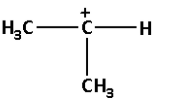
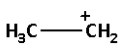
->We are given four carbocations. Carbocation (A) has two methyl groups, carbocation (B) has three methyl groups, carbocation (C) has no methyl group but has three hydrogen atoms and carbocation (D) has one methyl group.
Thus, carbocation (B) has the highest number of methyl groups and so it is the most stable carbocation.
Thus, the correct option is (B).
Note:
When a carbon atom carrying a positive charge is attached to only one alkyl group it is known as a primary carbocation. When a carbon atom carrying a positive charge is attached to two other alkyl groups it is known as a secondary carbocation. When a carbon atom carrying a positive charge is attached to three other alkyl groups it is known as a tertiary carbocation. A tertiary carbocation is more stable than the secondary carbocation which is more stable than the primary carbocation.
Complete step by step solution:
->The effect regarding the transmission of unequal sharing of the bonding electrons through a chain of atoms in a molecule which leads to permanent dipole in a bond is known as the inductive effect.
->The methyl $\left( { - {\text{C}}{{\text{H}}_{\text{3}}}} \right)$ group pushes electron density towards the carbon having positive charge and shows an inductive effect. As the methyl group pushes electron density towards the carbon having positive charge the charge density on the carbocation decreases.
Thus, more the number of methyl groups, more stable is the carbocation.
->We are given four carbocations. Carbocation (A) has two methyl groups, carbocation (B) has three methyl groups, carbocation (C) has no methyl group but has three hydrogen atoms and carbocation (D) has one methyl group.
Thus, carbocation (B) has the highest number of methyl groups and so it is the most stable carbocation.
Thus, the correct option is (B).
Note:
When a carbon atom carrying a positive charge is attached to only one alkyl group it is known as a primary carbocation. When a carbon atom carrying a positive charge is attached to two other alkyl groups it is known as a secondary carbocation. When a carbon atom carrying a positive charge is attached to three other alkyl groups it is known as a tertiary carbocation. A tertiary carbocation is more stable than the secondary carbocation which is more stable than the primary carbocation.
Recently Updated Pages
Master Class 11 Economics: Engaging Questions & Answers for Success

Master Class 11 English: Engaging Questions & Answers for Success
Master Class 11 Maths: Engaging Questions & Answers for Success
Class 11 Question and Answer - Your Ultimate Solutions Guide
Master Class 11 Social Science: Engaging Questions & Answers for Success
Master Class 11 Business Studies: Engaging Questions & Answers for Success
Trending doubts
One Metric ton is equal to kg A 10000 B 1000 C 100 class 11 physics CBSE
There are 720 permutations of the digits 1 2 3 4 5 class 11 maths CBSE
Differentiate between an exothermic and an endothermic class 11 chemistry CBSE
In what year Guru Nanak Dev ji was born A15 April 1469 class 11 social science CBSE
Difference Between Prokaryotic Cells and Eukaryotic Cells
State and prove Bernoullis theorem class 11 physics CBSE