




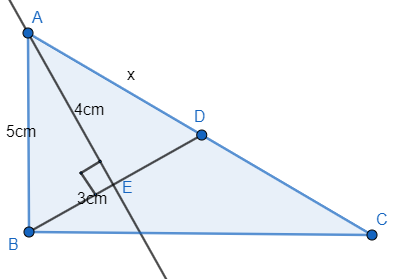
What’s the length of $\left| AC \right|$ ?
$\begin{align}
& \left[ AB \right]\bot \left[ BC \right] \\
& \left[ AH \right]\bot \left[ BD \right] \\
& \left| AD \right|=\left| DC \right| \\
& \left| BH \right|=3cm \\
& \left| AB \right|=5cm \\
\end{align}$
Answer
 Verified
525.9k+ views
Hint: We are asked to find the length of the side AC as shown in the figure in the question. To find this, we will use some basic laws like sum of three angles of any triangle is ${{180}^{\circ }}$ and trigonometric ratios such as sine and cosine and the Pythagoras theorem and we will finally use the Lami’s theorem to solve this problem and find the length of AC.
Complete step by step answer:
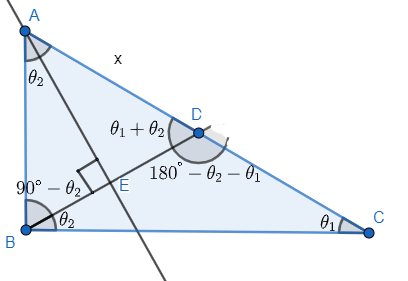
We know that, $\left| AD \right|=\left| DC \right|$, hence we can find any one and then find AC. Let us assume the length of AD as x cm for time being. Hence even DC will have a length of x cm. We will assume the angle $\angle DCB$ to be ${{\theta }_{1}}$ and the angle $\angle DBC$ to be ${{\theta }_{2}}$ . Since the total angle of a triangle is ${{180}^{\circ }}$, we get angle $\angle BDC$ as ${{180}^{\circ }}-{{\theta }_{1}}-{{\theta }_{2}}$ , as shown. And since AC is a straight line, its total angle is ${{180}^{\circ }}$, hence angle $\angle ADE$ will be ${{\theta }_{1}}+{{\theta }_{2}}$ as shown in the figure.
We also know that $\angle ABC={{90}^{\circ }}$ , hence $\angle ABE={{90}^{\circ }}-{{\theta }_{2}}$ and by the law of total angle of a triangle, $\angle BAE={{\theta }_{2}}$ . Now, taking the triangle, $\vartriangle ABE$ , we have,
$\begin{align}
& \sin {{\theta }_{2}}=\dfrac{BE}{AB} \\
& \Rightarrow \sin {{\theta }_{2}}=\dfrac{3}{5} \\
& \Rightarrow \cos {{\theta }_{2}}=\dfrac{4}{5} \\
\end{align}$
And from triangle, $\vartriangle ABC$ , we have,
$\begin{align}
& \sin {{\theta }_{1}}=\dfrac{AB}{AC} \\
& \sin {{\theta }_{1}}=\dfrac{5}{2x} \\
& \cos {{\theta }_{1}}=\dfrac{BC}{AC} \\
\end{align}$
By, Pythagoras theorem, $BC=\sqrt{4{{x}^{2}}-25}$ , hence,
$\cos {{\theta }_{1}}=\dfrac{\sqrt{4{{x}^{2}}-25}}{2x}$
Now, take the $\vartriangle AED$ , by applying Lami’s theorem, we get,
$\dfrac{x}{\sin {{90}^{\circ }}}=\dfrac{4}{\sin \left( {{\theta }_{1}}+{{\theta }_{2}} \right)}$
By expanding sine and cross multiplying, we get
$x\left( \sin {{\theta }_{1}}\cos {{\theta }_{2}}+\cos {{\theta }_{1}}\sin {{\theta }_{2}} \right)=4$
By substituting the values of sine and cosine from the previous step, we get,
$\begin{align}
& x\left( \dfrac{5}{2x}\dfrac{4}{5}+\dfrac{\sqrt{4{{x}^{2}}-25}}{2x}\dfrac{3}{5} \right)=4 \\
& x\left( \dfrac{2}{x}+\dfrac{3\sqrt{4{{x}^{2}}-25}}{10x} \right)=4 \\
& \Rightarrow \sqrt{4{{x}^{2}}-25}=\dfrac{20}{3} \\
\end{align}$
Squaring on both sides, we get,
$\begin{align}
& 4{{x}^{2}}-25=\dfrac{400}{9} \\
& 4{{x}^{2}}=\dfrac{625}{9} \\
& \Rightarrow x=\sqrt{\dfrac{625}{36}} \\
& \Rightarrow x=\dfrac{25}{6} \\
\end{align}$
Therefore, the value of Ac will be,
$\begin{align}
& \left| AC \right|=2x \\
& \left| AC \right|=\dfrac{25}{3} \\
\end{align}$
Therefore, the value of the side AC is $\dfrac{25}{3}$ cm.
Note: When we solve this problem, we use the angle property of triangles and straight lines. One must be careful to take ${{180}^{\circ }}$ as total angle or the sum of the angles of a triangle and must use the fact that sum of the two angles created by a line intersecting another line is also ${{180}^{\circ }}$. Also, while using the trigonometric ratios, we must choose the proper sides based on the definition of the ratio we are using.
Complete step by step answer:
We know that, $\left| AD \right|=\left| DC \right|$, hence we can find any one and then find AC. Let us assume the length of AD as x cm for time being. Hence even DC will have a length of x cm. We will assume the angle $\angle DCB$ to be ${{\theta }_{1}}$ and the angle $\angle DBC$ to be ${{\theta }_{2}}$ . Since the total angle of a triangle is ${{180}^{\circ }}$, we get angle $\angle BDC$ as ${{180}^{\circ }}-{{\theta }_{1}}-{{\theta }_{2}}$ , as shown. And since AC is a straight line, its total angle is ${{180}^{\circ }}$, hence angle $\angle ADE$ will be ${{\theta }_{1}}+{{\theta }_{2}}$ as shown in the figure.
We also know that $\angle ABC={{90}^{\circ }}$ , hence $\angle ABE={{90}^{\circ }}-{{\theta }_{2}}$ and by the law of total angle of a triangle, $\angle BAE={{\theta }_{2}}$ . Now, taking the triangle, $\vartriangle ABE$ , we have,
$\begin{align}
& \sin {{\theta }_{2}}=\dfrac{BE}{AB} \\
& \Rightarrow \sin {{\theta }_{2}}=\dfrac{3}{5} \\
& \Rightarrow \cos {{\theta }_{2}}=\dfrac{4}{5} \\
\end{align}$
And from triangle, $\vartriangle ABC$ , we have,
$\begin{align}
& \sin {{\theta }_{1}}=\dfrac{AB}{AC} \\
& \sin {{\theta }_{1}}=\dfrac{5}{2x} \\
& \cos {{\theta }_{1}}=\dfrac{BC}{AC} \\
\end{align}$
By, Pythagoras theorem, $BC=\sqrt{4{{x}^{2}}-25}$ , hence,
$\cos {{\theta }_{1}}=\dfrac{\sqrt{4{{x}^{2}}-25}}{2x}$
Now, take the $\vartriangle AED$ , by applying Lami’s theorem, we get,
$\dfrac{x}{\sin {{90}^{\circ }}}=\dfrac{4}{\sin \left( {{\theta }_{1}}+{{\theta }_{2}} \right)}$
By expanding sine and cross multiplying, we get
$x\left( \sin {{\theta }_{1}}\cos {{\theta }_{2}}+\cos {{\theta }_{1}}\sin {{\theta }_{2}} \right)=4$
By substituting the values of sine and cosine from the previous step, we get,
$\begin{align}
& x\left( \dfrac{5}{2x}\dfrac{4}{5}+\dfrac{\sqrt{4{{x}^{2}}-25}}{2x}\dfrac{3}{5} \right)=4 \\
& x\left( \dfrac{2}{x}+\dfrac{3\sqrt{4{{x}^{2}}-25}}{10x} \right)=4 \\
& \Rightarrow \sqrt{4{{x}^{2}}-25}=\dfrac{20}{3} \\
\end{align}$
Squaring on both sides, we get,
$\begin{align}
& 4{{x}^{2}}-25=\dfrac{400}{9} \\
& 4{{x}^{2}}=\dfrac{625}{9} \\
& \Rightarrow x=\sqrt{\dfrac{625}{36}} \\
& \Rightarrow x=\dfrac{25}{6} \\
\end{align}$
Therefore, the value of Ac will be,
$\begin{align}
& \left| AC \right|=2x \\
& \left| AC \right|=\dfrac{25}{3} \\
\end{align}$
Therefore, the value of the side AC is $\dfrac{25}{3}$ cm.
Note: When we solve this problem, we use the angle property of triangles and straight lines. One must be careful to take ${{180}^{\circ }}$ as total angle or the sum of the angles of a triangle and must use the fact that sum of the two angles created by a line intersecting another line is also ${{180}^{\circ }}$. Also, while using the trigonometric ratios, we must choose the proper sides based on the definition of the ratio we are using.
Recently Updated Pages
Master Class 10 Computer Science: Engaging Questions & Answers for Success

Master Class 10 General Knowledge: Engaging Questions & Answers for Success
Master Class 10 English: Engaging Questions & Answers for Success
Master Class 10 Social Science: Engaging Questions & Answers for Success
Master Class 10 Maths: Engaging Questions & Answers for Success
Master Class 10 Science: Engaging Questions & Answers for Success
Trending doubts
What is the median of the first 10 natural numbers class 10 maths CBSE
Which women's tennis player has 24 Grand Slam singles titles?
Who is the Brand Ambassador of Incredible India?
Why is there a time difference of about 5 hours between class 10 social science CBSE
Write a letter to the principal requesting him to grant class 10 english CBSE
A moving boat is observed from the top of a 150 m high class 10 maths CBSE