




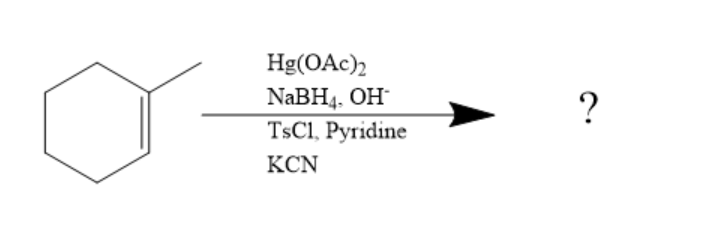
What product will be formed?
Answer
 Verified
561k+ views
Hint :There are many reagents in organic chemistry for different chemical reactions. $ Hg{(OAc)_2} $ and $ NaB{H_4},O{H^ - } $ when used together they introduce $ - OH $ group on $ s{p^2} $ carbon making it saturated $ s{p^3} $ . $ TsCl $ when attack on the $ - OH $ group converts it into $ - OTs $ which is a very good leaving group and $ KCN $ in the above reaction is used to introduce the $ - CN $ group.
Complete Step By Step Answer:
Reagents are chemical substances which are used in numerous organic reactions to synthesize desired products.
The reaction given is:
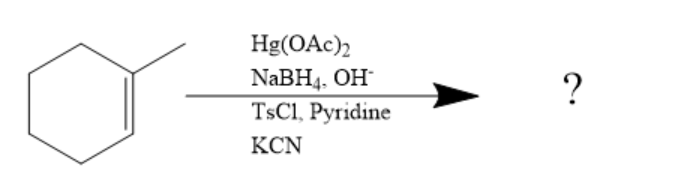
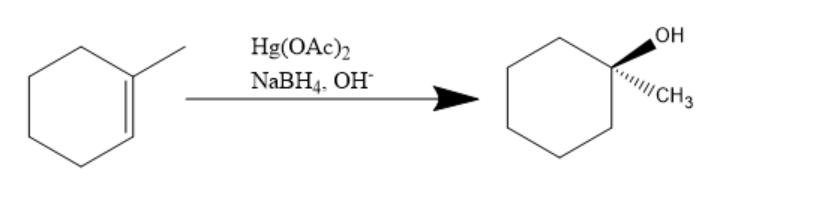
In the above given reaction, first $ Hg{(OAc)_2} $ and $ NaB{H_4},O{H^ - } $ is added and it will introduce $ - OH $ group on $ s{p^2} $ carbon making it saturated $ s{p^3} $ according to markovnikov's rule.
It states that with the addition of HX or other polar reagent to an asymmetric alkene, the hydrogen gets attached to the carbon with more number of hydrogen substituents, and the X group or electronegative part gets attached to the carbon with more number of alkyl substituents.
Hence, the reaction proceeds as:
Now, pyridine (being a base) abstract the hydrogen from hydroxyl group and $ TsCl $ is added, it attack on $ - OH $ group converts it into $ - OTs $ which is a very good leaving group and the reaction proceeds as follow:
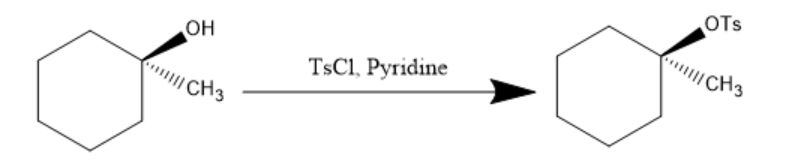
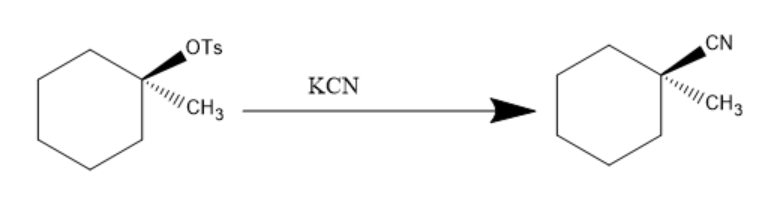
Now, the $ KCN $ is added to the product and $ - OTs $ being a very good leaving group, leaves and $ C{N^ - } $ attacks and is introduced to the compound. The reaction can be written as:
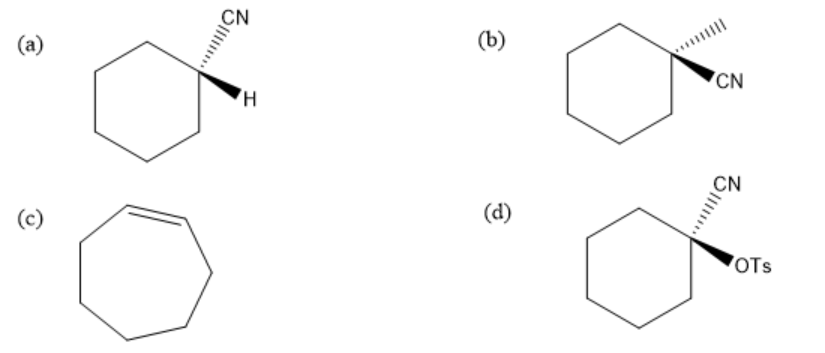
Hence, the final product of above given reaction is:
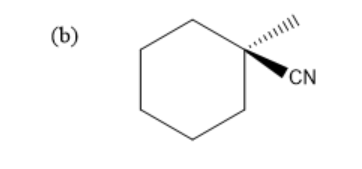
Therefore, the correct option is (b).
Note :
For the addition of hydroxyl group to a double bond (unsaturated bond) through the markovnikov rule, we use reagents as $ B{H_3},THF,{H_2}{O_2} $ and $ OH^{-} $. In this reaction, the hydrogen gets attached to the carbon with more alkyl substituents, and the X group or electronegative part gets attached to the carbon with more hydrogen substituents.
Complete Step By Step Answer:
Reagents are chemical substances which are used in numerous organic reactions to synthesize desired products.
The reaction given is:
In the above given reaction, first $ Hg{(OAc)_2} $ and $ NaB{H_4},O{H^ - } $ is added and it will introduce $ - OH $ group on $ s{p^2} $ carbon making it saturated $ s{p^3} $ according to markovnikov's rule.
It states that with the addition of HX or other polar reagent to an asymmetric alkene, the hydrogen gets attached to the carbon with more number of hydrogen substituents, and the X group or electronegative part gets attached to the carbon with more number of alkyl substituents.
Hence, the reaction proceeds as:
Now, pyridine (being a base) abstract the hydrogen from hydroxyl group and $ TsCl $ is added, it attack on $ - OH $ group converts it into $ - OTs $ which is a very good leaving group and the reaction proceeds as follow:
Now, the $ KCN $ is added to the product and $ - OTs $ being a very good leaving group, leaves and $ C{N^ - } $ attacks and is introduced to the compound. The reaction can be written as:
Hence, the final product of above given reaction is:
Therefore, the correct option is (b).
Note :
For the addition of hydroxyl group to a double bond (unsaturated bond) through the markovnikov rule, we use reagents as $ B{H_3},THF,{H_2}{O_2} $ and $ OH^{-} $. In this reaction, the hydrogen gets attached to the carbon with more alkyl substituents, and the X group or electronegative part gets attached to the carbon with more hydrogen substituents.
Recently Updated Pages
If x a + bt + ct2 where x is in meters and t is in class 11 physics CBSE

A car covers the first half distance between two places class 11 physics CBSE
The resultant of two vectors overrightarrow P and overrightarrow class 11 physics CBSE
Find the value of cos 135 class 11 maths CBSE
A mass M is held in place by an applied force F and class 11 physics CBSE
A solution of glucose in water is labelled as 10 dfracwv class 11 chemistry CBSE
Trending doubts
One Metric ton is equal to kg A 10000 B 1000 C 100 class 11 physics CBSE
Find the value of the expression given below sin 30circ class 11 maths CBSE
What do you mean by retardation What is its SI uni class 11 physics CBSE
Draw a diagram of nephron and explain its structur class 11 biology CBSE
10 examples of friction in our daily life
Difference between physical and chemical change class 11 chemistry CBSE