




What is the vsepr model for \[~N{{H}_{3}}\]?
Answer
 Verified
592.5k+ views
Hint :We know that Valence shell electron pair repulsion theory, or VSEPR theory, is a concept used in chemistry to determine the structure of single molecules from the number of pairs of electrons surrounding their central atoms.
Complete Step By Step Answer:
Valence-shell electron pair repulsion theory: The Valence Shell Electron Pair Repulsion Theory abbreviated as VSEPR theory is based on the premise that there is a repulsion between the pairs of valence electrons in all atoms, and the atoms will always tend to arrange themselves in a manner in which this electron pair repulsion is minimalized. This arrangement of the atom determines the geometry of the resulting molecule. In a molecule two types of electron pair are there, bond pair and lone pair.
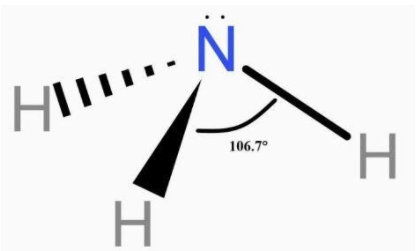
Ammonia is made up of one atom of nitrogen and three atoms of hydrogen. Nitrogen has eight electrons around it i.e. it has four electron pairs. These pairs are arranged tetrahedral. Of the four pairs: one pair is a lone pair. So, the resulting shape is a trigonal pyramid.
Additional Information:
The repulsion between electron pairs follows the order, lone pair \[\] lone pair \[>\] lone pair \[\] bond pair \[>\] bond pair \[\] bond pair, because different types of repulsion distortion in geometry will be observed from the standard geometry w.r.t hybridization.
Note :
Remember that The VSEPR theory assumes that each atom in a molecule will achieve a geometry that minimizes the repulsion between electrons in the valence shell of that atom. The structure of ammonia molecules as per the valence-shell electron pair repulsion theory is trigonal pyramid.
Complete Step By Step Answer:
Valence-shell electron pair repulsion theory: The Valence Shell Electron Pair Repulsion Theory abbreviated as VSEPR theory is based on the premise that there is a repulsion between the pairs of valence electrons in all atoms, and the atoms will always tend to arrange themselves in a manner in which this electron pair repulsion is minimalized. This arrangement of the atom determines the geometry of the resulting molecule. In a molecule two types of electron pair are there, bond pair and lone pair.
Ammonia is made up of one atom of nitrogen and three atoms of hydrogen. Nitrogen has eight electrons around it i.e. it has four electron pairs. These pairs are arranged tetrahedral. Of the four pairs: one pair is a lone pair. So, the resulting shape is a trigonal pyramid.
Additional Information:
The repulsion between electron pairs follows the order, lone pair \[\] lone pair \[>\] lone pair \[\] bond pair \[>\] bond pair \[\] bond pair, because different types of repulsion distortion in geometry will be observed from the standard geometry w.r.t hybridization.
Note :
Remember that The VSEPR theory assumes that each atom in a molecule will achieve a geometry that minimizes the repulsion between electrons in the valence shell of that atom. The structure of ammonia molecules as per the valence-shell electron pair repulsion theory is trigonal pyramid.
Recently Updated Pages
If x a + bt + ct2 where x is in meters and t is in class 11 physics CBSE

A car covers the first half distance between two places class 11 physics CBSE
The resultant of two vectors overrightarrow P and overrightarrow class 11 physics CBSE
Find the value of cos 135 class 11 maths CBSE
A mass M is held in place by an applied force F and class 11 physics CBSE
A solution of glucose in water is labelled as 10 dfracwv class 11 chemistry CBSE
Trending doubts
One Metric ton is equal to kg A 10000 B 1000 C 100 class 11 physics CBSE
Find the value of the expression given below sin 30circ class 11 maths CBSE
What do you mean by retardation What is its SI uni class 11 physics CBSE
Draw a diagram of nephron and explain its structur class 11 biology CBSE
10 examples of friction in our daily life
Difference between physical and chemical change class 11 chemistry CBSE