




What is the vertex of $y={{x}^{2}}+6x+5$ ?
Answer
 Verified
545.7k+ views
Hint: From the equation we can see that after plotting the given quadratic equation we will get some kind of parabola. We also know that the vertex of that parabola would be the minimum value of that parabola.
Complete step-by-step solution:
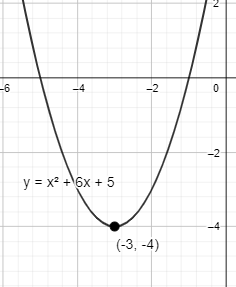
Now we can see that from the given equation we will get a parabola opening up and its vertex will be the minimum value of this parabola. Axis of symmetry for the same is the vertical line along the vertex.
In order to find the minimum value we will find the derivative of the given function as $f'(x)=2x+6$ now keeping it equal to zero will give us the value of x at which the derivative is zero therefore, x=-3 and since minimum value is one of the extrema value so it will be at critical points since we know that polynomials are infinitely differentiable so the only critical that will occur will be at the point where the derivative is zero which is -3.
Also, we can see that the factors of the quadratic equations are $y=(x+1)(x+5)$ so the x-intercepts are at -1 and -5 and similarly the y-intercept is at 0.
Thus the required vertex is at $\left(-3,f\left(-3\right) \right)$.
Now $f(-3)={{(-3)}^{2}}+6(-3)+5$
Which is equal to -4.
Therefore the coordinates of the vertex are $(-3,-4).$
The axis of symmetry is $x=-3.$
Note: Remember formula of conic section and just simply apply them. It is a direct question. Using the proper form of equation and comparing it with the general form of equation of the curve is necessary to avoid errors.
Complete step-by-step solution:
Now we can see that from the given equation we will get a parabola opening up and its vertex will be the minimum value of this parabola. Axis of symmetry for the same is the vertical line along the vertex.
In order to find the minimum value we will find the derivative of the given function as $f'(x)=2x+6$ now keeping it equal to zero will give us the value of x at which the derivative is zero therefore, x=-3 and since minimum value is one of the extrema value so it will be at critical points since we know that polynomials are infinitely differentiable so the only critical that will occur will be at the point where the derivative is zero which is -3.
Also, we can see that the factors of the quadratic equations are $y=(x+1)(x+5)$ so the x-intercepts are at -1 and -5 and similarly the y-intercept is at 0.
Thus the required vertex is at $\left(-3,f\left(-3\right) \right)$.
Now $f(-3)={{(-3)}^{2}}+6(-3)+5$
Which is equal to -4.
Therefore the coordinates of the vertex are $(-3,-4).$
The axis of symmetry is $x=-3.$
Note: Remember formula of conic section and just simply apply them. It is a direct question. Using the proper form of equation and comparing it with the general form of equation of the curve is necessary to avoid errors.
Recently Updated Pages
Master Class 11 Social Science: Engaging Questions & Answers for Success

Master Class 11 Physics: Engaging Questions & Answers for Success
Master Class 11 Maths: Engaging Questions & Answers for Success
Master Class 11 Economics: Engaging Questions & Answers for Success
Master Class 11 Computer Science: Engaging Questions & Answers for Success
Master Class 11 Chemistry: Engaging Questions & Answers for Success
Trending doubts
One Metric ton is equal to kg A 10000 B 1000 C 100 class 11 physics CBSE
There are 720 permutations of the digits 1 2 3 4 5 class 11 maths CBSE
1 Quintal is equal to a 110 kg b 10 kg c 100kg d 1000 class 11 physics CBSE
State and prove Bernoullis theorem class 11 physics CBSE
Difference Between Prokaryotic Cells and Eukaryotic Cells
Discuss the various forms of bacteria class 11 biology CBSE