




What is the vertex of $y=2{{x}^{2}}+8x-3$?
Answer
 Verified
546.9k+ views
Hint: Compare the given equation with the general form of a parabola as: - \[y=a{{x}^{2}}+bx+c\]. Find the respective values of a, b and c. Now, find the discriminant of the given quadratic equation by using the formula: - \[D={{b}^{2}}-4ac\], where D = discriminant. Write the expression as: -\[y=a\left[ {{\left( x+\dfrac{b}{2a} \right)}^{2}}-\dfrac{D}{4{{a}^{2}}} \right]\] and convert it into the form \[\left( y+\dfrac{D}{4a} \right)=a\left[ {{\left( x+\dfrac{b}{2a} \right)}^{2}} \right]\]. The vertex of the parabola will be given as \[\left( \dfrac{-b}{2a},\dfrac{-D}{4a} \right)\].
Complete step-by-step solution:
Here we have been provided with the quadratic equation: - $y=2{{x}^{2}}+8x-3$ and we are asked to find its vertex. First we need to write the vertex form of this quadratic equation using completing the square method.
Clearly the given equation is the general form of a parabola whose vertex we need to determine. The vertex of a parabola \[y=a{{x}^{2}}+bx+c\] is a point where its maxima or minima lie depending on the case that the parabola is opening upward or downward. Also, the vertex is the point through which the vertical line passing denotes the line of symmetry.
Any quadratic equation of the form \[y=a{{x}^{2}}+bx+c\] can be simplified as \[y=a\left[ {{\left( x+\dfrac{b}{2a} \right)}^{2}}-\dfrac{D}{4{{a}^{2}}} \right]\] using completing the square method and then it can be further written as \[\left( y+\dfrac{D}{4a} \right)=a\left[ {{\left( x+\dfrac{b}{2a} \right)}^{2}} \right]\]. Here, ‘D’ denotes the discriminant. The vertex is then given as \[\left( \dfrac{-b}{2a},\dfrac{-D}{4a} \right)\]. Now, on comparing $y=2{{x}^{2}}+8x-3$ with the general form we get,
\[\Rightarrow \] a = 2, b = 8, c = -3
Applying the formula for discriminant of a quadratic equation given as \[D={{b}^{2}}-4ac\] we get,
\[\begin{align}
& \Rightarrow D={{\left( 8 \right)}^{2}}-4\left( 2 \right)\left( -3 \right) \\
& \Rightarrow D=64+24 \\
& \Rightarrow D=88 \\
\end{align}\]
So we can write the equation of the parabola as: -
\[\begin{align}
& \Rightarrow y=2\left[ {{\left( x+\dfrac{8}{2\times 2} \right)}^{2}}-\dfrac{88}{4\times {{\left( 2 \right)}^{2}}} \right] \\
& \Rightarrow y=2\left[ {{\left( x+2 \right)}^{2}}-11 \right] \\
& \Rightarrow \left( y+22 \right)=2{{\left( x+2 \right)}^{2}} \\
\end{align}\]
Hence, the vertex of the parabola is $\left( -2,-22 \right)$.
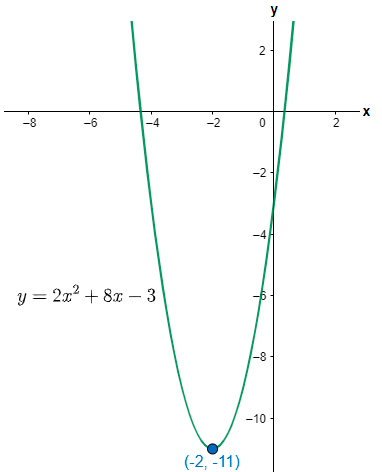
Note: Note that the equation \[\left( y+\dfrac{D}{4a} \right)=a\left[ {{\left( x+\dfrac{b}{2a} \right)}^{2}} \right]\] is known as the vertex form of the parabola. If we are asked to determine if the parabola is opening upward or downward then we can say that it is opening upward because the value of a is 2 which is positive. The point $\left( -2,-22 \right)$ denotes the minimum value of the parabola which is y = -22 and the point of minima is x = -2.
Complete step-by-step solution:
Here we have been provided with the quadratic equation: - $y=2{{x}^{2}}+8x-3$ and we are asked to find its vertex. First we need to write the vertex form of this quadratic equation using completing the square method.
Clearly the given equation is the general form of a parabola whose vertex we need to determine. The vertex of a parabola \[y=a{{x}^{2}}+bx+c\] is a point where its maxima or minima lie depending on the case that the parabola is opening upward or downward. Also, the vertex is the point through which the vertical line passing denotes the line of symmetry.
Any quadratic equation of the form \[y=a{{x}^{2}}+bx+c\] can be simplified as \[y=a\left[ {{\left( x+\dfrac{b}{2a} \right)}^{2}}-\dfrac{D}{4{{a}^{2}}} \right]\] using completing the square method and then it can be further written as \[\left( y+\dfrac{D}{4a} \right)=a\left[ {{\left( x+\dfrac{b}{2a} \right)}^{2}} \right]\]. Here, ‘D’ denotes the discriminant. The vertex is then given as \[\left( \dfrac{-b}{2a},\dfrac{-D}{4a} \right)\]. Now, on comparing $y=2{{x}^{2}}+8x-3$ with the general form we get,
\[\Rightarrow \] a = 2, b = 8, c = -3
Applying the formula for discriminant of a quadratic equation given as \[D={{b}^{2}}-4ac\] we get,
\[\begin{align}
& \Rightarrow D={{\left( 8 \right)}^{2}}-4\left( 2 \right)\left( -3 \right) \\
& \Rightarrow D=64+24 \\
& \Rightarrow D=88 \\
\end{align}\]
So we can write the equation of the parabola as: -
\[\begin{align}
& \Rightarrow y=2\left[ {{\left( x+\dfrac{8}{2\times 2} \right)}^{2}}-\dfrac{88}{4\times {{\left( 2 \right)}^{2}}} \right] \\
& \Rightarrow y=2\left[ {{\left( x+2 \right)}^{2}}-11 \right] \\
& \Rightarrow \left( y+22 \right)=2{{\left( x+2 \right)}^{2}} \\
\end{align}\]
Hence, the vertex of the parabola is $\left( -2,-22 \right)$.
Note: Note that the equation \[\left( y+\dfrac{D}{4a} \right)=a\left[ {{\left( x+\dfrac{b}{2a} \right)}^{2}} \right]\] is known as the vertex form of the parabola. If we are asked to determine if the parabola is opening upward or downward then we can say that it is opening upward because the value of a is 2 which is positive. The point $\left( -2,-22 \right)$ denotes the minimum value of the parabola which is y = -22 and the point of minima is x = -2.
Recently Updated Pages
Master Class 11 Social Science: Engaging Questions & Answers for Success

Master Class 11 Physics: Engaging Questions & Answers for Success
Master Class 11 Maths: Engaging Questions & Answers for Success
Master Class 11 Economics: Engaging Questions & Answers for Success
Master Class 11 Computer Science: Engaging Questions & Answers for Success
Master Class 11 Chemistry: Engaging Questions & Answers for Success
Trending doubts
One Metric ton is equal to kg A 10000 B 1000 C 100 class 11 physics CBSE
There are 720 permutations of the digits 1 2 3 4 5 class 11 maths CBSE
1 Quintal is equal to a 110 kg b 10 kg c 100kg d 1000 class 11 physics CBSE
State and prove Bernoullis theorem class 11 physics CBSE
Difference Between Prokaryotic Cells and Eukaryotic Cells
Discuss the various forms of bacteria class 11 biology CBSE