




What is the steric number of $N{H_3}$?
Answer
 Verified
543.9k+ views
Hint: Steric number is the number of atoms, groups, or lone pairs around the central atom in a molecule. It determines the molecular geometry. Find out the number of lone pairs and bonded atoms in $N{H_3}$ using Lewis structure and calculate the steric number using the formula:
Steric number $ = $(number of lone pairs on central atom)$ + $(number of atoms bonded to central atom)
Complete answer:
The steric number is defined as the number of atoms bonded to a central atom of a molecule plus the number of lone pairs attached to the central atom. The steric number is used in the VSEPR theory to determine the molecular geometry of a molecule.
The formula for calculating the steric number $ = $(number of lone pairs on central atom)$ + $(number of atoms bonded to the central atom)
Drawing Lewis's structure is important to calculate the steric number.
First we will draw the Lewis structure of $N{H_3}$ as follows:
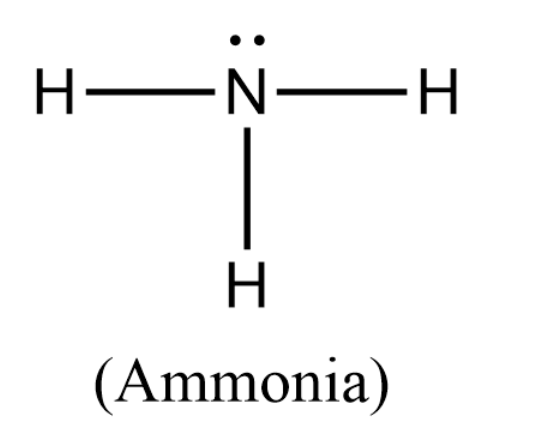
In the structure of ammonia, we can see that the nitrogen atom forms single bonds with three hydrogen atoms, with each of these bonds accounting for 2 valence electrons. The remaining 2 valence electrons are placed on the nitrogen atom as a lone pair of electrons.
Steric number $ = $(number of lone pairs on central atom)$ + $(number of atoms bonded to central atom)
(For ammonia number of lone pairs$ = 1$ and number of bonded atoms $ = 3$)
Steric number$ = 1 + 3$
$ \Rightarrow 4$
Therefore the steric number of ammonia is $4$
Note:
The steric number also tells the hybridization of the central atom. In the case of ammonia, the steric number is $4$ and this implies that the hybridization of nitrogen atoms is $s{p^3}$. It also determines the bonded atom lone pair arrangement, the shape that maximizes the distances between the valence-shell electron pairs.
Steric number $ = $(number of lone pairs on central atom)$ + $(number of atoms bonded to central atom)
Complete answer:
The steric number is defined as the number of atoms bonded to a central atom of a molecule plus the number of lone pairs attached to the central atom. The steric number is used in the VSEPR theory to determine the molecular geometry of a molecule.
The formula for calculating the steric number $ = $(number of lone pairs on central atom)$ + $(number of atoms bonded to the central atom)
Drawing Lewis's structure is important to calculate the steric number.
First we will draw the Lewis structure of $N{H_3}$ as follows:
In the structure of ammonia, we can see that the nitrogen atom forms single bonds with three hydrogen atoms, with each of these bonds accounting for 2 valence electrons. The remaining 2 valence electrons are placed on the nitrogen atom as a lone pair of electrons.
Steric number $ = $(number of lone pairs on central atom)$ + $(number of atoms bonded to central atom)
(For ammonia number of lone pairs$ = 1$ and number of bonded atoms $ = 3$)
Steric number$ = 1 + 3$
$ \Rightarrow 4$
Therefore the steric number of ammonia is $4$
Note:
The steric number also tells the hybridization of the central atom. In the case of ammonia, the steric number is $4$ and this implies that the hybridization of nitrogen atoms is $s{p^3}$. It also determines the bonded atom lone pair arrangement, the shape that maximizes the distances between the valence-shell electron pairs.
Recently Updated Pages
Basicity of sulphurous acid and sulphuric acid are

Master Class 11 English: Engaging Questions & Answers for Success
Master Class 11 Physics: Engaging Questions & Answers for Success
Master Class 11 Computer Science: Engaging Questions & Answers for Success
Master Class 11 Chemistry: Engaging Questions & Answers for Success
Master Class 11 Social Science: Engaging Questions & Answers for Success
Trending doubts
Difference Between Prokaryotic Cells and Eukaryotic Cells
Two of the body parts which do not appear in MRI are class 11 biology CBSE
One Metric ton is equal to kg A 10000 B 1000 C 100 class 11 physics CBSE
10 examples of friction in our daily life
Draw a diagram of nephron and explain its structur class 11 biology CBSE
What will happen if the mucus is not secreted by the class 11 biology CBSE