




What is the slope of the line \[y=2\]?
Answer
 Verified
567.3k+ views
Hint: The given line is y=2, there can be many ways to find the slope of a given line. The three main and basic ways to do it are - the basic definition of slope i.e., it is the tangent of the angle it makes with the positive x-axis, it is the change in values of y and x given by derivative $\dfrac{dy}{dx}$ and from the standard form of a line y=mx+c. So we will use the first method and verify using the second one.
Complete step by step solution:
So, we have to find the slope of line y=2.
Using definition, slope is tangent of the angle it makes with the positive x-axis, we can express it as
\[m=\tan \theta =\dfrac{\Delta y}{\Delta x}\]
So, the slope is the ratio of the rise (vertical change) to run (horizontal change). So, we can say
\[m=\dfrac{{{y}_{2}}-{{y}_{1}}}{{{x}_{2}}-{{x}_{1}}}\]
Let us first plot the graph for y=2. It will be a horizontal line passing through points with y-coordinate as 2.
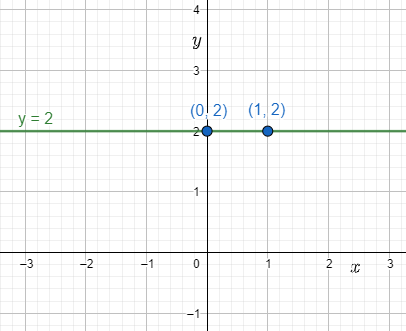
It can be easily seen that \[\left( 0,2 \right)\] and \[\left( 1,2 \right)\] lies on the line. Thus, the slope is
\[\begin{align}
& m=\dfrac{2-2}{1-0} \\
& m=0 \\
\end{align}\]
In our second method, we are going to use \[\dfrac{dy}{dx}\] to verify.
Now let's change the line in another form,
\[f\left( x \right)=y=2\]
So, we can say that
$m=\dfrac{f(x+\Delta x)-f(x)}{\Delta x}$
Let us take the delta-x approaching zero (why?)
(because if we look at this value, for the case of a curve, this represents the slope of a secant. As we decrease delta-x our approximation becomes more and more accurate i.e., the secant starts becoming the tangent)
So, the expression turns out to be
$\displaystyle \lim_{\Delta x \to \infty} \dfrac{f(x+\Delta x)-f(x)}{\Delta x}$
Which is nothing but \[\dfrac{dy}{dx}\].
\[\begin{align}
& m=\dfrac{dy}{dx} \\
& m=\dfrac{d}{dx}\left( 2 \right) \\
& m=0 \\
\end{align}\]
Hence, the slope of line y=2 is 0.
Note: We can conclude that differentiation of a curve at a particular point represents its slope at that point, (and in the case of a straight line it is the same for every point). Also, note that the given line is parallel to the x-axis so we directly conclude without solving that its slope will be 0. Using third method, we are directly using the slope form of the line
\[y=mx+c\]
Where “m” represents the slope of the line and “c” represents the intercept it makes with the y-axis.
So, converting our line in this form, we get
By comparison, we can see that slope is \[0\].
Complete step by step solution:
So, we have to find the slope of line y=2.
Using definition, slope is tangent of the angle it makes with the positive x-axis, we can express it as
\[m=\tan \theta =\dfrac{\Delta y}{\Delta x}\]
So, the slope is the ratio of the rise (vertical change) to run (horizontal change). So, we can say
\[m=\dfrac{{{y}_{2}}-{{y}_{1}}}{{{x}_{2}}-{{x}_{1}}}\]
Let us first plot the graph for y=2. It will be a horizontal line passing through points with y-coordinate as 2.
It can be easily seen that \[\left( 0,2 \right)\] and \[\left( 1,2 \right)\] lies on the line. Thus, the slope is
\[\begin{align}
& m=\dfrac{2-2}{1-0} \\
& m=0 \\
\end{align}\]
In our second method, we are going to use \[\dfrac{dy}{dx}\] to verify.
Now let's change the line in another form,
\[f\left( x \right)=y=2\]
So, we can say that
$m=\dfrac{f(x+\Delta x)-f(x)}{\Delta x}$
Let us take the delta-x approaching zero (why?)
(because if we look at this value, for the case of a curve, this represents the slope of a secant. As we decrease delta-x our approximation becomes more and more accurate i.e., the secant starts becoming the tangent)
So, the expression turns out to be
$\displaystyle \lim_{\Delta x \to \infty} \dfrac{f(x+\Delta x)-f(x)}{\Delta x}$
Which is nothing but \[\dfrac{dy}{dx}\].
\[\begin{align}
& m=\dfrac{dy}{dx} \\
& m=\dfrac{d}{dx}\left( 2 \right) \\
& m=0 \\
\end{align}\]
Hence, the slope of line y=2 is 0.
Note: We can conclude that differentiation of a curve at a particular point represents its slope at that point, (and in the case of a straight line it is the same for every point). Also, note that the given line is parallel to the x-axis so we directly conclude without solving that its slope will be 0. Using third method, we are directly using the slope form of the line
\[y=mx+c\]
Where “m” represents the slope of the line and “c” represents the intercept it makes with the y-axis.
So, converting our line in this form, we get
By comparison, we can see that slope is \[0\].
Recently Updated Pages
Master Class 12 Economics: Engaging Questions & Answers for Success

Master Class 12 English: Engaging Questions & Answers for Success
Master Class 12 Social Science: Engaging Questions & Answers for Success
Master Class 12 Maths: Engaging Questions & Answers for Success
Master Class 12 Physics: Engaging Questions & Answers for Success
Master Class 11 Social Science: Engaging Questions & Answers for Success
Trending doubts
One Metric ton is equal to kg A 10000 B 1000 C 100 class 11 physics CBSE
Difference Between Prokaryotic Cells and Eukaryotic Cells
Two of the body parts which do not appear in MRI are class 11 biology CBSE
1 ton equals to A 100 kg B 1000 kg C 10 kg D 10000 class 11 physics CBSE
Draw a diagram of nephron and explain its structur class 11 biology CBSE
10 examples of friction in our daily life