




What is the period of $y=\cos x$?
Answer
 Verified
530.1k+ views
Hint: First we need to understand the meaning of the term ‘period’ of a function. Assume ‘T’ as the period of the given cosine function and consider the relation $\cos \left( T+x \right)=\cos x$. Use the formula of the general solution of the cosine function given as if $\cos a=\cos b$ then $a=2n\pi \pm b$, where n is any integer, and consider two cases (one with + sign and one with – sign). Use the fact that T should be independent of x to reject the incorrect relation.
Complete step-by-step solution:
Here we have been provided with the function $y=\cos x$ and we are asked to find its period. First we need to understand the meaning of ‘period’ of a function.
Now, in mathematics the period of a function $y=f\left( x \right)$ is defined as the interval of x after which the value of the function starts repeating itself. Such a function is known as a periodic function. Generally we denote the period of a function with T and mathematically we have $f\left( T+x \right)=f\left( x \right)$. T is a constant. So assuming the period of the function $y=\cos x$ and using the above relation we get,
$\Rightarrow \cos \left( T+x \right)=\cos \left( x \right)$
We know that the general solution of a trigonometric equation of the form $\cos a=\cos b$ is given as $a=2n\pi \pm b$. So we get,
\[\Rightarrow T+x=2n\pi \pm x,n\in \] integers
(i) Considering the + sign we get,
\[\begin{align}
& \Rightarrow T+x=2n\pi +x \\
& \Rightarrow T=2n\pi \\
\end{align}\]
(i) Considering the – sign we get,
\[\begin{align}
& \Rightarrow T+x=2n\pi -x \\
& \Rightarrow T=2n\pi -2x \\
\end{align}\]
Now, the period of a function is a constant and it must be independent of the variable x, so we have case (ii). Therefore we get,
\[\Rightarrow T=2n\pi \]
Here we need to choose the smallest positive integer value of n to get a fixed period, so substituting n = 1 we get,
\[\therefore T=2\pi \]
Drawing the graph of the cosine function we have,
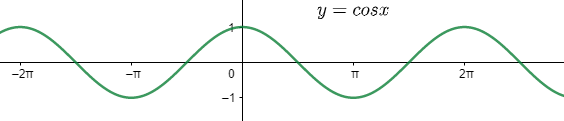
Hence, the period of the cosine function is $2\pi $.
Note: You must remember the period of all the trigonometric functions because they are used in the chapter like integration where the limits will be made very large and this property of the periodic function will be used. The period of sine, cosine, secant and cosecant function is $2\pi $ whereas the period of the tangent and co – tangent function is $\pi $. If any constant ‘a’ is multiplied as the coefficient of the function such that it becomes of the form $\cos \left( ax \right)$ then the period becomes $T'=\dfrac{T}{\left| a \right|}$.
Complete step-by-step solution:
Here we have been provided with the function $y=\cos x$ and we are asked to find its period. First we need to understand the meaning of ‘period’ of a function.
Now, in mathematics the period of a function $y=f\left( x \right)$ is defined as the interval of x after which the value of the function starts repeating itself. Such a function is known as a periodic function. Generally we denote the period of a function with T and mathematically we have $f\left( T+x \right)=f\left( x \right)$. T is a constant. So assuming the period of the function $y=\cos x$ and using the above relation we get,
$\Rightarrow \cos \left( T+x \right)=\cos \left( x \right)$
We know that the general solution of a trigonometric equation of the form $\cos a=\cos b$ is given as $a=2n\pi \pm b$. So we get,
\[\Rightarrow T+x=2n\pi \pm x,n\in \] integers
(i) Considering the + sign we get,
\[\begin{align}
& \Rightarrow T+x=2n\pi +x \\
& \Rightarrow T=2n\pi \\
\end{align}\]
(i) Considering the – sign we get,
\[\begin{align}
& \Rightarrow T+x=2n\pi -x \\
& \Rightarrow T=2n\pi -2x \\
\end{align}\]
Now, the period of a function is a constant and it must be independent of the variable x, so we have case (ii). Therefore we get,
\[\Rightarrow T=2n\pi \]
Here we need to choose the smallest positive integer value of n to get a fixed period, so substituting n = 1 we get,
\[\therefore T=2\pi \]
Drawing the graph of the cosine function we have,
Hence, the period of the cosine function is $2\pi $.
Note: You must remember the period of all the trigonometric functions because they are used in the chapter like integration where the limits will be made very large and this property of the periodic function will be used. The period of sine, cosine, secant and cosecant function is $2\pi $ whereas the period of the tangent and co – tangent function is $\pi $. If any constant ‘a’ is multiplied as the coefficient of the function such that it becomes of the form $\cos \left( ax \right)$ then the period becomes $T'=\dfrac{T}{\left| a \right|}$.
Recently Updated Pages
Master Class 11 Computer Science: Engaging Questions & Answers for Success

Master Class 11 Business Studies: Engaging Questions & Answers for Success
Master Class 11 Economics: Engaging Questions & Answers for Success
Master Class 11 English: Engaging Questions & Answers for Success
Master Class 11 Maths: Engaging Questions & Answers for Success
Master Class 11 Biology: Engaging Questions & Answers for Success
Trending doubts
One Metric ton is equal to kg A 10000 B 1000 C 100 class 11 physics CBSE
There are 720 permutations of the digits 1 2 3 4 5 class 11 maths CBSE
Discuss the various forms of bacteria class 11 biology CBSE
Draw a diagram of a plant cell and label at least eight class 11 biology CBSE
State the laws of reflection of light
10 examples of friction in our daily life