




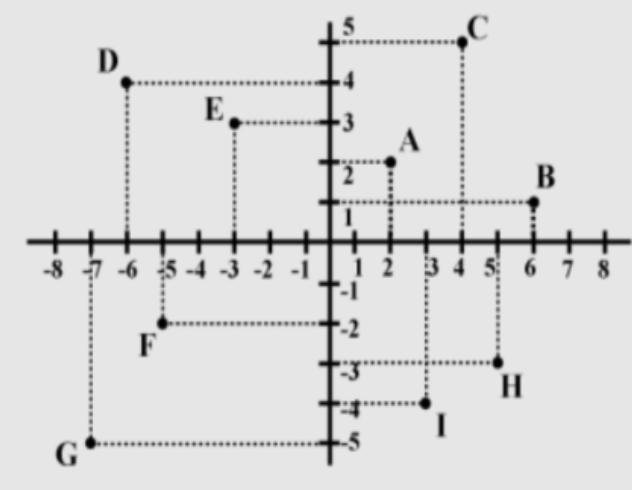
What is the ordinate of the point \[D\]?
Answer
 Verified
523.2k+ views
Hint: To find the exact location of the point \[D\] or the coordinates of the point \[D\] we find its distance in the \[x\] axis and \[y\] axis from the origin. Here to find the ordinate of the point \[D\] the distance from the origin of the point \[D\] on the \[y\] axis is enough.
Complete step-by-step solution:
We observe on the coordinate plane that the point \[D\] is \[6\]a unit's distance away on the left side of the origin or the point \[(0,0)\] which is the intersection point of both the axes known as the \[x\] axis and the \[y\] axis.
That is the point \[D\] is \[6\]units left to the origin i.e. the abscissa of the point \[D\] is \[ - 6\].
Now, we find its distance on the \[y\] axis i.e. the point \[D\] is \[4\] units above the origin which implies that the ordinate of the point\[D\] is \[4\].
Hence, the ordinate of\[D\] is \[4\].
Additional information: The coordinates of a point are a pair of numbers that define its exact location on a two-dimensional plane or the coordinate plane. We know that the coordinate plane has two axes viz. \[x\]- axis and \[y\]-axis and are at right angles two each other. We calculate all the points with reference to the origin or the point which is the intersection of both the \[x\] axis and \[y\] axis. The abscissa is the coordinate of the \[x\] axis and the ordinate is the coordinate of the \[y\] axis of the given point.
Note: It is very important that we know the terms related to the coordinate axes. The distance above the origin on-axis is taken as positive and below the origin is negative. Similarly, the distance on the right side of the origin on the \[x\] axis is taken as positive, and to the left of the origin is taken as negative.
Complete step-by-step solution:
We observe on the coordinate plane that the point \[D\] is \[6\]a unit's distance away on the left side of the origin or the point \[(0,0)\] which is the intersection point of both the axes known as the \[x\] axis and the \[y\] axis.
That is the point \[D\] is \[6\]units left to the origin i.e. the abscissa of the point \[D\] is \[ - 6\].
Now, we find its distance on the \[y\] axis i.e. the point \[D\] is \[4\] units above the origin which implies that the ordinate of the point\[D\] is \[4\].
Hence, the ordinate of\[D\] is \[4\].
Additional information: The coordinates of a point are a pair of numbers that define its exact location on a two-dimensional plane or the coordinate plane. We know that the coordinate plane has two axes viz. \[x\]- axis and \[y\]-axis and are at right angles two each other. We calculate all the points with reference to the origin or the point which is the intersection of both the \[x\] axis and \[y\] axis. The abscissa is the coordinate of the \[x\] axis and the ordinate is the coordinate of the \[y\] axis of the given point.
Note: It is very important that we know the terms related to the coordinate axes. The distance above the origin on-axis is taken as positive and below the origin is negative. Similarly, the distance on the right side of the origin on the \[x\] axis is taken as positive, and to the left of the origin is taken as negative.
Recently Updated Pages
Three beakers labelled as A B and C each containing 25 mL of water were taken A small amount of NaOH anhydrous CuSO4 and NaCl were added to the beakers A B and C respectively It was observed that there was an increase in the temperature of the solutions contained in beakers A and B whereas in case of beaker C the temperature of the solution falls Which one of the following statements isarecorrect i In beakers A and B exothermic process has occurred ii In beakers A and B endothermic process has occurred iii In beaker C exothermic process has occurred iv In beaker C endothermic process has occurred

Master Class 10 Social Science: Engaging Questions & Answers for Success
Master Class 10 Science: Engaging Questions & Answers for Success
Master Class 10 Maths: Engaging Questions & Answers for Success
Master Class 10 General Knowledge: Engaging Questions & Answers for Success
Master Class 10 Computer Science: Engaging Questions & Answers for Success
Three beakers labelled as A B and C each containing 25 mL of water were taken A small amount of NaOH anhydrous CuSO4 and NaCl were added to the beakers A B and C respectively It was observed that there was an increase in the temperature of the solutions contained in beakers A and B whereas in case of beaker C the temperature of the solution falls Which one of the following statements isarecorrect i In beakers A and B exothermic process has occurred ii In beakers A and B endothermic process has occurred iii In beaker C exothermic process has occurred iv In beaker C endothermic process has occurred
Master Class 10 Social Science: Engaging Questions & Answers for Success
Master Class 10 Science: Engaging Questions & Answers for Success
Trending doubts
Explain the Treaty of Vienna of 1815 class 10 social science CBSE
In cricket, how many legal balls are there in a standard over?
Why is there a time difference of about 5 hours between class 10 social science CBSE
Who Won 36 Oscar Awards? Record Holder Revealed
What is the median of the first 10 natural numbers class 10 maths CBSE
What is deficiency disease class 10 biology CBSE