




What is the optical axis?
Answer
 Verified
576.3k+ views
Hint: The question is based on the concept of optics. the optical axis of the spherical mirrors passes through its geometrical centre and its centre of curvature. The spherical mirrors and the lens have this optical axis.
Complete answer:
The straight line joining the pole and the centre of curvature of the spherical mirror extended on both sides is the optical axis.
The optical axis is also called the principal axis. This principal axis is taken as the x-axis. The heights measured upwards and perpendicular to the principal axis are taken as positive and the heights measured downwards and perpendicular to the principal axis are taken as negative.
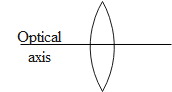
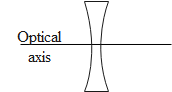
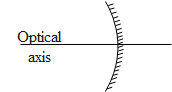
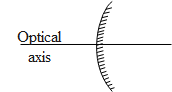
The diagram representing the optical axis is given as follows.
In the case of a convex lens.
In the case of a concave lens.
In the case of a concave mirror.
In the case of a concave mirror.
The path of the light ray along the principal axis perpendicular to the surfaces will be unchanged.
The diagrammatic representation of the definition of the optical axis, that is, a straight line joining the pole and the centre of curvature of the spherical mirror extended on both sides, is given as follows.
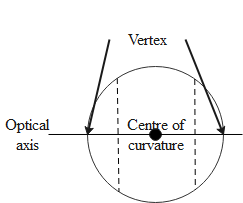
\[\therefore \] The optical axis is a straight line joining the pole and the centre of curvature of the spherical mirror extended on both sides.
Note:
The term optic axis is different from the term optical axis. The optic axis is a term used in crystallography, whereas, the optical axis is a term used in optics. Irrespective of the type of mirror, the optical axis remains the same, similarly, in the case of a lens, irrespective of the type of lens, the optical axis remains the same.
Complete answer:
The straight line joining the pole and the centre of curvature of the spherical mirror extended on both sides is the optical axis.
The optical axis is also called the principal axis. This principal axis is taken as the x-axis. The heights measured upwards and perpendicular to the principal axis are taken as positive and the heights measured downwards and perpendicular to the principal axis are taken as negative.
The diagram representing the optical axis is given as follows.
In the case of a convex lens.
In the case of a concave lens.
In the case of a concave mirror.
In the case of a concave mirror.
The path of the light ray along the principal axis perpendicular to the surfaces will be unchanged.
The diagrammatic representation of the definition of the optical axis, that is, a straight line joining the pole and the centre of curvature of the spherical mirror extended on both sides, is given as follows.
\[\therefore \] The optical axis is a straight line joining the pole and the centre of curvature of the spherical mirror extended on both sides.
Note:
The term optic axis is different from the term optical axis. The optic axis is a term used in crystallography, whereas, the optical axis is a term used in optics. Irrespective of the type of mirror, the optical axis remains the same, similarly, in the case of a lens, irrespective of the type of lens, the optical axis remains the same.
Recently Updated Pages
Master Class 12 Business Studies: Engaging Questions & Answers for Success

Master Class 12 Chemistry: Engaging Questions & Answers for Success
Master Class 12 Biology: Engaging Questions & Answers for Success
Class 12 Question and Answer - Your Ultimate Solutions Guide
Master Class 11 English: Engaging Questions & Answers for Success
Master Class 11 Social Science: Engaging Questions & Answers for Success
Trending doubts
Which are the Top 10 Largest Countries of the World?
Draw a labelled sketch of the human eye class 12 physics CBSE
The end of compass needle which points towards north class 12 physics CBSE
Differentiate between homogeneous and heterogeneous class 12 chemistry CBSE
Why is the cell called the structural and functional class 12 biology CBSE
When was the first election held in India a 194748 class 12 sst CBSE