




What is the most stable carbocation?
Answer
 Verified
590.4k+ views
Hint: Carbocation is an ion bearing positively-charged carbon atom with six electrons in their valence shell which make them electron deficient. They are highly unstable electrophiles and quickly react with nucleophiles to form a new bond. Due to their reactivity with heteroatoms, carbocations are very useful intermediates in many organic reactions.
Complete answer:
There are mainly four different types of carbocation named on the basis of the carbon groups bonded with carbon. The different types of carbocation are methyl, primary, secondary and tertiary carbocation.
$ \bullet $Methyl carbocation: When no carbon is attached to the carbon with positive charge, it is known as methyl carbocation.
$ \bullet $Primary carbocation: When one carbon is attached to the carbon with positive charge, it is known as primary carbocation.
$ \bullet $Secondary carbocation: When two carbon are attached to the carbon with positive charge, it is known as secondary carbocation.
$ \bullet $Tertiary carbocation: When three carbons are attached to the carbon with positive charge, it is known as three carbocation.
The stability of carbocations depends on the following factors:
$1.$Resonance: The stability of carbocations are directly proportional to resonance. More the number of resonating structures, more is the stability of carbocation.
$2.$Hyperconjugation and inductive effect: Increasing substitution increases the hyperconjugation and thus it increases the stability.
$3.$Electronegativity: Electronegativity is the capacity of an atom to attract electrons. The electronegativity of a carbon with positive charge directly affects the stability of carbocations. Hence, more the electronegativity, more is the stability.
Therefore, from the above points we can say that tertiary carbocations are the most stable carbocation.
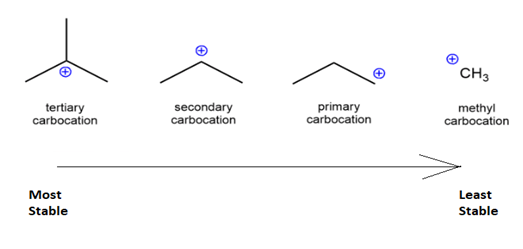
Fig: Stability of carbocation.
Note:
The formation of carbocation depends on two fundamental steps:
$1.$Cleavage of carbon bond: Whenever there is a cleavage of a bond, the leaving group takes away the shared electrons; thus making the carbon atom as electron deficient and as a result a positive charge is developed with the formation of a carbocation.
$2.$Electrophilic addition: In this case, electrophile attacks on the unsaturated points resulting in the formation of pi bond and formation of carbocation.
Complete answer:
There are mainly four different types of carbocation named on the basis of the carbon groups bonded with carbon. The different types of carbocation are methyl, primary, secondary and tertiary carbocation.
$ \bullet $Methyl carbocation: When no carbon is attached to the carbon with positive charge, it is known as methyl carbocation.
$ \bullet $Primary carbocation: When one carbon is attached to the carbon with positive charge, it is known as primary carbocation.
$ \bullet $Secondary carbocation: When two carbon are attached to the carbon with positive charge, it is known as secondary carbocation.
$ \bullet $Tertiary carbocation: When three carbons are attached to the carbon with positive charge, it is known as three carbocation.
The stability of carbocations depends on the following factors:
$1.$Resonance: The stability of carbocations are directly proportional to resonance. More the number of resonating structures, more is the stability of carbocation.
$2.$Hyperconjugation and inductive effect: Increasing substitution increases the hyperconjugation and thus it increases the stability.
$3.$Electronegativity: Electronegativity is the capacity of an atom to attract electrons. The electronegativity of a carbon with positive charge directly affects the stability of carbocations. Hence, more the electronegativity, more is the stability.
Therefore, from the above points we can say that tertiary carbocations are the most stable carbocation.
Fig: Stability of carbocation.
Note:
The formation of carbocation depends on two fundamental steps:
$1.$Cleavage of carbon bond: Whenever there is a cleavage of a bond, the leaving group takes away the shared electrons; thus making the carbon atom as electron deficient and as a result a positive charge is developed with the formation of a carbocation.
$2.$Electrophilic addition: In this case, electrophile attacks on the unsaturated points resulting in the formation of pi bond and formation of carbocation.
Recently Updated Pages
If x a + bt + ct2 where x is in meters and t is in class 11 physics CBSE

A car covers the first half distance between two places class 11 physics CBSE
The resultant of two vectors overrightarrow P and overrightarrow class 11 physics CBSE
Find the value of cos 135 class 11 maths CBSE
A mass M is held in place by an applied force F and class 11 physics CBSE
A solution of glucose in water is labelled as 10 dfracwv class 11 chemistry CBSE
Trending doubts
Find the value of the expression given below sin 30circ class 11 maths CBSE
One Metric ton is equal to kg A 10000 B 1000 C 100 class 11 physics CBSE
Draw a diagram of nephron and explain its structur class 11 biology CBSE
10 examples of friction in our daily life
Proton was discovered by A Thomson B Rutherford C Chadwick class 11 chemistry CBSE
Bond order ofO2 O2+ O2 and O22 is in order A O2 langle class 11 chemistry CBSE