




What is the $ K $ in Hooke's law?
Answer
 Verified
548.1k+ views
Hint: Hooke’s law states that the force needed to extend or compress a spring by some distance varies linearly to that distance. Hooke’s law is applicable within the valid elastic limit of the spring. It is functional within a very limited frame of reference as no material can be compressed or stretched beyond a certain minimum or maximum size.
Complete answer:
Suppose we take a simple helical spring whose one end is free.
We extend the free end by applying a force of magnitude $ F $
Let $ x $ be the amount by which the free end is expanded from it’s relaxed position.
Now as Hooke’s law states that the force needed to extend or compress a spring by some distance varies linearly to that distance.
$ F{\text{ }}\alpha {\text{ }}x $
$ \Rightarrow F = - Kx $
Where $ F $ is the restoring force or the spring force
$ K $ is the proportionality constant also known as spring constant
The value of $ K $ depends not only on the kind of elastic material under consideration but also on its dimensions and shape.
The negative sign in Hooke’s law implies that the spring force acts in the opposite direction of the applied force.
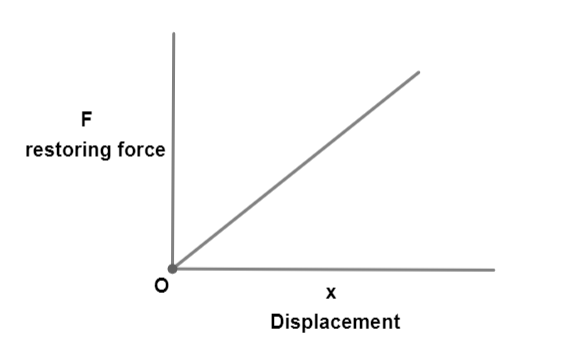
We can calculate the spring constant by plotting the graph between the restoring force $ F $ and the displacement of spring $ x $
The graph will be a straight line and the slope of the graph gives the spring constant $ K $
Note:
Hooke’s law ceases to apply past the elastic limit of a material and is accurate only for solid bodies if the forces and deformations are small. The law isn’t a universal principle and only applies to the materials as long as they aren’t stretched way past their capacity.
Complete answer:
Suppose we take a simple helical spring whose one end is free.
We extend the free end by applying a force of magnitude $ F $
Let $ x $ be the amount by which the free end is expanded from it’s relaxed position.
Now as Hooke’s law states that the force needed to extend or compress a spring by some distance varies linearly to that distance.
$ F{\text{ }}\alpha {\text{ }}x $
$ \Rightarrow F = - Kx $
Where $ F $ is the restoring force or the spring force
$ K $ is the proportionality constant also known as spring constant
The value of $ K $ depends not only on the kind of elastic material under consideration but also on its dimensions and shape.
The negative sign in Hooke’s law implies that the spring force acts in the opposite direction of the applied force.
We can calculate the spring constant by plotting the graph between the restoring force $ F $ and the displacement of spring $ x $
The graph will be a straight line and the slope of the graph gives the spring constant $ K $
Note:
Hooke’s law ceases to apply past the elastic limit of a material and is accurate only for solid bodies if the forces and deformations are small. The law isn’t a universal principle and only applies to the materials as long as they aren’t stretched way past their capacity.
Recently Updated Pages
Basicity of sulphurous acid and sulphuric acid are

Master Class 11 English: Engaging Questions & Answers for Success
Master Class 11 Physics: Engaging Questions & Answers for Success
Master Class 11 Computer Science: Engaging Questions & Answers for Success
Master Class 11 Chemistry: Engaging Questions & Answers for Success
Master Class 11 Social Science: Engaging Questions & Answers for Success
Trending doubts
One Metric ton is equal to kg A 10000 B 1000 C 100 class 11 physics CBSE
Draw a diagram of nephron and explain its structur class 11 biology CBSE
What will happen if the mucus is not secreted by the class 11 biology CBSE
Draw a diagram of a plant cell and label at least eight class 11 biology CBSE
What is the purity of pure gold in carat class 11 chemistry CBSE
Lysosomes are known as suicidal bags of cell why class 11 biology CBSE