




What is the IUPAC name of ${(CC{l_3})_3}CCl$?
Answer
 Verified
636.3k+ views
Hint: The trivial name of the given compound is perchloric isobutane. It is also known as tris-(trichloromethyl) chloromethane. The molecular formula of the compound is ${C_4}C{l_{10}}$ and molecular weight $402.54$ gram. The structure of the compound ${(CC{l_3})_3}CCl$ is given below;
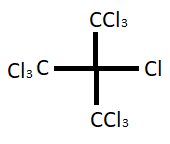
Complete step by step solution:
So let's start the IUPAC naming step by step of the given compound ${(CC{l_3})_3}CCl$ or perchloric isobutane. We know that while writing IUPAC the name of any compound halogens never takes precedence, so here in this compound there is no other functional group except halogen (chlorine) so we will find out the longest continuous carbon chain. In this compound the longest chain contains three carbon atoms so the root word would be prop and there is no double or triple bond so we will use primary suffix ane. We can number the carbon atoms of principal chain as follows;
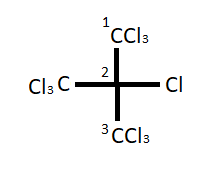
We can see in the compound that on the second carbon atom there is a trichloromethyl substituent. On the first and third carbon the compound has six chloro substituents. Together with the extra chloro substituent at second carbon, there are seven chloro substituents.
So the IUPAC name of the compound will be ;$2 - \left( {Trichloromethyl} \right) - 1,1,1,2,3,3,3 - heptafluoropropane$, Here number $1,1,1,2,3,3,3$ refers the position of chloro substituents in the carbon chain.
Note: So we have approached the naming of the given compound by counting the carbon atoms in the main chain and then we name the primary suffix and prefix. If all the hydrogen atoms of isobutane structure are replaced with chlorine then the given compound is formed therefore it is called perchloric isobutane.
Complete step by step solution:
So let's start the IUPAC naming step by step of the given compound ${(CC{l_3})_3}CCl$ or perchloric isobutane. We know that while writing IUPAC the name of any compound halogens never takes precedence, so here in this compound there is no other functional group except halogen (chlorine) so we will find out the longest continuous carbon chain. In this compound the longest chain contains three carbon atoms so the root word would be prop and there is no double or triple bond so we will use primary suffix ane. We can number the carbon atoms of principal chain as follows;
We can see in the compound that on the second carbon atom there is a trichloromethyl substituent. On the first and third carbon the compound has six chloro substituents. Together with the extra chloro substituent at second carbon, there are seven chloro substituents.
So the IUPAC name of the compound will be ;$2 - \left( {Trichloromethyl} \right) - 1,1,1,2,3,3,3 - heptafluoropropane$, Here number $1,1,1,2,3,3,3$ refers the position of chloro substituents in the carbon chain.
Note: So we have approached the naming of the given compound by counting the carbon atoms in the main chain and then we name the primary suffix and prefix. If all the hydrogen atoms of isobutane structure are replaced with chlorine then the given compound is formed therefore it is called perchloric isobutane.
Recently Updated Pages
Master Class 11 English: Engaging Questions & Answers for Success

Master Class 11 Social Science: Engaging Questions & Answers for Success
Master Class 11 Maths: Engaging Questions & Answers for Success
Master Class 11 Biology: Engaging Questions & Answers for Success
Master Class 11 Physics: Engaging Questions & Answers for Success
Master Class 11 Chemistry: Engaging Questions & Answers for Success
Trending doubts
Find the value of the expression given below sin 30circ class 11 maths CBSE
Draw a diagram of a plant cell and label at least eight class 11 biology CBSE
Draw a diagram of nephron and explain its structur class 11 biology CBSE
Difference between physical and chemical change class 11 chemistry CBSE
How do I convert ms to kmh Give an example class 11 physics CBSE
What is the atomic mass of Sodium a 22 gmol b 23 gmol class 11 chemistry CBSE